




The election held on Falgun 21, 2082—corresponding to March 5, 2026—for Nepal’s Federal Parliament marks a significant moment in which voters expressed their preferences with notable clarity. One compelling explanation for the Rastriya Swatantra Party’s (RSP) unexpectedly strong performance points to widespread public dissatisfaction with a political economy controlled by a small elite. This elite, it is argued, maintained its power through monopolistic practices, protected fiefdoms, and entrenched patronage networks.
Such an outcome calls for ongoing scholarly reflection. Following this election result, serious introspection is needed—not just for political leaders but also for analysts, commentators, and academics seeking to understand its broader democratic implications. The effort to grasp the deeper significance of this electoral change has only just begun.
In democratic systems, elections go beyond routine institutional procedures; they are crucial moments when citizens reassess the legitimacy of their leaders. The current mandate seems to reflect a cumulative buildup of public discontent that has grown over time. Citizens gradually become aware of institutional flaws—especially in areas like transparency, accountability, and fairness. Once this awareness reaches a tipping point, elections serve as a platform for society to express both dissatisfaction with the past and hopes for a different political direction. Therefore, the recent vote signifies not only a rejection of existing political structures but also a search for new ways to govern.
History consistently demonstrates that these moments test the political maturity of both leaders and institutions. Leaders who respond to electoral signals with humility and foresight often restore their legitimacy through reforms and adjustments. Conversely, ignoring or underestimating shifts in public opinion can hasten their political decline. In a democracy, legitimacy is not permanent; it must be constantly reinforced through responsiveness, effective performance, and ethical conduct. Political authority relies on citizens’ trust and confidence.
Indeed, democratic institutions around the world face increasing pressures from economic inequality, institutional fatigue, and declining public trust. Nepal is not immune to these trends.
The current electoral result should be seen not only as a transfer of political power but also as a chance for deeper democratic reflection. It encourages political leaders to rethink how their institutions connect with the citizens they serve. Understanding and responding to the message behind the public vote could bring about institutional reforms and more accountable governance. On the other hand, ignoring this message might deepen the frustrations that initially drove the electoral change.
If traditional power centers view this result as just another normal fluctuation in election cycles, they miss a crucial failure in political foresight. Democratic systems rely not only on constitutional rules and formal procedures but also on institutions’ capacity to adapt to shifts in public opinion. When election results reveal a growing disconnect between citizens and leaders, they serve as early warning signals for the political system. Ignoring these signs has historically led to more severe legitimacy crises rather than stability.
At the same time, it’s essential to recognize a key truth about politics. Politics isn’t solely about ideological aims or moral debates; it’s also shaped by strategy, power dynamics, and rivalry. In this sense, the political arena resembles a chessboard where results depend not only on the apparent strength of major players but also on unexpected moves by seemingly minor participants. Power is never fixed; it constantly evolves through institutions, public opinion, and strategic maneuvers.
Philosophically, elections are more than just replacing elites; they signify the continuous renewal of legitimacy in a democracy. Voting is not merely about selecting leaders but also about reevaluating the moral authority of the entire governing system. The results represent more than just wins or losses; they embody a challenge to entrenched power, long-standing political narratives, and established leadership traditions that have shaped Nepal’s political landscape.
Political philosophy reminds us that democracy depends on a delicate balance between stability and change. Institutions require stability to operate effectively, but they must also be adaptable enough to meet shifting public expectations. When institutions become too detached from society, they risk transforming from channels of representation into tools of exclusion. At that point, electoral mandates serve as a corrective mechanism, reminding political actors that sovereignty ultimately belongs to the people, not to parties, leaders, or entrenched influence networks.
Therefore, the main challenge facing Nepal’s political system today is not just who will become prime minister or which coalition will hold the majority in parliament. While these questions are significant in the short term, they do not address the deeper democratic issue highlighted by the election. The more important concern is how—and through whom—the patience, hopes, and frustrations of the people can be transformed into real institutional reform and responsible governance.
Comparative global experience shows that political leadership and institutional decisions significantly influence a country’s development path. China offers a clear example. The intense campaigns launched under Mao Zedong—particularly the Great Leap Forward and the Cultural Revolution—caused widespread social and economic chaos. However, starting in the late 1970s and gaining momentum through the 1980s, Deng Xiaoping’s reform program gradually introduced market-oriented policies and opened China to the global economy. These reforms substantially reduced poverty and transformed China’s economic landscape. The main lesson from this experience is not to idolize specific leaders but to recognize that policy choices, institutional frameworks, and openness to reform can fundamentally change a nation’s growth trajectory.
For Nepal, this insight has significant implications. Structural change requires more than just words; it involves dismantling deeply entrenched patronage systems, building stronger, independent, and transparent institutions, increasing internal party democracy, and empowering citizens beyond mere voting. The core issue isn’t only leadership but a governance system that remains disconnected from the people. Therefore, any new government must prioritize reforming institutions from the outset to rebuild public trust and establish a solid foundation for democracy.
Within a constitutional democracy, forming a government also involves clear normative duties. After a government is established, political parties must focus on achieving the goals outlined in the constitution. Debates about whether a party has a unique ideology or a fully developed doctrine are of limited practical significance, since the constitutional framework sets the main boundaries of governance. Fundamental objectives—such as good governance, inclusiveness, economic growth, and social justice—are constitutionally mandated and bind all political actors. Still, parties are responsible for developing credible plans to demonstrate how they will turn these constitutional goals into actual policies and institutional outcomes.
The tension between populism and constitutionalism in philosophy requires careful analysis. Populism, as a political strategy, often reduces complex institutional responsibilities to a narrative emphasizing direct popular voice against elites. While this approach can boost public participation and challenge complacent political elites, it may also neglect the protective functions of institutional rules and procedural norms that uphold democracy. Conversely, constitutional democracy aims to balance popular sovereignty with institutional boundaries. The will of the people is expressed through elections but is filtered through rules designed to ensure stability, accountability, and minority rights protection.
Elections, therefore, play a central role in democratic legitimacy. They are not merely contests for political power but also mechanisms through which citizens allocate authority to different visions of governance. Because of this, it is illogical for any political actor to dismiss or undermine the very process by which public support is given. The strength of democracy depends on the understanding that political power originates from the people, and that parties must continually earn public trust through transparent policies, reliable programs, and proven results.
Democracy has always been a complex and unpredictable process. It relies on rights, freedoms, and a collective dedication to the common good, but its development has never followed a straight line. Today, the future of democracy seems more debated than ever. The American thinker Daniel Patrick Moynihan once warned that the global spread of democracy could unintentionally weaken its liberal core, turning it into a system that exists in appearance but lacks real vitality—similar to the declining monarchies of the nineteenth century. This concern is becoming more relevant in many parts of the world today.
Over the past thirty-five years, Nepal has seen a concerning pattern where politicians and parties frequently make grand promises to voters but then pursue policies that contradict those promises once in office.
The global democratic landscape offers a sobering outlook. When liberal institutions weaken, political systems may seem stable on the surface but face deeper underlying problems. Nepal’s recent elections highlight this paradox. Procedural democracy is clearly apparent: election campaigns are lively, political parties compete vigorously, and votes are counted transparently. However, the core aspects of democracy—such as effective representation, policy innovation, and inclusive socio-economic progress—remain uncertain. This disconnect between procedural legitimacy and actual performance is a major challenge for modern democracies.
Indeed, democratic institutions around the world face increasing pressures from economic inequality, institutional fatigue, and declining public trust. Nepal is not immune to these trends. While procedural democracy remains in place, substantive democracy—defined by the effective delivery of justice, opportunity, and accountable governance—often seems fragile. Nonetheless, democracy has a paradoxical strength rooted in its inherent uncertainty. Unlike authoritarian systems, democratic outcomes are never fully predetermined. This uncertainty is not a weakness but a vital feature that promotes debate, participation, and political competition.
Uncertainty turns political conflict into peaceful competition instead of violence. It opens space for innovative ideas to challenge established norms and for new leaders to shift political priorities. Since outcomes are never final, democratic systems include mechanisms to self-correct. Governments can be replaced, policies can be amended, and institutions can be peacefully reformed. When citizens view this uncertainty as vital to democratic life, it fosters an environment where freedom can flourish.
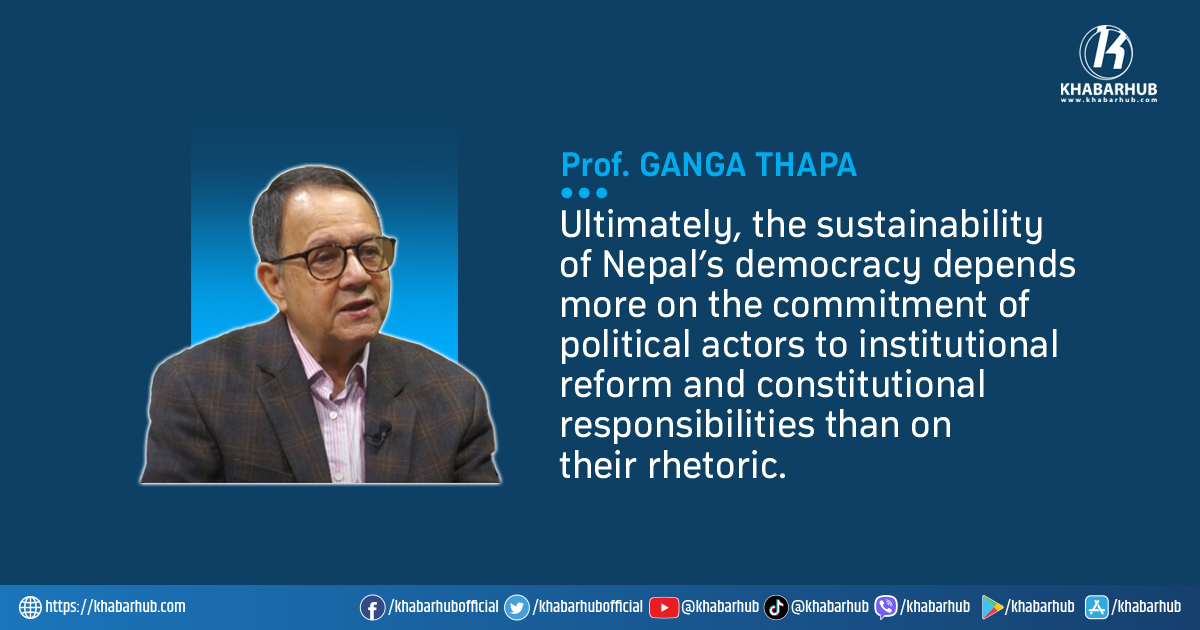
Ultimately, Nepal’s democratic sustainability depends more on political actors’ commitment to institutional reform and constitutional responsibilities than on their rhetoric. If the new government can overcome patronage politics and focus on strengthening governance structures, it could gradually repair the fragile bond between the state and its people. This change would go beyond just leadership, representing a fundamental shift—from viewing politics as a power struggle to seeing it as a collective effort aimed at public service, accountability, and societal progress.
Over the past thirty-five years, Nepal has seen a concerning pattern where politicians and parties frequently make grand promises to voters but then pursue policies that contradict those promises once in office. This ongoing disconnect between rhetoric and action has undermined public trust in political leaders. Rather than pursuing reforms or demonstrating accountability, their conduct often reveals inconsistency and a disregard for voter expectations, occasionally even showing blatant disrespect for democratic principles.






Comment