




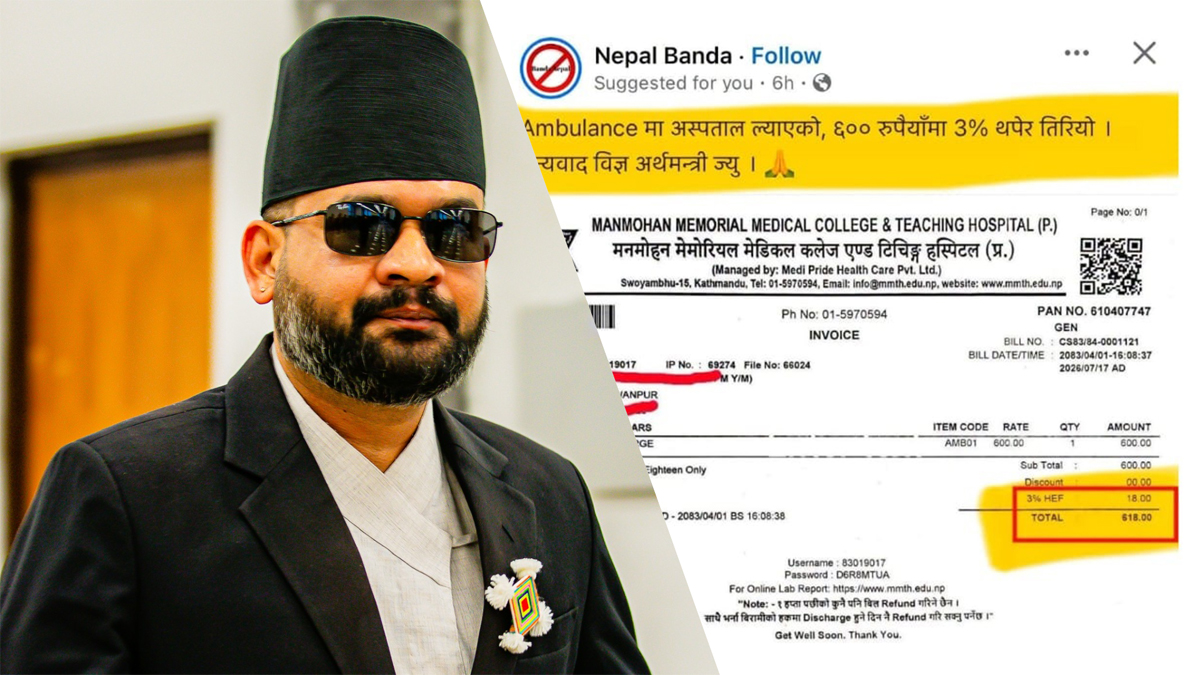
KATHMANDU: The government’s decision to impose a 3 percent “Health Equity Fee” on treatment at private health institutions has come into full effect, making private healthcare more expensive and triggering widespread criticism from patients, healthcare providers and consumer advocates.
Introduced through the fiscal year 2026/27 Finance Bill, the fee was scheduled to take effect from July 17 and is now being fully implemented at private hospitals across the country.
The new levy has sparked strong reactions on social media, with many users sharing hospital and ambulance bills showing the additional charge. Critics argue that the fee places an extra financial burden on patients already struggling to meet healthcare costs.
UML leader and social activist Prakash Paudel questioned the policy, saying illness should not be treated as a taxable event. He argued that welfare states are expected to support citizens during times of hardship, not increase their financial burden.
Paudel cited his own hospital bill, saying he paid Rs 14,083.93 under the new fee, and urged the government to immediately reconsider and withdraw the policy.
Similar concerns have been raised over ambulance services after bills surfaced showing the additional 3 percent charge on transportation costs.
Hospitals oppose additional burden on patients
Binod Adhikari, information officer at Om Hospital, said the hospital has been collecting the additional fee from patients since the first day of the new fiscal year in accordance with the government’s directive.
He said while some patients may not be significantly affected, those seeking treatment out of necessity would face additional hardship.
Gyanendra Man Karki, president of the Association of Private Medical and Dental Colleges, accused the government of turning private hospitals into tax collection agents.
“We already pay taxes to the government. Now we are being asked to collect additional money from patients on the government’s behalf. Ultimately, it is the public that bears the burden,” he said.
Consumer groups warn of legal challenge
Jyoti Baniya, president of the Consumer Welfare Protection Forum, described the fee as contrary to the spirit of the Constitution.
He argued that governments should facilitate access to essential services such as healthcare, education and electricity rather than impose additional charges on them. Baniya warned that if the government does not withdraw the policy, consumer groups will pursue legal action.
Government defends policy
The government has defended the measure, saying the Health Equity Fee is intended to strengthen healthcare services and encourage greater use of public hospitals.
According to Dr Samir Kumar Adhikari, assistant spokesperson for the Ministry of Health and Population, the policy is part of a broader strategy to improve public health services while better regulating the private healthcare sector.
He said the government is also strictly enforcing the requirement for private hospitals to provide 10 percent free treatment to poor, helpless and abandoned patients.
Dr Adhikari added that the government will continue expanding basic hospitals in every local government, upgrading health centres, improving medical infrastructure and increasing healthcare personnel.
He argued that as access to public hospitals improves nationwide, those who can afford private healthcare will continue to use private facilities, while economically disadvantaged citizens will be able to receive treatment through free services at both public hospitals and the mandatory quota in private institutions.






Comment