





KATHMANDU: Economic Digest offers a concise yet comprehensive overview of significant business happenings in Nepal, presented in easily digestible summaries.
Nepal’s economic and infrastructural landscape is marked by both promising progress and persistent systemic challenges. Notably, the country achieved a record NPR 17.46 billion in electricity exports, becoming a net power exporter and signaling growing energy diplomacy and trade deficit reduction potential.
However, this momentum contrasts with severe inefficiencies in public service delivery and infrastructure, as seen in the stalling of 371 drinking water projects in Madhes and disruptions in cross-border trade due to landslides and logistical failures.
Financially, the life insurance sector and startup lending initiatives show growth, while rising banking operation costs and the telecom sector’s declining user base expose sustainability concerns. Governance gaps, especially in procurement transparency—as in Nepal Telecom’s alleged favoritism toward Huawei—and underutilized foreign aid amid Nepal’s looming LDC graduation, underscore the urgency for institutional reforms.
Meanwhile, shifts in remittance patterns, increased climate finance preparedness, and food and commodity dependency reflect evolving economic structures that demand strategic long-term planning.
Nepal exports record Rs. 17.46 billion worth of power
In FY 2024/25, Nepal exported 2.35 billion units of electricity valued at NPR 17.46 billion to India and Bangladesh—a 21 % increase in volume and 3.31 % rise in value from the previous year. India accounted for NPR 17.19 billion of the exports, while Bangladesh purchased NPR 266.7 million under a tripartite agreement, with payments made in US dollars. With imports from India at NPR 12.92 billion, Nepal was a net exporter by NPR 4.5 billion. Energy Minister Dipak Khadka hailed the milestone in energy diplomacy, noting that the annual addition of 700 MW to the grid will further boost exports and significantly reduce the trade deficit.
Nepal unveils draft climate finance mobilisation procedure to boost global fund access
The Ministry of Finance has introduced the Climate Finance Mobilisation Procedure 2025—the country’s first comprehensive framework to access and manage international climate funds. The policy focuses on loss and damage compensation, adaptation, emission reduction, and carbon trading, aligning with national objectives and the Paris Agreement. A Climate Finance Unit under the ministry will coordinate proposal submissions, donor engagement, and digital monitoring. The procedure supports projects at federal, provincial, local, private, and NGO levels, with stringent accreditation, transparency, and reporting measures. It also proposes a Common Climate Fund to pool resources and avoid duplication. Officials say the initiative will strengthen capacity, accountability, and equitable use of funds.
Life insurance business grows by 16 % in fiscal year 2081–82
Nepal’s life insurance sector saw a 16.05 % growth in fiscal year 2081–82, collecting nearly NPR 1.81 trillion in premiums, up from NPR 1.56 trillion the previous year, according to the Nepal Insurance Authority. Nepal Life Insurance led with NPR 48.03 billion in premiums (26.47 % of the total). Other top performers included National Life (NPR 22.42 billion), LIC Nepal (NPR 19.92 billion), and Himalayan Life (NPR 17.66 billion). Sun Nepal Life Insurance achieved the highest growth rate at 28.8 %. Across the board, all firms reported significant increases, indicating growing demand for life insurance products in Nepal.
Over 1,100 containers of Dashain goods stuck at Nepal–China border amid landslides and pilgrim rush
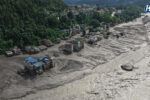
About 1,100 containers of Dashain festival goods are stranded at the Nepal–China border—600 between Nyalam and Kodari, and hundreds more at Kerung. The July floods destroyed the Miteri Bridge and cut off the Rasuwagadhi route, redirecting shipments to the congested Tatopani crossing, overwhelmed by over 1,000 Kailash Manasarovar pilgrims. Landslides on both sides further stalled cargo clearance. Traders warn of shortages, soaring prices, and substantial losses, as billions of rupees worth of clothing, electronics, and other goods remain inaccessible. Officials caution that poor road conditions cast doubt on timely deliveries.
Banking sector’s operating and management costs rise sharply, nearly Rs. 1 trillion spent on salaries and office expenses
Nepal’s banking sector witnessed a sharp uptick in operational and management expenses. As of Jestha 2081/82, 54 banks and financial institutions spent nearly NPR 1 trillion on salaries, allowances, and office management, as reported by Nepal Rastra Bank. Commercial banks alone accounted for NPR 86.4 billion—NPR 53.13 billion on salaries and NPR 33.27 billion on office expenses—an increase of NPR 3.5 billion from the previous year. Development banks and finance companies also maintained high spending. While this reflects sector growth, there are rising concerns about cost efficiency amid the expanding financial sector.
371 drinking water projects stalled in Madhes
The Bishrampur drinking water project in Dhanusha, initiated in 2015 to serve 618 households, remains unfinished after a decade—deep boring and pipelines are still pending. Similar delays afflict projects in Kemalipur, Sabaila, Pashupatinagar, Dhangadha, and Bateshwor. Across Madhes Province, 371 drinking water schemes started between FY 1999/2000 and 2017/18 remain stalled, with only 94 operational.
The provincial government attributes the standstill to funding shortfalls, as these federally transferred projects depend on conditional grants. This year’s allocation of NPR 160 million falls far short of the NPR 8 billion required. Completion of these projects could deliver clean water to 1.6 million residents.
Rasuwa flood and landslide insurance claims total nearly Rs 99 crore
Following the devastating flood and landslide in Rasuwa on Ashad 23, 78 insurance claims amounting to NPR 98.59 crore had been filed as of Shrawan 22, the Nepal Insurance Authority reports. Eleven non-life insurers are involved. Himalayan Everest Insurance tops with NPR 55 crore from just two claims; Shikhar Insurance follows with NPR 16.96 crore from 15 claims. Other significant contributions come from Nepal Insurance, Sanima GIC, and Neco Insurance. Property insurance leads with NPR 61.47 crore, followed by marine (NPR 22.04 crore), engineering (NPR 5.95 crore), and motor claims.
Government provides Rs. 88.66 crore startup loans to 600 entrepreneurs with latest knowledge and skills
Through the Industrial Enterprise Development Institute, the government has disbursed NPR 88.66 crore in startup loans to 600 entrepreneurs. Of the 661 projects recommended for FY 2081/82, 61 were rejected during field inspection due to discrepancies or blacklist status. Loans—from NPR 5 lakh to 25 lakh at a 3 % interest rate—are secured by collateral. The second phase received over 5,000 proposals, 1,314 were shortlisted, and 661 approved. Last year, NPR 21 crore was disbursed to 165 entrepreneurs. For FY 2082/83, NPR 73 crore is allocated, with plans to introduce long-term operational guidelines for future disbursement.
Nepal Telecom loses 7.7 million mobile broadband customers in one year
Nepal Telecom lost approximately 7.7 million mobile broadband users over the past year, reducing its market share from 71.85 % to 55.68 %, according to the Nepal Telecommunication Authority. Meanwhile, Ncell’s share rose 16.17 % to 44.32 %. Although Nepal Telecom still issues more SIM cards, its market is shrinking in favor of Ncell, which has attracted users with aggressive marketing and inexpensive data plans. Nepal Telecom cited bureaucratic delays and procurement challenges, while the Telecom Authority provided only raw data without analysis, though industry experts largely attribute the shift to promotional strategies and service offerings.
Nepal Telecom prepares to award controversial billing system tender to Huawei amid allegations of favoritism
Nepal Telecom is preparing to award its billing system contract to Huawei, following a tender process reportedly designed to favor the Chinese company. Despite a Supreme Court directive to maintain vendor balance and prevent monopolies, the tender specifications appear limited to Huawei-compatible systems—using outdated, lower-spec hardware aligned with Huawei’s older, sanctioned equipment—undermining technological updates and encouraging vendor lock-in. Investigations into previous irregular 4G contract awards to Huawei suggest repeat manipulation, with officials who halted prior contracts allegedly facilitating Huawei’s continued dominance.
Huawei’s malpractices undermine Nepal Telecom’s 4G service quality
Regulatory investigations and user feedback indicate that Nepal Telecom’s 4G service has suffered due to Huawei’s malpractice. Through its partner CCSi, Huawei used substandard Chinese antennas instead of the contracted American and European models, violating agreement terms. The Commission for the Investigation of Abuse of Authority is currently investigating. Additionally, Huawei failed to install crucial ‘small cell’ devices—part of a NPR 70 million contract—needed to extend network coverage. This shortfall has severely affected the reach and quality of Nepal Telecom’s 4G service.
Nepal faces declining foreign aid amid LDC graduation and execution challenges
Foreign aid to Nepal fell to US$1.37 billion in 2022/23—a three-year decline from pandemic-era levels. Causes include shifts in global priorities, altered donor strategies, and domestic inefficiencies like poor project execution and delayed reimbursements. As Nepal approaches graduation from the Least Developed Country category, concessional aid and grants are expected to diminish, replaced by loans. Aid channeled through governmental routes is declining while off-budget disbursements rise—raising concerns about transparency and ownership. Public financial management and project delivery reforms are urgently needed to sustain development amid evolving aid dynamics.
Nepal heavily dependent on imports for kwati beans despite Janai Purnima tradition
On Janai Purnima, many Nepalis enjoy Kwati—a stew made from nine sprouted beans like black gram, soybeans, mung beans, peas, lentils, chickpeas, and others. Despite Nepal’s agricultural potential, over 99% of the beans used remain imported, predominantly from Canada, Australia, and Myanmar, with smaller shipments from India, Russia, the U.S., and elsewhere. In FY 2081/82, the country imported 199,070 metric tons valued at NPR 18.25 billion—similar to the previous year’s volume. Domestic production is minimal and typically sold locally before reaching broader markets. Once reserved for Janai Purnima, Kwati is now consumed year-round, increasing demand but deepening dependency on foreign supply.
Investigation launched into illegal cargo smuggling at Tribhuvan Airport customs
Tribhuvan Airport Customs has initiated an investigation after intercepting 35 cartons of illegal cigarettes and approximately 150 kg of dried meat concealed among 300 cargo cartons. The goods, linked to Dipinex Logistic and Ekima Express Pvt. Ltd., were destined for cities including London, Melbourne, and New York. Early findings suggest internal collusion enabling the smuggling by bypassing customs inspections. Multiple courier and cargo firms are suspected of repeatedly sending undeclared or illicit goods abroad, damaging Nepal’s international reputation and causing significant revenue losses. A five-member inquiry committee has been formed to conduct further investigations.
Relief for Madhesh farmers as timely rains boost paddy transplantation to 76 %
After a prolonged dry spell left farmers in Madhesh Province struggling—relying on costly deep tube wells and irregular electricity—continuous rainfall over the past week turned the tide. By August 8, 76.54% (285,234 hectares) of the 372,645 hectares allocated for paddy had been transplanted, up 19.27% from the previous week. Bara led the pace with 95% transplantation, followed by Parsa at 92% and Rautahat at 85%. Agricultural officials report that the rain rejuvenated parched fields, restored soil conditions, and brought much-needed relief and optimism to farmers.
Nepal’s remittance economy transforms with growing female contribution and formal channels
Since the mid-1990s, Nepal’s remittance sector has expanded significantly, now benefiting over one-third of households. Women account for nearly 20% of remittance sends, reflecting shifts in migration trends. Use of informal channels has dropped sharply to just 7%, while formal transfer systems dominate. Despite rising inflows, most remittances are spent on household consumption, with limited savings or investment. Transfer costs vary by destination, though improvements have been noted—except in corridors like India and Saudi Arabia, where costs have risen. Recently, new destinations have emerged, and transfers occur more frequently, with older migrants sending larger sums and men transferring more often than women.
Jumla supplies Rs. 690 million worth of farm produce despite falling output
During FY 2024/25, Jumla district exported over 23,000 tonnes of agricultural produce—earning NPR 690 million and stimulating local incomes and the economy. Apples led the exports with 21,270 tonnes—earning NPR 610 million, the highest output in four years. Other significant products included marsi rice, walnuts, beans, millet, and flour. Remarkably, Jumla records Nepal’s highest millet productivity at 1.41 tonnes per hectare. However, overall food crop output dropped to 24,231 tonnes—8,000 tonnes less than the previous year—mainly due to 2022 floods that damaged paddy fields. Officials cite ongoing concerns over storage, processing, and price stability.
Travel and tour companies can now access foreign exchange directly from banks for hotel bookings abroad
Nepal Rastra Bank’s Foreign Exchange Management Department has updated regulations, enabling travel and tour companies to obtain foreign exchange directly from commercial banks for paying hotel services abroad (excluding India). Previously, Nepali travelers managed such expenses using the foreign currency allowance printed in their passports. Now, travel agencies can sign contracts with foreign service providers and receive necessary foreign exchange from banks on behalf of travelers. To access the facility, companies must submit nine specific documents—including registration, tax clearance, and notarized agreements. Commercial banks can now process foreign exchange without further central bank approval.
House panel pushes PPP model for Udayapur Cement Industry
The House Committee on Industry, Commerce, Labour, and Consumer Welfare has urged the government to run the Udayapur Cement Industry under a public private partnership (PPP) model to enhance competitiveness. After analyzing the challenges during a field study, the committee directed the Ministry of Industry, Commerce, and Supplies to draft and implement a strategic plan to rehabilitate the struggling plant. It also instructed the Ministry of Finance to disburse pending Provident Fund contributions to workers if requested. Additionally, the panel recommended expanding exports of areca nut, tea, ginger, and herbs, and improving branding and distribution for local alcohol.
Gold price hits record Rs. 199,400 per tola, nearing Rs. 200,000 mark
Gold prices in Nepal reached a fresh high of NPR 199,400 per tola on Friday, up NPR 1,000 from Thursday’s rate of NPR 198,400. The previous record was NPR 198,500 on Tuesday. Silver also rose by NPR 10, trading at NPR 2,325 per tola. Trader Tej Ratna Shakya attributed the spike to rising international gold prices, driven by President Donald Trump’s new tariffs on imports from countries such as South Korea, India, and Brazil. Global gold prices climbed USD 18 per ounce to USD 3,397. Shakya cautioned that prices could exceed NPR 200,000 soon—potentially impacting sales during Teej, Dashain, and Tihar.





Comment