





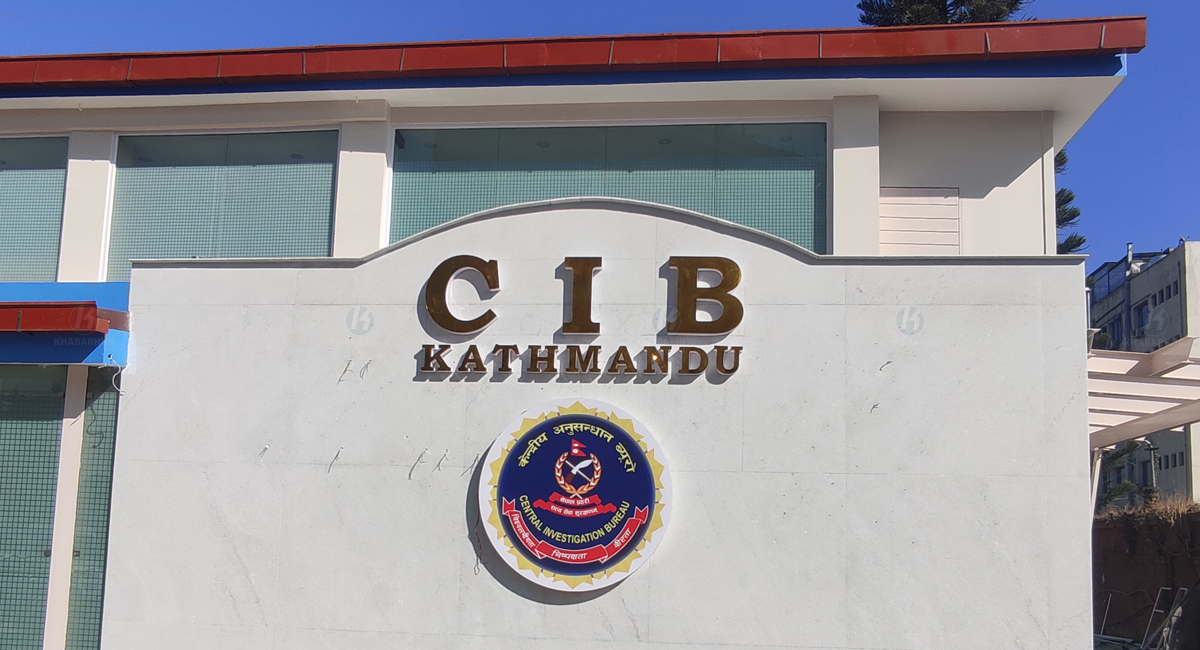
KATHMANDU: The Central Investigation Bureau’s (CIB) independent probe into Prabhu Bank has triggered wide-ranging debate over institutional jurisdiction, prompting questions about whether Nepal’s financial regulatory framework is being undermined.
While the arrests of senior Prabhu Bank officials have drawn public attention, the larger concern emerging within financial and regulatory circles is the manner in which the investigation was initiated, and the extent to which the Nepal Rastra Bank (NRB), the country’s central bank, was sidelined in the process.
Although the CIB is legally empowered to investigate criminal offenses, the NRB Act clearly assigns regulatory supervision, inspection, and enforcement actions over banks and financial institutions to the central bank.
This legal boundary, experts say, is not merely procedural but fundamental to ensuring financial stability and credibility in the banking system. The recent developments have therefore raised concerns about institutional overlap, regulatory confusion, and possible long-term repercussions for the financial sector.
The controversy escalated after the CIB on Sunday arrested Prabhu Bank Chief Executive Officer (CEO) Ashok Sherchan, Deputy CEO Maniram Pokharel, and Chief Credit Officer Rivas Shrestha. The three officials were detained on allegations of fraud, criminal breach of trust, and misuse of authority, and the bureau has already secured a five-day judicial remand to continue its investigation.

While the allegations themselves are serious, financial analysts note that it is the process, not the arrests, that has cast a shadow over the regulatory system. Under the NRB Act, the central bank holds the sole authority for supervision and enforcement actions involving banks. Its supervisory mandate includes identifying irregularities, ordering corrective actions, recommending penalties, and forwarding cases for further investigation when criminal intent is suspected.
However, in the Prabhu Bank case, NRB did not initiate or recommend the investigation. According to NRB Spokesperson Guru Prasad Paudel, the central bank had not detected or forwarded any such case during its regular inspections. Instead, the investigation was triggered by complaints filed directly with the police, a deviation that many in the financial sector view as unusual and potentially disruptive.
“This is not a case forwarded by NRB after spotting violations during bank supervision,” Paudel clarified. “Police acted based on complaints they received. NRB only provided technical assistance when requested.”
His statement has amplified concerns within the industry. Experts argue that bypassing NRB not only risks creating confusion among banks but also sets a precedent where multiple agencies could undertake parallel investigations without clear coordination.
Former NRB Executive Director Nar Bahadur Thapa voiced strong disagreement with the way the process unfolded. Speaking to Khabarhub, he said that enforcement actions involving CEOs and top management of commercial banks should ideally be taken under the leadership or at least the explicit involvement of the central bank.
“Bypassing NRB sends the wrong signal,” Thapa said. “The regulator must be at the center of any enforcement action involving licensed financial institutions. Without NRB’s oversight, how can CEOs operate with clarity? What should they prioritize, the regulator’s directives or the fear of sudden intervention by other agencies?”
Thapa warned that if such parallel interventions continue, banks may grow increasingly reluctant to approve loans, especially in sectors already considered risky. This could further tighten credit flows at a time when the economy is already struggling with slow growth, shrinking investment, and weakening demand.
“NRB on one side and investigative agencies on another makes it difficult for the sector to function,” he said, adding that even minor inconsistencies could be construed as criminal acts if institutional boundaries are blurred.
Financial institutions have not yet issued formal statements, but industry insiders confirm that the banking sector is unsettled. Senior executives from multiple banks, speaking informally, said the incident has created a “climate of fear,” particularly because NRB’s supervisory process was bypassed despite being the legally designated authority.
Under NRB’s supervisory framework, the central bank conducts regular inspections, monitors bank compliance, and reviews loan portfolios for signs of misconduct or systemic risk. If it identifies serious violations, NRB either takes action itself or refers cases to investigative agencies with proper documentation. This layered system is designed to avoid regulatory overlaps and ensure that banks operate under a clear chain of accountability.
Industry experts argue that this framework is essential for financial stability, especially now that Nepal has recently been placed on the FATF grey list. Many believe that strengthening NRB, not diluting its authority, is the key to improving governance and restoring confidence in the financial system.
Thapa echoed this sentiment, saying that grey-list pressure should not become grounds for arbitrary or poorly coordinated enforcement. “Just because the country is on the grey list does not mean people should be subjected to undue pressure. Problems can arise anywhere when the economy is weak. But solutions must be systemic, not reactionary,” he noted.
He also urged the central bank to publicly clarify its position regarding the ongoing investigation. “In the past, when NRB identified wrongdoing, investigations were coordinated and transparent. If NRB’s role has been bypassed in this case, it is serious and warrants public explanation.”
Regulatory scholars warn that allowing investigative agencies to intervene directly in cases involving licensed financial institutions, without NRB’s leadership, could permanently distort the balance of power between regulatory and investigative bodies. They say this may inadvertently weaken NRB’s ability to enforce discipline and maintain financial stability.
More developments are expected as the investigation continues, with significant implications not only for Prabhu Bank but for the future of financial regulation in Nepal.






Comment