




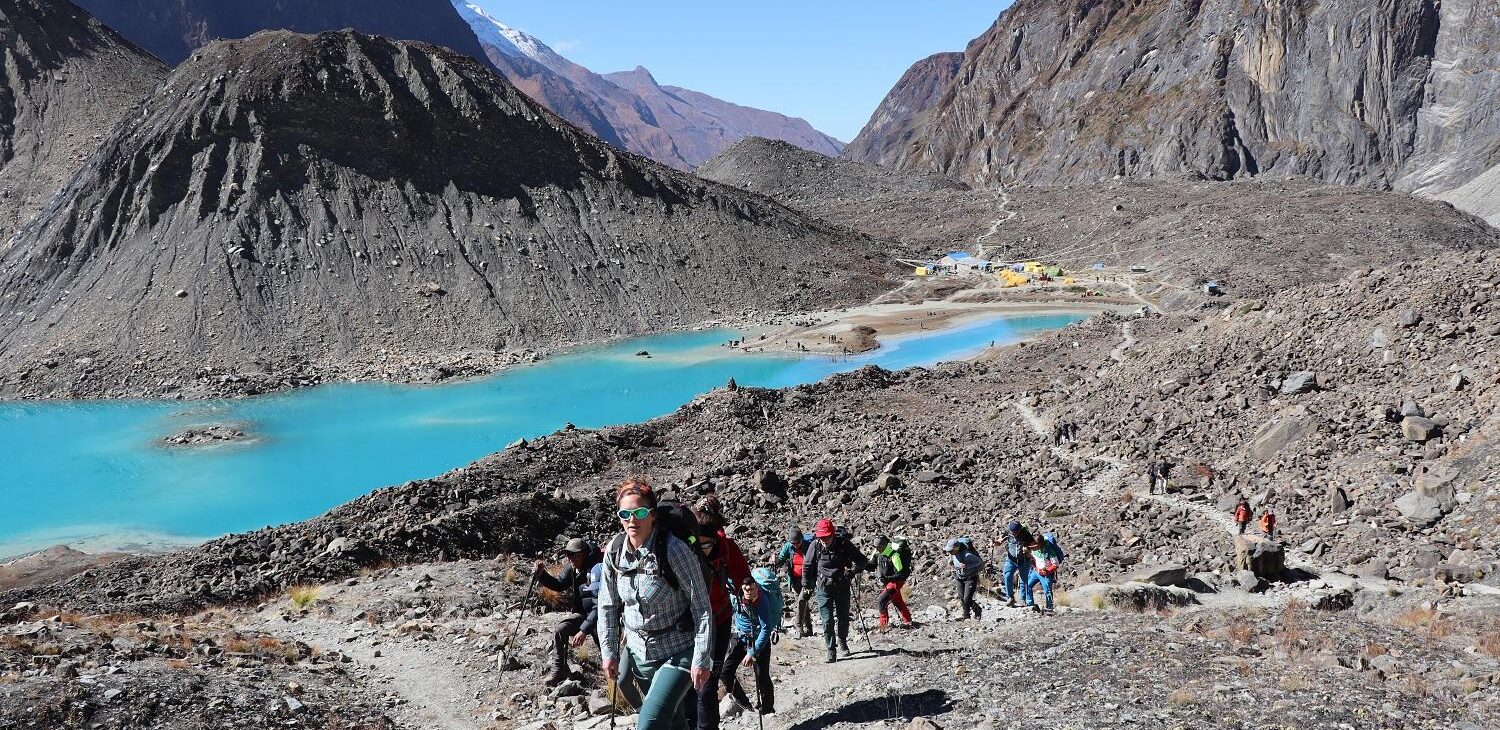
MYAGDI: Annapurna Base Camp, once largely unknown to visitors, has emerged as one of Nepal’s growing mountain tourism destinations, attracting an increasing number of domestic and international trekkers.
Located at the foot of the 8,091-meter Annapurna I in Annapurna Rural Municipality–4 of Myagdi district, the base camp has gained popularity following the development of trekking infrastructure, accommodation facilities, and sustained promotional efforts.
Chairperson of Annapurna Rural Municipality Bharat Kumar Pun said tourist arrivals have exceeded expectations since the route was formally identified and promoted.
“After establishing that Annapurna Base Camp and the trekking route to it lie within Myagdi and conducting extensive promotional activities, visitor numbers have increased beyond the capacity of existing infrastructure,” Pun said. “Its relatively short and accessible trekking route has made it particularly popular among domestic tourists.”
Until 2067 BS, Annapurna Base Camp was widely believed to be located solely within Kaski district. The area’s connection to Myagdi gained recognition after Maurice Herzog, the leader of the first successful ascent of Annapurna I, visited Narchang in 2012 and shared details of the original climbing route and base camp used during the historic expedition.
Inspired by Herzog’s account, a local team led by Tej Gurung, then principal of Prabha Secondary School, conducted research and exploration of the route. In 2077 BS, Annapurna Rural Municipality officially mapped and named the trekking trail the “Maurice Herzog Trail.”
“Based on information provided by Herzog, we gradually developed the route by constructing 68 wooden bridges along the Nilgiri and Annapurna river corridors and eventually reached the base camp,” Pun said.
“After more than a decade of infrastructure development, the trail became fully operational three years ago and has since attracted significant interest as a relatively untouched destination.”
Situated at an altitude of 4,190 meters above sea level, the base camp can now be reached through a 22-kilometer trekking route extending from Humkhola. A 20-kilometer road linking Narchang and Humkhola has also improved accessibility.
The trail offers visitors panoramic views of the Annapurna and Nilgiri mountain ranges, towering waterfalls, alpine landscapes, glacial rivers, rare flora, and wildlife. Trekkers can typically reach the base camp within two days and return on the third day.
One of the area’s main attractions is Panchkunda Lake, a glacial lake located at an altitude of 4,050 meters below the base camp. Spread across approximately 17,684 square meters, the lake is fed by meltwater from Annapurna’s snowfields. Visitors can enjoy simultaneous views of both Annapurna Himal and Panchkunda Lake, a feature that has become a major draw for tourists.
The base camp also features statues of Maurice Herzog, Louis Lachenal, and Sonam Balung Sherpa, members of the first Annapurna expedition team. An open-air museum displays a copper plaque listing the names of all 536 climbers who have successfully summited Annapurna I to date.
Despite the growing popularity of the destination, several challenges remain. Limited accommodation capacity, inadequate communication services, the absence of reliable electricity and health facilities, and difficulties in waste management have created operational challenges for both tourists and local businesses.
Michael Pun, a hotel entrepreneur from Bhusket, said the temporary restaurant established along the trekking route has the capacity to accommodate only around 50 guests per day, while visitor numbers often exceed 200 during the peak spring and autumn trekking seasons.
“Because the area falls within the Annapurna Conservation Area Project (ACAP), constructing permanent infrastructure requires government approval,” he said. “At present, only temporary structures have been permitted, forcing operators to rely on tents to accommodate the growing number of visitors.”
Local stakeholders have stressed the need to expand accommodation facilities, improve communication and emergency rescue services, strengthen waste management systems, complete the remaining sections of the trekking trail, and upgrade suspension bridges to support the area’s continued tourism growth.





Comment