




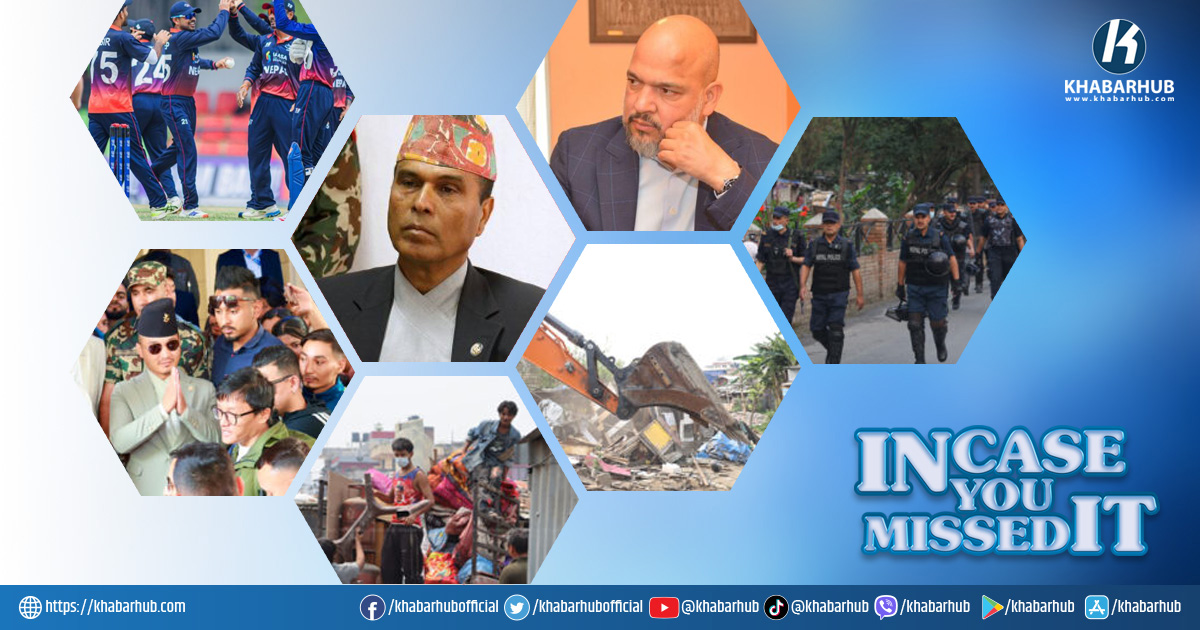
KATHMANDU: Last week’s developments in Nepal present a dense and politically charged narrative centered on governance instability, anti-corruption enforcement, institutional restructuring, and escalating tensions among political and economic elites.
At the heart of these events lies the resignation of Home Minister Sudan Gurung, which acts as a catalyst for a wider set of interconnected political, judicial, and administrative actions. Collectively, the week’s news reflects a state undergoing assertive—but contested—efforts at reform, particularly under the leadership of Prime Minister Balendra Shah (Balen), while simultaneously revealing the fragility of trust between political actors, state institutions, and the public.
Resignation of Home Minister Sudan Gurung
The resignation of Home Minister Sudan Gurung marks the most symbolically significant event of the week. Officially, Gurung justified his departure on “moral grounds,” emphasizing integrity, public trust, and ethical leadership. However, the broader context suggests a more complex political calculation shaped by allegations of business links, share transactions, and growing scrutiny over financial transparency.
His resignation illustrates a recurring tension in transitional political systems: the gap between reformist rhetoric and institutional vulnerability. Gurung initially emerged as a decisive figure in law enforcement, associated with early arrests of senior officials.
This created an image of a strong anti-corruption executor. Yet, the rapid shift from reformer to accused highlights how fragile political legitimacy becomes when personal financial histories intersect with public office.
Importantly, his statement that “morality is greater than position” functions not only as ethical justification but also as a political narrative designed to preserve personal legitimacy while exiting under pressure.
In many democratic systems, such resignations can either signal institutional maturity or mask unresolved political conflicts. In this case, it appears to be both: an assertion of moral responsibility and an indication of unresolved elite rivalry.
Political infighting
The resignation is closely linked to tensions involving Rastriya Swatantra Party (RSP) Chair Rabi Lamichhane. The reported exchange of indirect accusations through social media reflects an emerging pattern of political confrontation shifting from formal institutions to public digital spaces.
Lamichhane himself is entangled in allegations involving cooperative fraud and shareholding controversies linked to Gorkha Media Network. The overlapping nature of allegations against both figures suggests a broader systemic issue: political actors in Nepal are increasingly operating at the intersection of media ownership, business networks, and governance authority.
Gurung’s alleged indirect accusations against journalists and media-linked financial dealings deepen this narrative. Rather than isolated scandals, these developments point toward a structural entanglement between media capital, political influence, and financial irregularities. This raises serious questions about regulatory oversight, conflict of interest frameworks, and the independence of investigative institutions.
Expansion of anti-corruption enforcement
A parallel development is the arrest of prominent business figures such as Shekhar Golchha and Bikram Pandey, along with ongoing investigations into multiple actors in financial misconduct cases. The Commission for the Investigation of Abuse of Authority (CIAA) and Central Investigation Bureau (CIB) appear to be executing an expanded anti-corruption campaign targeting both political and corporate elites.
On the surface, this signals institutional strengthening and an aggressive anti-corruption posture. However, the simultaneity of arrests across political affiliations raises concerns about selective enforcement versus systemic reform.
When high-profile arrests cluster around politically sensitive moments—such as a ministerial resignation—they risk being interpreted as politically synchronized actions rather than purely judicial processes.
The case involving Deepak Bhatta and related money laundering investigations reinforces this perception of widening financial scrutiny. Yet, without transparent communication and judicial independence clearly visible to the public, such enforcement risks being viewed as politically motivated rather than institutionally neutral.
Encroachment clearance campaigns
The clearance of settlements along the Bagmati River and demolition drives in Birgunj represent the state’s assertive urban governance agenda. These actions reflect an attempt to enforce rule of law in land use, infrastructure expansion, and environmental management.
However, the human cost of such enforcement is significant. The relocation of displaced families to Dasharath Stadium and the rapid eviction timelines—sometimes less than 12 hours—highlight a governance dilemma: balancing legal enforcement with social protection.
These operations reveal the dual identity of the Nepali state: reform-oriented in its ambition but administratively underprepared for humane execution. The absence of adequate resettlement planning often transforms legal action into social disruption, undermining public trust even when the legal basis is strong.
Institutional reform agenda
Prime Minister Balendra Shah’s directives on removing party-affiliated structures from educational institutions signal a bold institutional reform agenda. His framing of campuses, hospitals, and schools as “sacred spaces” free from political influence reflects a technocratic and depoliticized vision of governance.
This approach aligns with broader reformist narratives seen in emerging political leadership models across South Asia, where governance is positioned as efficiency-driven and ideology-minimizing. However, the resistance from university officials citing security concerns demonstrates the entrenched nature of political networks within Nepal’s academic institutions.
The tension here is structural: political parties have historically used student unions as recruitment and influence mechanisms. Attempting to dismantle them without transitional frameworks risks confrontation, institutional instability, and potential resistance from organized student groups.
Parliamentary instability
The postponement of the federal parliament session a day after its announcement raises concerns about procedural stability and executive-legislative coordination. While officially attributed to “special reasons,” such abrupt changes undermine institutional predictability.
This reflects a broader pattern in Nepal’s governance system where executive decisions frequently override parliamentary scheduling, reinforcing perceptions of centralized decision-making. In fragile democracies, repeated procedural disruptions can weaken legislative authority and diminish public confidence in representative governance.
Judiciary, regulatory bodies, and legal accountability
The Nepal Medical Council’s deregistration of doctors who acquired foreign citizenship reflects regulatory enforcement of professional eligibility laws. Similarly, CIAA corruption cases and money laundering extensions demonstrate active judicial processes.
However, the legal system appears to be under pressure from an increasing volume of politically sensitive cases. The extension of custody for suspects such as Deepak Bhatta and Sulav Agrawal suggests prolonged investigative procedures, which, while legally justified, also raise concerns about due process efficiency.
The judiciary’s role is thus expanding in both scope and political visibility, making it a central arena for governance legitimacy.
International engagement and diplomacy
The visit of US Assistant Secretary Samir Paul Kapur underscores Nepal’s continued geopolitical relevance in South and Central Asia. Engagements with ministers and economic stakeholders indicate a focus on strengthening trade, investment, and diplomatic alignment.
Such visits are not merely ceremonial; they signal external validation of the current government and its policy direction. For a newly formed administration, international engagement serves both economic and political legitimacy functions.
Political consolidation and ideological narratives
Finally, Prachanda’s call for unity among leftist forces reflects ongoing ideological recalibration within Nepal’s communist movement. His emphasis on resisting imperialism and preserving republican achievements suggests an attempt to consolidate fragmented leftist politics.
However, ideological appeals contrast sharply with the current wave of corruption allegations and institutional instability. This divergence highlights a broader disconnect between political ideology and governance performance.
Conclusion: State in active transition
The events of the week collectively portray Nepal as a state in active transition—politically assertive, institutionally ambitious, but structurally strained. The resignation of a high-profile minister, simultaneous corruption investigations, urban clearance drives, and institutional reform efforts indicate a government attempting to assert control and reform simultaneously.
Yet, these efforts also expose deep vulnerabilities: overlapping allegations of corruption among elites, fragile trust in institutions, contested governance reforms, and uneven administrative capacity.
The central question emerging from these developments is not merely whether Nepal is fighting corruption or reforming institutions, but whether its political and administrative systems are mature enough to sustain such rapid and multi-front transformation without destabilizing public confidence.
In essence, last week’s events reflect a nation navigating between reformist ambition and institutional realism—where each political action simultaneously signals progress and exposes fragility.



Comment