




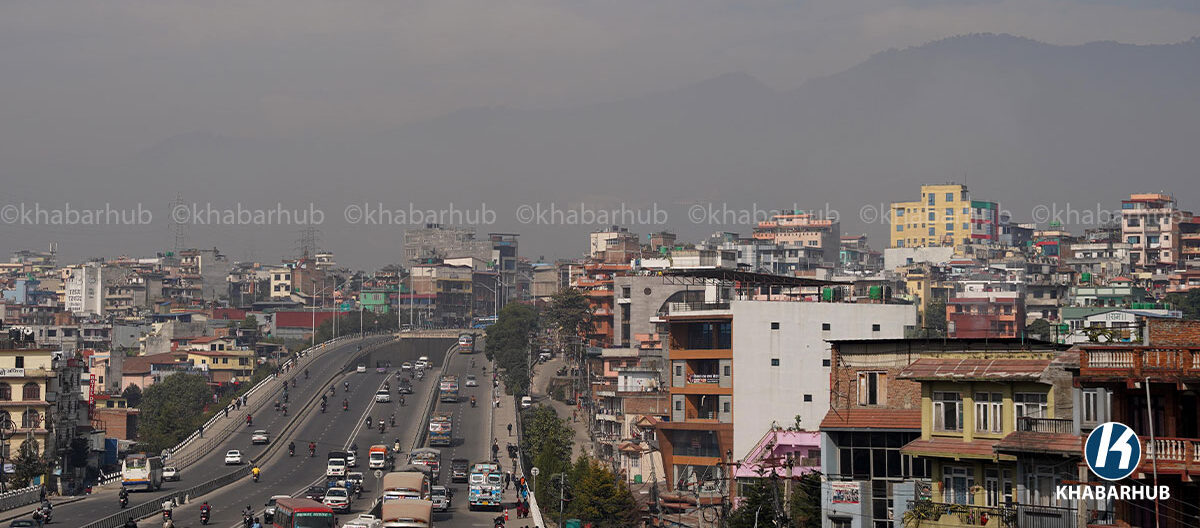
KATHMANDU: Air pollution in Kathmandu Valley has surged to unhealthy levels today, with the Air Quality Index (AQI) reaching 175 by midday. The city now ranks as the seventh most polluted globally, raising alarms over public health and the urgent need for environmental measures.
Cairo in Egypt recorded the highest pollution globally, with an AQI of 273. Gyanraj Subedi, Director General of the Department of Environment, said that the rise in pollution is due to dry weather, lack of wind, industrial operations, and rapid construction and development. He added that smoke and dust from industrial activities, cross-border pollution, and emissions from neighboring India have also contributed.
“Pollution may increase further unless it rains,” Subedi warned, urging concerned authorities to emphasize environment-friendly development. Disaster management expert Dr. Dharmaraj Upreti explained that an AQI between 0 and 50 is considered good, while 51 to 100 is moderate or alert. An AQI of 101 to 150 is considered unhealthy for sensitive groups such as respiratory and heart patients, while an AQI of 151 to 200 is unhealthy for everyone.
Levels between 201 and 300 are very unhealthy, and any reading above 300 is considered extremely dangerous. According to the Air Quality Management Action Plan for Kathmandu Valley, 2076, an AQI above 300 is treated as a disaster.
The plan recommends measures such as stopping garbage burning, increasing street cleaning using brooms and vacuums, and issuing public warnings to children, senior citizens, and vulnerable populations.
The National Environment Policy, 2076, also outlines strategies to prepare and implement national standards for air, water, soil, sound, electromagnetic waves, radioactive radiation, and hazardous chemical pollution. Additionally, the policy calls for establishing quality measurement centers in major cities, industrial areas, and other high-risk locations to monitor air, water, and sound quality.






Comment