




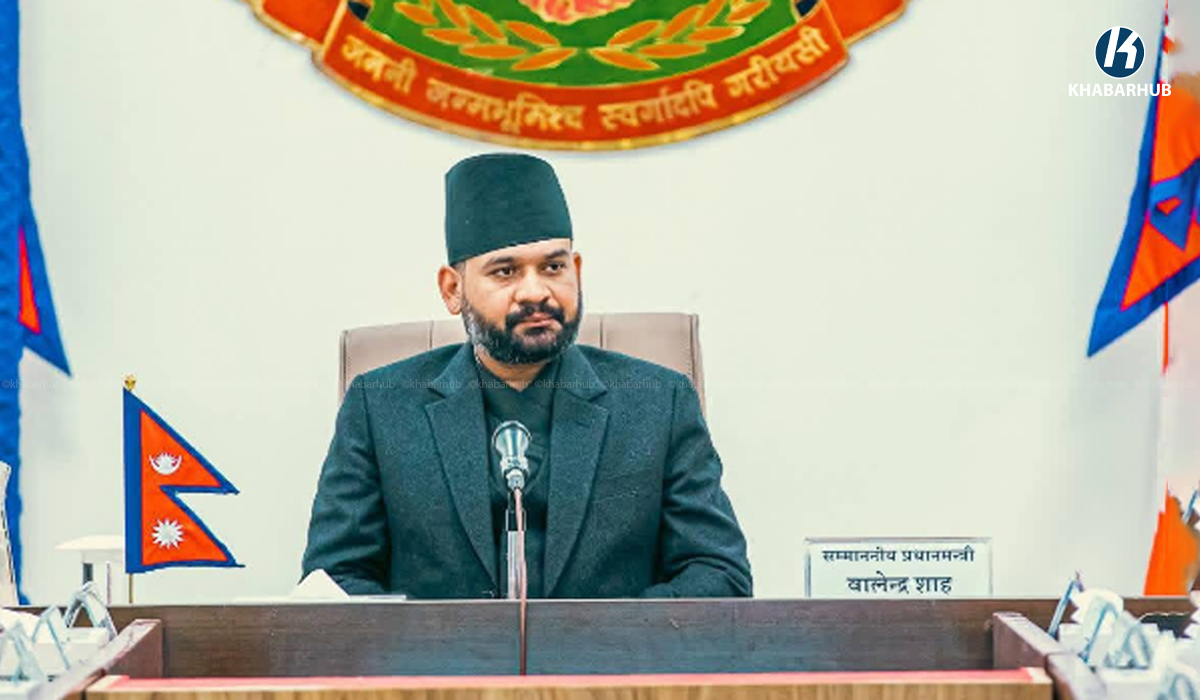
KATHMANDU: The government led by Balen Shah has come under mounting criticism after moving forward with a series of ordinances while keeping the federal parliament session in limbo.
Despite previously calling a budget session, the government abruptly postponed the meeting overnight and has since accelerated the issuance of ordinances. On Tuesday, the Cabinet recommended two ordinances, related to cooperatives and the Constitutional Council, to President Ram Chandra Poudel.
A day later, additional ordinances concerning universities, healthcare, and amendments to existing Nepal laws were also forwarded to the president for approval. Sources indicate that the government is also preparing to introduce another ordinance related to civil service reforms.
The move has triggered widespread criticism, with opposition parties and analysts accusing the government of bypassing Parliament and undermining democratic norms.
Questions over parliamentary process
Uncertainty continues to loom over when the parliament will reconvene. Although the Cabinet had earlier recommended convening the session from April 30, it reversed the decision days later, postponing the meeting without a clear timeline.
Political observers argue that the government’s reliance on ordinances—despite commanding near two-thirds majority—raises concerns about its commitment to parliamentary procedures.
As per constitutional provisions, any ordinance must be endorsed by Parliament within 60 days of the commencement of the House session. Failing that, the ordinance automatically becomes inactive.
Nepal has witnessed similar instances in the past. Ordinances introduced under former Prime Minister KP Sharma Oli also lapsed after failing to secure parliamentary approval, particularly following the dissolution of the House.
Government defends ‘fast-track’ approach
Defending the government’s decision, Energy Minister Biraj Bhakta Shrestha said the ordinances were necessary to expedite governance and address urgent issues.
“Due to time constraints, we had to move through a fast-track approach. The ordinances are being introduced in line with laws and procedures, and they will not harm anyone,” Shrestha said.
Officials from the Prime Minister’s Secretariat also argued that pressing issues—such as problems in the cooperative sector and legal complexities in the Constitutional Council—required immediate intervention.
They maintained that lawmakers would have the opportunity to debate the ordinances once Parliament resumes.
Ruling party whip Pradeep Chandra Pariyar said the looming constitutional deadline to present the national budget by May 29 had forced the government to act swiftly.
“This is not about bypassing Parliament. The government is focused on delivering results. Comparisons with past administrations are misplaced,” Pariyar said.
Opposition mounts pressure
Major opposition parties, including the Nepali Congress, CPN-UML, and others, have strongly criticized the government’s decision, calling it a dangerous attempt to centralize power.
Opposition leaders such as Bhishmaraj Angdembe and Ram Bahadur Thapa have demanded that the government immediately summon Parliament and clarify its intent behind the ordinance route.
The opposition has also appealed to President Poudel to halt the approval of ordinances, arguing that issuing them while Parliament is functional undermines legislative authority.
Concerns over democratic norms
Legal experts and political analysts warn that frequent use of ordinances by a near two-thirds majority government could erode public trust in parliamentary democracy.
Senior journalist and parliamentary affairs expert Hari Bahadur Thapa noted that resorting to ordinances under such circumstances signals a lack of confidence in the legislature.
Opposition leaders, including Khushbu Oli, have described the move as a “serious attack on parliamentary practice,” while others argue it reflects an emerging authoritarian tendency within the executive.
Even smaller parties and political groups have joined the criticism, warning that sidelining Parliament could weaken democratic accountability.
What lies ahead?
With no clear date for the resumption of Parliament and growing political pressure, the government may face increasing resistance in pushing its ordinance agenda.
Experts suggest that if opposition parties intensify their protests, the government could be forced to reconsider its approach. However, given the current political arithmetic, the likelihood of a major rollback appears uncertain.
The unfolding developments have once again placed Nepal’s ordinance mechanism—and its implications for democratic governance—at the center of national debate.




Comment