




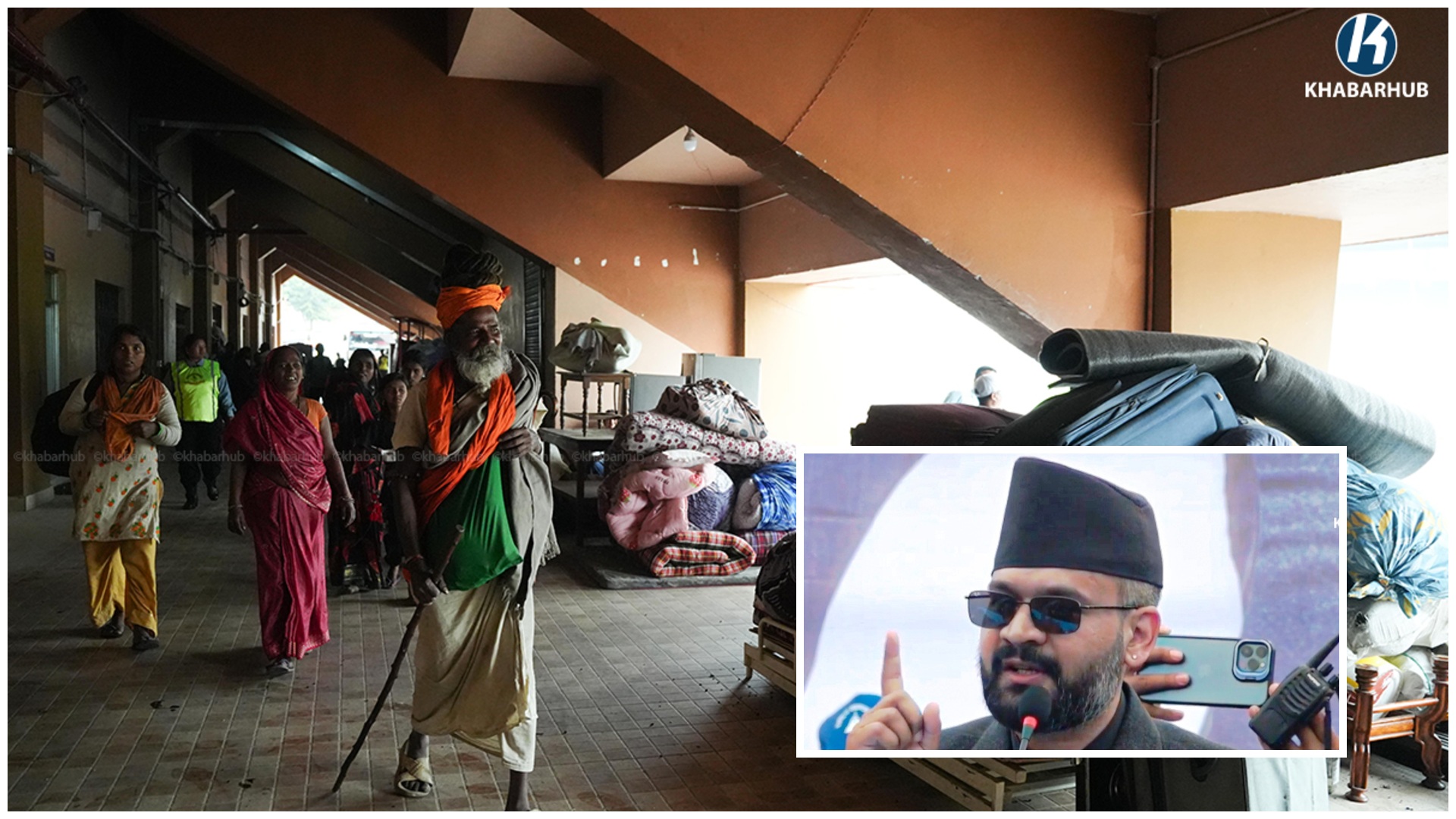
KATHMANDU: A news team reached the Radhaswamy Satsang in Kirtipur on Wednesday afternoon, where squatters have been temporarily relocated.
The satsang lies along the banks of the Bagmati River, opposite the main gate of Tribhuvan University, on the road connecting Balkhu to Dakshinkali. As the team entered the premises, they were approached by a group of armed Nepal Police, Kathmandu Metropolitan Police, and satsang volunteers.
Familiar faces—individuals the reporters had met during previous coverage—were also present, giving an initial sense that reporting would proceed smoothly. However, security personnel who had been monitoring movements from the gate soon questioned the team’s purpose. When informed that they were there to gather news, the officials responded with restrictions.
Reporters were politely instructed not to use mobile cameras or record audio within the premises. “According to the discipline of our satsang, we do not take photos or videos here. You should follow that as well,” said a volunteer who requested anonymity.
The restriction was discouraging for journalists attempting to document the living conditions of those displaced. Inside the compound, an open structure resembling a hall stood at the center, surrounded by around 25 temporary tents, with space for more. Armed police were seen managing tent arrangements and electricity supply.
Around the area, some squatters were organizing clothes and bedding, while a separate desk had been set up for psychological counseling. When reporters requested permission to observe the living conditions more closely, they were allowed—but with conditions.
When approached, one resident declined to speak, saying, “We are under strict monitoring and cannot talk.” Nearby, children expressed concerns about their disrupted education. “I don’t even know my results. I don’t know where I will study or what to do next. Otherwise, it’s okay here—I just wish I had new books,” said a sixth-grade student.
“If you want to see how they are staying, you can walk with us,” a city police officer and a satsang volunteer said. “But you are not allowed to talk to them here. If you know someone, call them outside the gate and speak there. We won’t stop you.”
Accompanied by officials, the team entered the designated area with only notebooks and pens, which were permitted. Near the section where police were working on tents and electricity, one reporter asked whether photos could be taken of the officials at work, even if squatters could not be photographed.
The response reflected underlying anxiety. “Why take photos and videos and write news about it? That’s what worries us—we might lose our jobs,” a city police officer replied.
The exchange highlighted the pressure faced by personnel on the ground. According to Parshuram Dahal, a volunteer overseeing the site, 161 individuals from 57 families were currently housed there. He said the satsang had arranged meals for them throughout the day.
“The government has asked us to manage their food for a week,” Dahal explained. “We are providing tea and biscuits at 7 a.m., lunch at 11 a.m., snacks at 2 p.m., and dinner from 6:30 p.m.”
He added that meals were distributed equally among all, from children to the elderly. Addressing complaints about insufficient packaged food, Dahal noted that cooking facilities at the site were not operational due to flooding.
“Our kitchen here is not functioning, so we are preparing food at the Samakhusi building and bringing it here,” he said, adding that packaged meals had been served until Tuesday evening.
“We had to rely on packed food for a few days, which may not have been sufficient for everyone. From this morning, we have started serving freshly prepared, purely vegetarian meals brought from our facilities, and people are being fed as much as they need,” he said.
Following the eviction of the squatter settlement in Thapathali on Saturday, displaced residents were relocated to the satsang. Of the 161 individuals initially housed there, two have already left, stating they had homes elsewhere in the Valley. “Two people have already departed because they had their own residences,” Dahal confirmed.
The current month has brought extreme weather conditions, with intense daytime heat followed by strong winds and rainfall in the evenings. For those who had already endured the trauma of losing long-standing shelter, the weather has added further hardship. Dahal noted that the wind and rain had made it difficult for residents to rest comfortably.
“There was heavy rain accompanied by strong winds last night. Water seeped into some of the tents, slightly soaking bedding for those staying in more exposed areas. That is why we have now reinforced the tents,” he explained.
Referring to media coverage, Dahal expressed concern over what he described as misrepresentation. “Earlier, around 500 people were involved in relief efforts; now we are serving around 100 people daily, starting with food distribution. It is unfair to make negative comments over such issues. Criticism has increased because some media reports were published without considering both perspectives. We are fully committed to service,” he said.
He added that the government had requested the satsang to manage the displaced population for 15 days. “We were told they would be relocated elsewhere within that period. We are ready to continue providing support, but arrangements for food have only been secured for one week so far. If we are asked to extend responsibility, we will need to seek additional donors,” he noted.
According to Dahal, the satsang currently has the capacity to accommodate around 50 families. “If needed, additional families can be managed at our Samakhusi facility. Here, we can host up to 100 families, and there are about 50 toilets available,” he said.
Shortly after this interaction, officials requested the media team to leave the main shelter area. While remaining within the premises, journalists attempted to speak with some residents. Frustration was evident among media personnel, particularly those gathering television footage, as they were not permitted to take photographs.
In one corner, an elderly woman, appearing mentally distressed, struggled to move through the tight passage with the help of a stick, repeatedly saying, “I am going to the office.” Nearby, an elderly man agreed to speak about his situation. He described the difficulties of sharing such confined space with extended family members.
Some claimed that a reporter from another outlet had been pushed out by police for attempting to film, though this could not be independently verified. Nevertheless, such restrictions in what appeared to be a public-interest situation raised concerns among journalists.
When approached, one resident declined to speak, saying, “We are under strict monitoring and cannot talk.” Nearby, children expressed concerns about their disrupted education. “I don’t even know my results. I don’t know where I will study or what to do next. Otherwise, it’s okay here—I just wish I had new books,” said a sixth-grade student.
Despite uncertainties, some children said they were adapting, spending time playing together. “We don’t have complaints about food or shelter. We play football, but we would like to have badminton,” they said.
Meanwhile, Bikram Lama, another displaced resident from Thapathali, downplayed concerns raised in media reports. “It’s normal for bedding to get wet when it rains like yesterday. Why exaggerate it? Please don’t overstate such issues,” he requested.
When asked about reports suggesting pressure from security personnel regarding videos circulated in the media, one resident dismissed the claim. “We are satisfied here. Facilities are being provided. There is no pressure,” he said.
Meanwhile, volunteers continued distributing lunch and tea to all residents. However, whether the meals were sufficient—especially for those who had last eaten early in the morning—remained an open question.
As people gathered for tea, we briefly entered the tents. Inside, squatters were arranging bedding in the newly set-up shelters. The tents, divided into two or three sections, were so cramped that even standing space was limited. Children ran through the narrow gaps between them.
In one corner, an elderly woman, appearing mentally distressed, struggled to move through the tight passage with the help of a stick, repeatedly saying, “I am going to the office.” Nearby, an elderly man agreed to speak about his situation. He described the difficulties of sharing such confined space with extended family members.
“On the first day, we barely managed to find two hammocks. My daughters-in-law slept in one, while I shared the other with my grandson. Later, four of his friends also arrived, and soon there was no space left,” he said.
He added that the lack of privacy created greater hardship for women. “When daughters-in-law, fathers-in-law, and brothers-in-law all have to stay in the same space, it becomes especially difficult for women,” he explained.
During the conversation, city police officers approached and instructed the media team to leave. “You have been here for two to three hours. It’s time to go outside,” one officer said.
As we were leaving, some women expressed frustration, saying that media coverage had made it harder for them to find rental rooms elsewhere. They claimed that videos circulating publicly had discouraged landlords from offering them accommodation.





Comment