




Nepal has spoken. Now it must act.
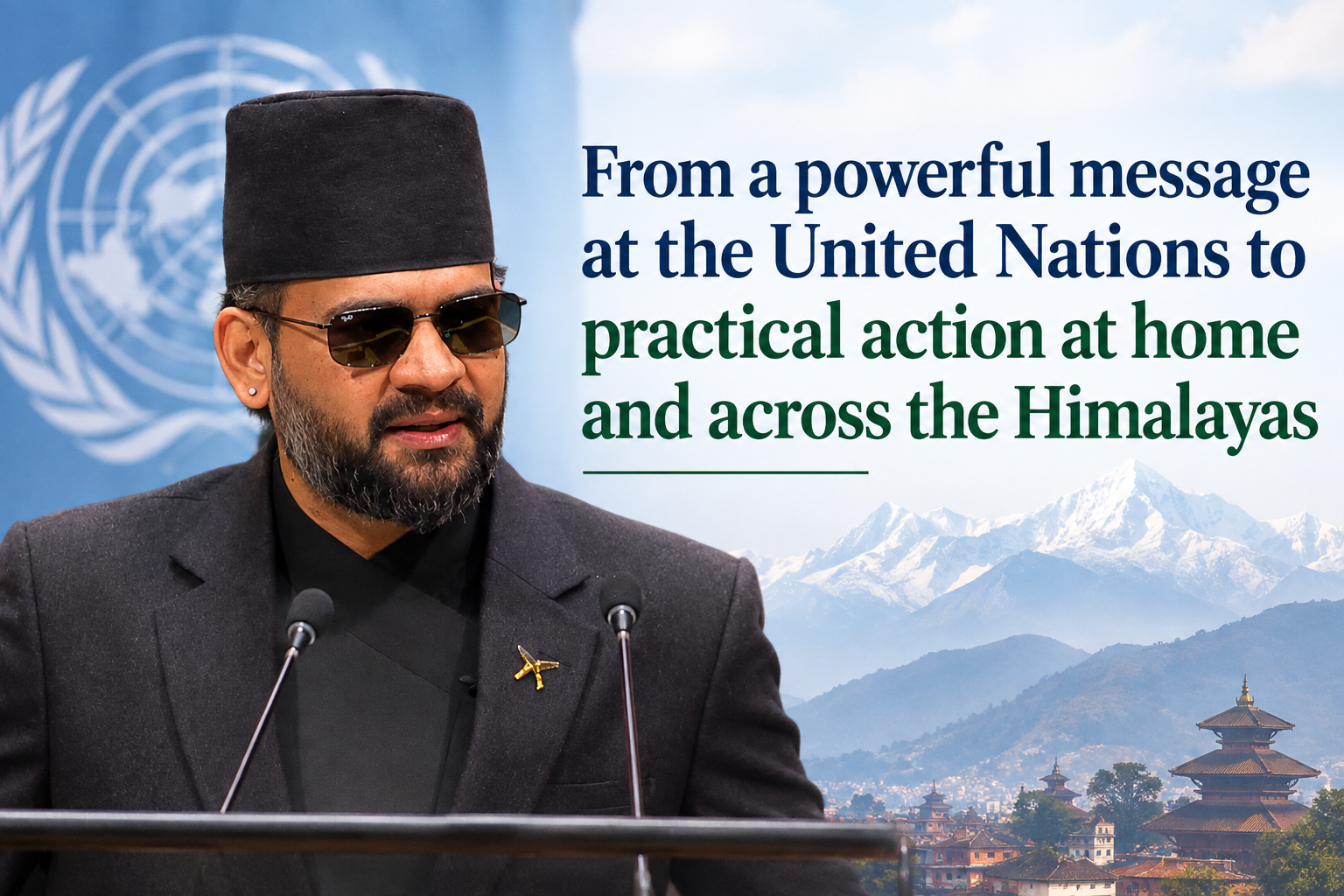
In his address to the 81st United Nations General Assembly on September 24, Prime Minister Balendra Shah placed the climate crisis in the Himalayas firmly on the international agenda. He proposed a Himalayan Climate Resilience Mechanism, initially involving Nepal, India and China, with cooperation on satellite data, scientific expertise, monitoring of dangerous glacial lakes, joint early-warning systems and coordinated disaster response.
The proposal is significant. But an announcement at the United Nations is only the beginning. The real test is whether Nepal can turn diplomatic language into sustained cooperation, investment and action.
In fact, Khabarhub, in its editorial on September 2, 2026, had argued for this direction even before the UN General Assembly, calling for Nepal to establish an International Centre for Himalayan Studies, Climate and Resilience and to position the country as a global meeting place for Himalayan science. The Prime Minister’s initiative now creates an opportunity to connect that scientific vision with a broader programme of diplomatic and practical climate action.
How can digital technologies help governments anticipate mountain hazards? What investments can reduce disaster losses? How can climate finance be structured to address the particular challenges of mountain countries?
Now, who will follow up with India and China? Who will bring governments, scientists, universities, ICIMOD, UN agencies, development banks and climate funds to the same table? Who will translate the proposal into financing arrangements, data-sharing mechanisms, scientific partnerships and operational early-warning systems? And who will ensure that the initiative remains a national priority after international attention shifts elsewhere? These questions point to a larger challenge. Nepal does not lack ideas. What it often lacks is the institutional machinery to carry those ideas forward over the long term.
From climate diplomacy to climate delivery
For Nepal, climate change is no longer simply an environmental issue. It is a question of water security, energy, agriculture, food security, infrastructure, tourism, settlements, migration, disaster management and economic development. Floods, landslides, glacial-lake outburst floods and other climate-related hazards can destroy roads and bridges, disrupt hydropower generation, threaten settlements and agricultural production, and impose heavy costs on the national economy. Climate change can also alter water availability and undermine development gains.
The Prime Minister described climate catastrophe as a development emergency in his UN address. Nepal must therefore connect climate diplomacy with development diplomacy. One practical step would be to establish a Special Envoy of the Prime Minister for Climate Change, with a specific mandate for Himalayan Resilience. Several countries have used special envoys or comparable senior representatives to strengthen climate diplomacy. The United States, China, India and the Maldives have all, at different times, assigned high-level representatives specific responsibilities for international climate engagement.
Nepal need not copy any particular model. But the experience of other countries shows that climate change has become sufficiently important—diplomatically, economically and strategically—to warrant sustained high-level attention. For Nepal, the case is even stronger because climate change intersects with foreign relations, Himalayan cooperation, water resources, energy, infrastructure, disaster risk and economic development.
A Special Envoy must be about delivery
The proposed Special Envoy should not become another ceremonial position. Nor should it duplicate the responsibilities of the Ministry of Foreign Affairs, Ministry of Forests and Environment, Ministry of Energy or other government agencies. It should instead be a small, professional mechanism linked closely to the Prime Minister’s Office, with direct access to the Prime Minister and the ability to coordinate across ministries and institutions.
Its first responsibility should be to advance the proposed Himalayan Climate Resilience Mechanism.
Working closely with the Ministry of Foreign Affairs, the Special Envoy could pursue practical cooperation with India and China on glacier and glacial-lake monitoring, satellite and earth-observation data, scientific expertise, early-warning systems, disaster-risk information, emergency preparedness and coordinated responses to disasters with cross-border implications.
Nepal should also explore cooperation with other mountain countries confronting similar climate risks. The Special Envoy could also strengthen Nepal’s wider international climate diplomacy. The country has important interests in adaptation, loss and damage, climate finance, technology transfer, mountain issues and climate-resilient development. A dedicated high-level representative could help ensure that these issues receive sustained attention across international forums.
Another critical responsibility would be mobilising climate finance.
Nepal has enormous climate-related needs, but the ability to convert those needs into well-prepared, investment-ready projects remains a challenge. The Special Envoy could work with the Ministry of Finance, sectoral ministries, development banks, diplomatic missions and international partners to develop a stronger pipeline of projects for the Green Climate Fund, Adaptation Fund, multilateral development banks, bilateral partners and responsible private investors.
Nepal must move from documenting vulnerability to financing resilience.
The Special Envoy could also help connect climate action with economic transformation. Nepal has opportunities in hydropower, renewable energy, electrification, clean transport, resilient infrastructure, sustainable tourism and emerging green industries. Climate policy should not be viewed merely as an environmental obligation; properly designed, it can support jobs, competitiveness, investment and inclusive growth.
Equally important is the connection between science, policy and investment. Nepal needs stronger links among government agencies, universities, ICIMOD, international research institutions, technology companies and development partners. The Special Envoy could help build partnerships around glacier science, hydrology, disaster risk, climate modelling, artificial intelligence, earth observation and climate-resilient infrastructure.
But the position must ultimately be measured by results.
There should be clear annual targets: progress on the Himalayan Climate Resilience Mechanism, international partnerships established, climate-finance proposals developed, investment mobilised, scientific cooperation strengthened and progress on climate-resilient development. The Special Envoy should report regularly to the Prime Minister. In short, the position must be about delivery, not designation.
Nepal also needs a Himalayan knowledge platform
This brings us to the second part of the strategy: the International Centre for Himalayan Studies, Climate and Resilience proposed by Khabarhub before the Prime Minister’s UN address. The idea deserves renewed attention precisely because the government has now placed Himalayan climate resilience on the international political agenda.
The two proposals could complement each other. The Special Envoy would provide the political and diplomatic bridge; the International Centre would provide the scientific and knowledge bridge. Nepal is well positioned to host such a platform. The Himalayas are not simply a geographical feature of Nepal. They form part of a global ecological and economic system that provides water, biodiversity and livelihoods to millions of people far beyond the country’s borders.
Nepal already has important institutional assets. ICIMOD is based in Kathmandu, while Nepalese universities, government agencies and research institutions possess expertise in glaciers, hydrology, climate, biodiversity, geology and disaster risk. The challenge is to connect these capabilities more effectively with one another and with the international scientific community. The proposed centre should not compete with ICIMOD, universities or existing research institutions. Nor should it become another conventional research body.
The first year should produce tangible results: a roadmap for the Himalayan Climate Resilience Mechanism; structured engagement with India and China; a pipeline of priority climate-finance and resilience investments; stronger international research partnerships; and a roadmap for the proposed Himalayan knowledge centre.
It should function as an open Himalayan knowledge platform connecting satellite data, field science, artificial intelligence, glacier monitoring, hydrology, climate modelling, disaster risk, infrastructure planning, economics, policy and finance.
Its guiding principle should be simple:
Science must serve society.
From research to practical solutions
The centre should be built around practical questions.
Where are the most dangerous glacial lakes? Which communities and infrastructure are most exposed? How are changing precipitation patterns and glacier dynamics affecting water availability? Which roads, bridges, hydropower projects and settlements require stronger climate-risk standards? How can satellite information and artificial intelligence improve early-warning systems? How can digital technologies help governments anticipate mountain hazards? What investments can reduce disaster losses? How can climate finance be structured to address the particular challenges of mountain countries?
Most importantly, how can scientific information move rapidly from researchers to governments, businesses and communities?
The centre could have four interconnected functions.
Research: Advancing interdisciplinary Himalayan science.
Data: Developing accessible platforms for climate, glacier, water and hazard information.
Policy: Translating scientific findings into policies, standards and investment decisions.
Capacity: Training the next generation of Himalayan scientists, engineers, policymakers and entrepreneurs.
The objective should not simply be to produce more research papers. It should be to produce knowledge that changes decisions.
Two institutions, one strategy
The Special Envoy and the International Centre should not be treated as separate initiatives. They could form two parts of a broader national strategy. The Special Envoy could engage governments, the UN, development banks, climate funds and international partners. The Centre could engage scientists, universities, ICIMOD, technology institutions, space agencies and research networks. One would build political cooperation; the other would build scientific cooperation. One would take Nepal’s message to the world; the other would help generate the knowledge and solutions needed to support that message. Together, they could help transform the proposed Himalayan Climate Resilience Mechanism from a diplomatic announcement into a programme of practical cooperation.
From vulnerability to leadership
There is a larger strategic opportunity for Nepal.
Nepal should not approach the international community only as a vulnerable mountain country seeking assistance. It can also position itself as a centre for knowledge, innovation and diplomacy on mountain resilience. The world needs better information about what is happening in the Himalayas. It needs reliable data, effective early-warning systems, climate-resilient infrastructure, innovative adaptation finance and stronger cooperation across borders.
Nepal cannot solve these challenges alone.
But it can help convene those who can.
Nepal can bring governments, scientists, development institutions, technology companies, investors and communities together around a shared Himalayan agenda. This is where climate diplomacy, science and economic development can reinforce one another. The opportunity is therefore larger than a single initiative announced at the United Nations.
The opportunity before Nepal
The Prime Minister has placed Himalayan climate resilience on the global political agenda. Now Nepal must build the institutional capacity to follow through. A Special Envoy of the Prime Minister for Climate Change, with a specific mandate for Himalayan Resilience, supported by a small professional secretariat, could provide political and diplomatic coordination. An International Centre for Himalayan Studies, Climate and Resilience, developed with Nepal’s existing institutions and international partners, could provide the scientific foundation.
Together, they could connect four areas that are too often addressed separately:
Diplomacy. Science. Finance. Implementation.
The first year should produce tangible results: a roadmap for the Himalayan Climate Resilience Mechanism; structured engagement with India and China; a pipeline of priority climate-finance and resilience investments; stronger international research partnerships; and a roadmap for the proposed Himalayan knowledge centre.
The real measure of Nepal’s UN initiative will not be how prominently it was received in New York. It will be whether, five years from now, Nepal can point to stronger Himalayan cooperation, better early-warning systems, more climate-resilient infrastructure, greater access to climate finance, stronger climate-compatible economic growth and a deeper global scientific understanding of the mountains.
The Himalayas cannot wait for another declaration.
Nepal has spoken.
Now it must organise itself to act.
Can Nepal become world’s meeting place for Himalayan science?






Comment