




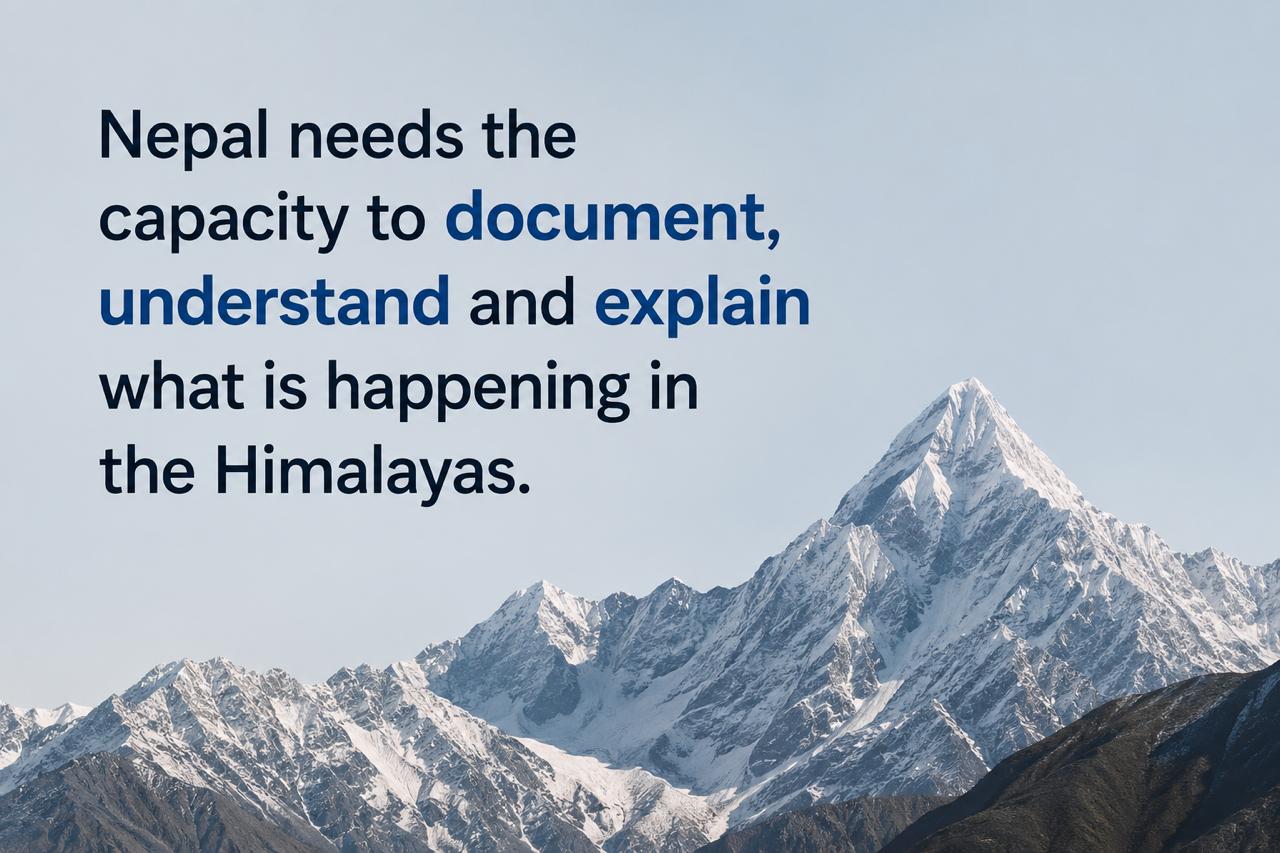
The Himalayas are changing—and faster than the world fully understands.
Glaciers are retreating, snowfall and rainfall patterns are shifting, permafrost is weakening, and mountain slopes are becoming increasingly unstable. Glacial lake outburst floods, avalanches, landslides, debris flows and flash floods are becoming more complex, interconnected and difficult to predict. Nepal has witnessed the consequences firsthand.
Recent floods and other disasters have once again exposed the vulnerability of mountain communities, infrastructure and river systems. Each major disaster leaves behind the same questions: What happened? Why did it happen? Could it have been predicted? And what can be done differently next time?
These are scientific questions, but they are also questions of national preparedness, development and human survival. For years, scientists in Nepal and around the world have warned that the rapidly changing Himalayan climate and cryosphere require stronger research, better monitoring, reliable data and greater preparedness. Yet the scale of the challenge is far beyond the capacity of any single institution or country.
The Himalayas do not recognize political borders.
Glaciers, rivers, snow, atmospheric systems and ecosystems are interconnected. Changes in the mountains can affect agriculture, hydropower, biodiversity, settlements and the lives of millions of people downstream. What happens in one part of the Himalayan system can have consequences across South Asia.
Nepal needs the capacity to document, understand and explain what is happening in the Himalayas. A country capable of producing reliable data, high-quality research and independent scientific analysis will have a stronger voice in global discussions on climate change, water security, disaster risk reduction and mountain development.
That is why the scientific response must also cross borders. And this is where Nepal has an opportunity.
Nepal is among the countries most exposed to the consequences of climate change in the Himalayas. But vulnerability should not mean that Nepal remains merely a recipient of warnings, research and international assistance. A country at the heart of such a critical mountain system should also aspire to become a centre of knowledge about it.
Nepal could—and should—lead where it can.
Its geography gives it an extraordinary advantage. The country offers a living laboratory for scientists studying glaciers, rivers, climate, geology, ecosystems and mountain hazards. Yet Nepal still lacks an ambitious international platform where scientists and universities from different countries can work together on these questions over the long term.
Khabarhub believes Nepal should seriously explore the establishment of an International Centre for Himalayan Studies, Climate and Resilience.
The idea is not to create another conventional government research institution, nor another organization that duplicates work already being done. The ambition should be much broader: to create an open international scientific platform where researchers from Nepal, India, China, Bhutan and other Himalayan countries, along with scientists and universities from around the world, can come to Nepal to study the changing Himalayan system.
The centre should be open by design.
Scientists should be able to come to Nepal to establish field studies, collaborate with Nepali researchers, access research facilities and data, organize scientific missions and conferences, develop joint research programmes and bring internationally funded projects to the country.
For Nepali universities and researchers, this could create opportunities that are currently limited. Students could participate in international research programmes while working in their own country. Young scientists could build networks with leading institutions abroad without having to leave Nepal permanently to become part of the global scientific community.
Over time, Nepal could become known not only as a destination for mountaineers and tourists, but as a destination for serious international Himalayan science. That would be a significant shift in the country’s global identity.
The proposed centre could serve as a Himalayan Research Commons, bringing together expertise in areas that are increasingly difficult to separate: the changing cryosphere; mountain hazards; climate, water and energy; ecosystems and communities; and emerging science and technology.
Research could combine field observations with satellite monitoring, remote sensing, laboratory science, artificial intelligence, GIS, modelling, sensors and local knowledge. But there is one principle that should guide the entire initiative: science must ultimately serve society.
Nepal does not need research that remains confined to academic journals. Scientific knowledge must help answer practical questions. What is changing? Why is it changing? What is likely to happen next? Who is at risk? How should communities prepare? How should roads, bridges, hydropower projects and settlements be designed in a changing mountain environment? How can early-warning systems become faster and more reliable?
This is where an international centre could make a real difference.
It could establish a Himalayan Observatory and Rapid Scientific Response Platform, bringing together multidisciplinary teams following major disasters and extreme events. Such teams could investigate what happened, collect evidence, assess risks and provide governments and communities with credible scientific information.
The objective should be to help Nepal and the wider Himalayan region move from reacting to disasters to anticipating risks, preparing for change and building resilience.
Of course, Nepal should not create a new institution simply for the sake of creating one.
The country already has important institutions and universities working in this field. The International Centre for Integrated Mountain Development (ICIMOD), based in Kathmandu, has extensive regional experience in mountain research, monitoring, capacity building and science-policy engagement.
Any new initiative must therefore complement—not compete with—ICIMOD.
The proposed centre would occupy a different space: an open academic and research platform specifically designed to attract universities, scientists and research programmes from around the world to Nepal. It should work closely with ICIMOD, Nepali universities, government agencies and other national and international institutions.
Nepal does not need institutional rivalry. It needs institutional cooperation. There are also legitimate questions that must be addressed.
Who would fund such a centre? Who would govern it? How would scientific independence be protected? How would data be shared? How would national security and sensitive information be handled? Would geopolitical tensions make scientific cooperation difficult?
These are not reasons to abandon the idea. They are reasons to design it carefully.
Any international research conducted beyond Nepal’s borders would have to respect national sovereignty, laws, research protocols and institutional permissions. Cooperation with India, China or any other country should take place through appropriate partnerships.
A credible centre would also need transparent governance, international scientific standards and a clear commitment to research integrity.
If Nepal is serious about the idea, it should begin not with a large building, but with a serious national and international discussion.
Perhaps the greatest long-term benefit would be the opportunity to develop a new generation of Himalayan scientists.
Nepal has talented students, researchers and engineers. What many lack is sustained access to major international research networks and opportunities to work on globally important scientific questions from within Nepal.
A Global Himalayan Scientists Programme could bring researchers from around the world to Nepal to work alongside Nepali scientists and students. Over time, this could help build expertise in glaciology, hydrology, geology, climate science, remote sensing, artificial intelligence and disaster risk management.
It would be an investment not merely in an institution, but in Nepal’s scientific future.
There is also a diplomatic dimension.
Nepal has every reason to raise the consequences of climate change and Himalayan disasters in international forums. But diplomacy becomes more powerful when it is supported by credible evidence.
And if it chooses to act with ambition and foresight, Nepal could become more than a country living under the shadow of Himalayan disasters. It could become one of the world’s leading places for understanding them.
Nepal needs the capacity to document, understand and explain what is happening in the Himalayas. A country capable of producing reliable data, high-quality research and independent scientific analysis will have a stronger voice in global discussions on climate change, water security, disaster risk reduction and mountain development.
Science can therefore become an instrument of diplomacy.
The ambition, however, should go beyond national interest.
The Himalayas are not only Nepal’s problem. They are a regional and global concern. They are connected to rivers, ecosystems, economies and the lives of hundreds of millions of people.
Imagine a glaciologist from China working alongside a hydrologist from India, a geologist from Nepal, a climate scientist from Europe and an artificial intelligence researcher from the United States, with professors and graduate students from universities around the world.
They would not come merely as visitors.
They would come as partners.
That is the kind of international scientific cooperation the changing Himalayas increasingly demand.
Nepal has the geography. It has the mountains. It has a growing community of young researchers and universities that can become partners. It also has a compelling reason to take the initiative.
The question is whether Nepal has the ambition to turn these advantages into a lasting international scientific platform.
Khabarhub believes it should.
The proposal deserves serious discussion among the government, universities, scientists, international organizations and development partners. It should be examined critically, tested for feasibility, refined where necessary and, if found viable, pursued with determination.
Nepal cannot stop the Himalayas from changing.
But Nepal can help the world understand those changes.
And if it chooses to act with ambition and foresight, Nepal could become more than a country living under the shadow of Himalayan disasters. It could become one of the world’s leading places for understanding them.
That would be an important contribution not only to Nepal, but to the entire Himalayan region and to the world.
It looks possible. Nepal should explore it.




Comment