




China’s rise is often reduced to a simple question: Is Beijing trying to replace the U.S. as the dominant power in the international system?
That question is important, but it is not sufficient. For smaller states such as Nepal, the more consequential question is different: How does China convert its growing national power into influence, and what does that mean for Nepal’s strategic choices as an immediate neighbor?
China’s grand strategy should not be understood only through military modernization, trade or the Belt and Road Initiative (BRI). Its approach is considerably broader. It combines institutions, ideas, development, connectivity, technology, finance, diplomacy and security into a mutually reinforcing architecture.
The objective is not necessarily to destroy the existing international order. Rather, China increasingly seeks to operate within existing institutions where useful, reform them where possible, supplement them where necessary, and build alternative networks where advantageous. Scholars disagree about whether this amounts to an attempt to displace the U.S.-led order or to reform it from within.
Rush Doshi, Director of the China Strategy Initiative at the Council on Foreign Relations and a former Biden administration official, argues that the U.S. must develop greater “allied scale” to counter China’s substantial industrial and economic power. Doshi views Chinese strategy as part of a long-term effort to challenge and ultimately displace American predominance. By contrast, other scholars emphasize China’s integration into existing international institutions, alongside selective efforts to contest and reshape those institutions.
For Nepal, this distinction matters.
China’s grand strategy is bigger than the BRI
The BRI is perhaps the most visible expression of China’s external strategy, but it should not be treated as the strategy itself. China’s broader architecture can be understood through at least five interconnected dimensions.
First, institutional embedding, multilateralism or institutional influence. China has invested heavily in multilateral institutions and forums, while also supporting new or complementary institutions and platforms. The objective is not simply participation. It is to increase the ability to influence the rules, agendas and priorities through which international cooperation takes place.
Second, normative and ideational influence. Concepts such as the Community with a Shared Future for Humanity, the Global Development Initiative (GDI), Global Security Initiative (GSI) and Global Civilization Initiative represent more than diplomatic slogans. They provide Beijing with a vocabulary through which it presents its preferred understanding of development, security, sovereignty and international cooperation.
China describes the GDI as development-centered and the GSI as emphasizing common, comprehensive, cooperative and sustainable security, sovereignty, the UN Charter and dialogue.
Whether other countries accept these concepts fully is another question. Strategic narratives matter because international influence is not produced by material power alone. It also depends on whether other states find a country’s ideas useful, legitimate or compatible with their own interests. Research on responses to the BRI, for example, shows that governments have adopted elements of China’s connectivity and prosperity narrative while simultaneously questioning aspects of China’s intentions and conduct.
Third, connectivity and economic interdependence. Roads, railways, ports, energy systems, digital networks and logistics corridors create more than physical infrastructure. They create relationships.
The strategic importance of connectivity lies in what comes after construction: trade flows, supply chains, standards, finance, technology, data, tourism, education and political interaction.
This is why the BRI should be understood as a connectivity architecture, not simply an infrastructure programme.
Fourth, technology, standards and the digital ecosystem. The future distribution of power will increasingly depend on who designs the technological systems through which economies and societies operate. Digital infrastructure, telecommunications, artificial intelligence, data governance, payment systems, green technologies and technical standards can generate forms of influence that are less visible than military power but potentially more enduring.
Fifth, security, resilience and strategic autonomy. China increasingly links development and security. Its security diplomacy extends beyond conventional military relationships into counterterrorism, public security, health, disaster response and other non-traditional security areas.
A sixth dimension—economic and financial statecraft—cuts across all five. The five dimensions should not be treated as independent policies. They reinforce each other.
Institutions give China legitimacy and voice. Ideas give China a vocabulary for international engagement. Connectivity creates interdependence. Technology creates ecosystems and standards. Security cooperation expands China’s role from economic actor to provider of public goods. Finance supplies resources across the entire architecture. Together, they create the possibility of something much more consequential than individual projects: structural influence. The strategic chain can therefore be understood as: national power → institutions → ideas → connectivity → technology → security → interdependence → strategic autonomy → rule-shaping capacity.
This is the larger picture Nepal needs to see.
China is building relationships, not simply projects
A project-by-project assessment of China can therefore miss the strategic pattern. A road is a project. A cross-border corridor is a network. A hydropower plant is an investment. An interconnected energy system is a strategic relationship. A telecommunications contract is commercial. A digital ecosystem can shape technological dependence and standards.
A development grant is financial assistance. A broader development partnership can create institutional familiarity, political trust and long-term interdependence.
This does not mean that every Chinese project has a hidden geopolitical objective. Such an assumption would be analytically unsound. China’s overseas engagement involves different institutions, companies, local governments, commercial interests and diplomatic priorities. Scholarship on the BRI has also emphasized the fragmented motivations and implementation processes behind it.
The point is different: Nepal should evaluate individual projects within the larger network in which they operate.
This is particularly important because China itself presents the GDI as a framework through which development cooperation can expand into connectivity, green development, digital development and capacity building. In August 2026, China’s ambassador to Nepal described GDI cooperation with Nepal in precisely these broad terms.
The implication is clear: Nepal should not approach Chinese engagement through the narrow lens of loans, grants or individual infrastructure projects.
It should ask: What strategic capability does this cooperation create for Nepal?
Nepal must move from project diplomacy to strategic diplomacy
Nepal’s relationship with China has entered a more structured phase. Nepal and China established diplomatic relations in 1955. Their relationship was elevated in 2019 to a Strategic Partnership of Cooperation Featuring Everlasting Friendship for Development and Prosperity. Nepal and China subsequently signed the BRI Framework for Cooperation in December 2024. Nepal’s Ministry of Foreign Affairs identifies connectivity, the economy, the environment, technology and culture as important areas of BRI cooperation.
In June 2026, Nepal’s Foreign Minister Shisir Khanal’s talks in Beijing covered political, economic and development cooperation, while Nepal reiterated its One China policy and China reiterated support for Nepal’s sovereignty, territorial integrity and independence.
These are important foundations. But diplomatic declarations do not automatically produce strategic outcomes.
Nepal needs to move from project diplomacy to strategic diplomacy. That means asking five questions of every major external initiative: What does Nepal gain? What capability does it create? What dependency could it create? What alternatives remain available? How does it contribute to Nepal’s long-term strategic autonomy?
The fifth question is the most important. Strategic autonomy does not mean isolation. Nor does it mean equidistance, equivalence or equicentrism between China, India and the U.S.
Strategic autonomy is the capacity to choose.
A small state becomes strategically vulnerable when it has only one supplier, one market, one connectivity route, one technological ecosystem, one source of finance or one diplomatic option.
The answer is not to reject external partnerships. It is to diversify them. Nepal should not choose between powers; it should build networks.
Nepal’s geography is often described as a constraint. It can also become an asset if Kathmandu develops the capacity to turn geography into connectivity. Nepal sits between India and China, but its strategic future need not be defined by being “between” them. It can become connected to both.
This requires a shift from the traditional “buffer state” imagination toward the concept of a vibrant bridge.
A bridge does not belong to either side. It creates value through connection. That should be the essence of Nepal’s strategic autonomy.
Nepal’s relationship with India is indispensable because of geography, trade, transit, energy, labour mobility and deep societal linkages. China is strategically imperative because of geography, infrastructure, technology, investment, northern connectivity and the wider transformation of Eurasia.
The U.S., Europe, Japan, South Korea, Australia, the Gulf states and other partners provide additional economic, technological, diplomatic and development opportunities. These relationships should not be viewed as mutually exclusive.
The strategic principle should be: Engage widely. Align selectively. Balance interests, not powers. That is more sustainable than attempting to balance China against India, or India against China.
Connectivity must become Nepal’s strategy
Nepal should therefore examine Chinese connectivity proposals not only in terms of construction but also in terms of national network architecture. The question is not simply whether a railway reaches Kathmandu. The question is what the railway connects Kathmandu to. Does it connect Nepalese production to markets? Does it reduce vulnerability? Does it complement rather than undermine southern connectivity? Does it create new tourism, logistics and industrial opportunities? Does Nepal have sufficient institutional and financial capacity to operate and maintain the infrastructure? Does the project strengthen Nepal’s bargaining position by giving it more than one external economic option?
The same logic applies to energy.
Nepal should seek to become a regional energy connector rather than merely an energy producer.
The same applies to digital infrastructure. Nepal should avoid thinking of digital connectivity simply as hardware. Cybersecurity, data governance, cloud infrastructure, artificial intelligence, digital payments and technical standards are becoming elements of national strategic autonomy.
Disaster diplomacy may be Nepal’s strategic opportunity
There is another area where Nepal can move beyond conventional geopolitical thinking: climate and disaster diplomacy.
The Himalaya is increasingly becoming a space where climate, water, infrastructure, migration, food security and national security intersect. Nepal, China and India share exposure to floods, landslides, glacial risks and other mountain-related hazards. These challenges do not respect political boundaries. This creates an unusual opportunity.
Nepal could develop a practical Himalayan Resilience Framework involving early-warning systems, hydrological data sharing, disaster communication, search and rescue, mountain science, resilient infrastructure and humanitarian assistance. Such cooperation does not require political alignment. It requires functional cooperation.
This could become an important component of Nepal’s foreign policy because it transforms geography from vulnerability into diplomatic relevance.
Instead of asking only what Nepal can receive from its neighbours, Kathmandu can begin asking what regional public goods Nepal can help create. That is the beginning of a contributing identity.
Nepal must understand Chinese power without either romanticizing or demonizing it
There are two analytical mistakes Nepal should avoid. The first is romanticizing China. China’s development achievements and economic capacity are undeniable, but Nepal must assess every engagement through its own national interests, institutional capacity, fiscal sustainability, transparency and long-term strategic consequences.
The second mistake is demonizing China. Reducing every Chinese initiative to geopolitical expansionism is equally unhelpful. It prevents Nepal from understanding the genuine economic, technological and developmental opportunities available through engagement.
The correct approach is neither ideological attraction nor ideological suspicion. It is strategic literacy.
Nepal needs to understand how China thinks, how Chinese institutions operate, how Chinese companies make decisions, how Chinese foreign policy narratives are constructed, how connectivity creates networks, how technology produces standards, and how economic relationships can evolve into strategic relationships. Only then can Nepal negotiate effectively.
The real lesson from China is strategic coherence
China’s greatest lesson for Nepal is not the BRI. It is strategic coherence. China has demonstrated the ability to connect domestic development objectives with external diplomacy, economic policy, technology, infrastructure, finance and security.
Nepal’s challenge is almost the opposite: policies often remain fragmented across ministries, institutions and political cycles.
A road may be considered an infrastructure project by one ministry, a trade issue by another, a diplomatic issue by the foreign ministry and a security issue by another institution.
China tends to view such elements as part of a larger strategic system. Nepal should learn to do the same. The country therefore needs a national strategic architecture that connects: development + diplomacy + connectivity + technology + energy + security + climate resilience.
This does not require copying China’s political system or development model. It requires learning the importance of strategic integration.
From dependency management to networked strategic autonomy
The next phase of Nepal’s foreign policy should therefore move beyond traditional hedging. Hedging is useful because it allows a small state to maintain relationships with competing major powers without committing fully to one side. But Nepal needs to go one step further. It needs to construct a diversified network of economic, technological, diplomatic, financial, connectivity and security relationships that gives the country multiple choices.
This can be called networked strategic autonomy. Its objective is not equidistance. Its objective is choice.
Nepal should be able to cooperate with China on connectivity without abandoning India; cooperate with India on energy without closing the northern option; engage the U.S. and Europe on technology and development without entering geopolitical blocs; work with Japan and South Korea on infrastructure and technology; cooperate with Gulf states on investment; and use multilateral institutions to widen diplomatic space.
The strength of Nepal’s foreign policy will therefore depend less on how closely it stands to any one power and more on how many meaningful options it can create for itself.
A Nepal that understands its geography can shape its destiny
China’s grand strategy offers Nepal a strategic lesson. Power in the twenty-first century is not created only by armies or territory. It is also created by networks, institutions, standards, technology, connectivity, finance, narratives and interdependence. Nepal cannot compete with China, India or the U.S. in material power. It does not need to. Its task is to develop strategic relevance through geography, diplomacy, resilience, connectivity and institutional credibility.
The objective should be a Nepal that is open but not dependent; connected but not captured; cooperative but not subordinate; confident but not confrontational. China should therefore neither be feared as an inevitable threat nor embraced as an automatic solution. It should be understood. And understanding China requires looking beyond the individual project to the system behind it.
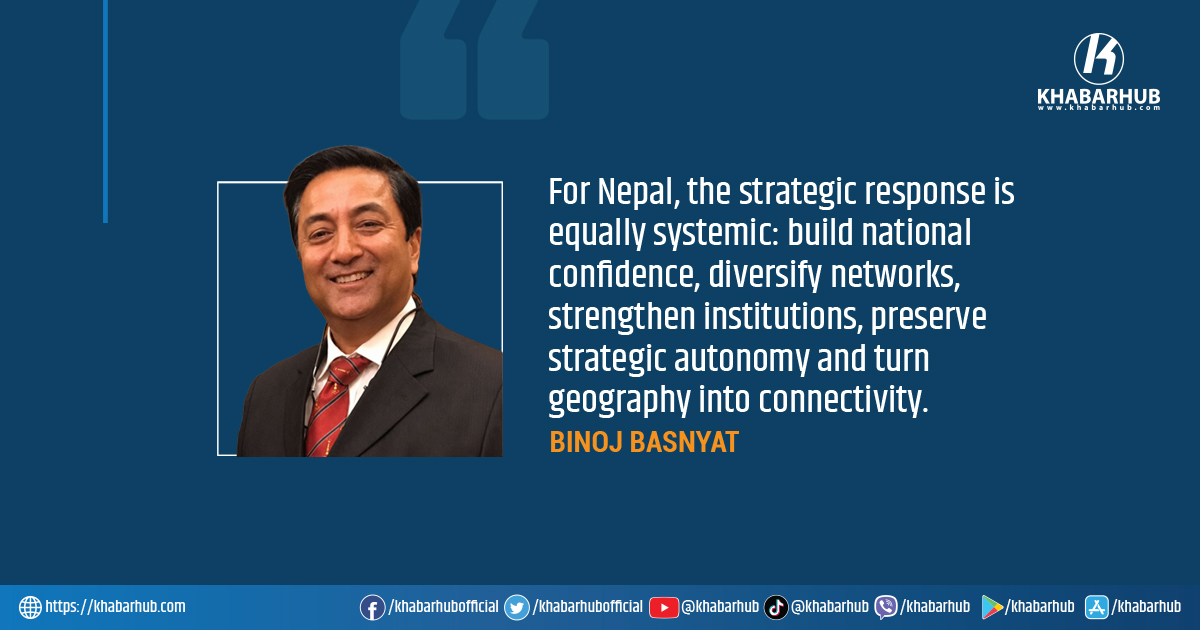
For Nepal, the strategic response is equally systemic: build national confidence, diversify networks, strengthen institutions, preserve strategic autonomy and turn geography into connectivity. The future of Nepal’s foreign policy should not be about choosing between competing powers.
It should be about creating enough capability and connectivity that Nepal can choose its partnerships according to its national interest. That is the essence of strategic autonomy. And in an increasingly networked world, that may be Nepal’s most important strategic asset.
(Basnyat is a Maj. Gen. (Retd.) of the Nepali Army, an independent strategic affairs analyst examining international relations, geopolitics, national security, regional power dynamics, statecraft and geopolitical change.)






Comment