




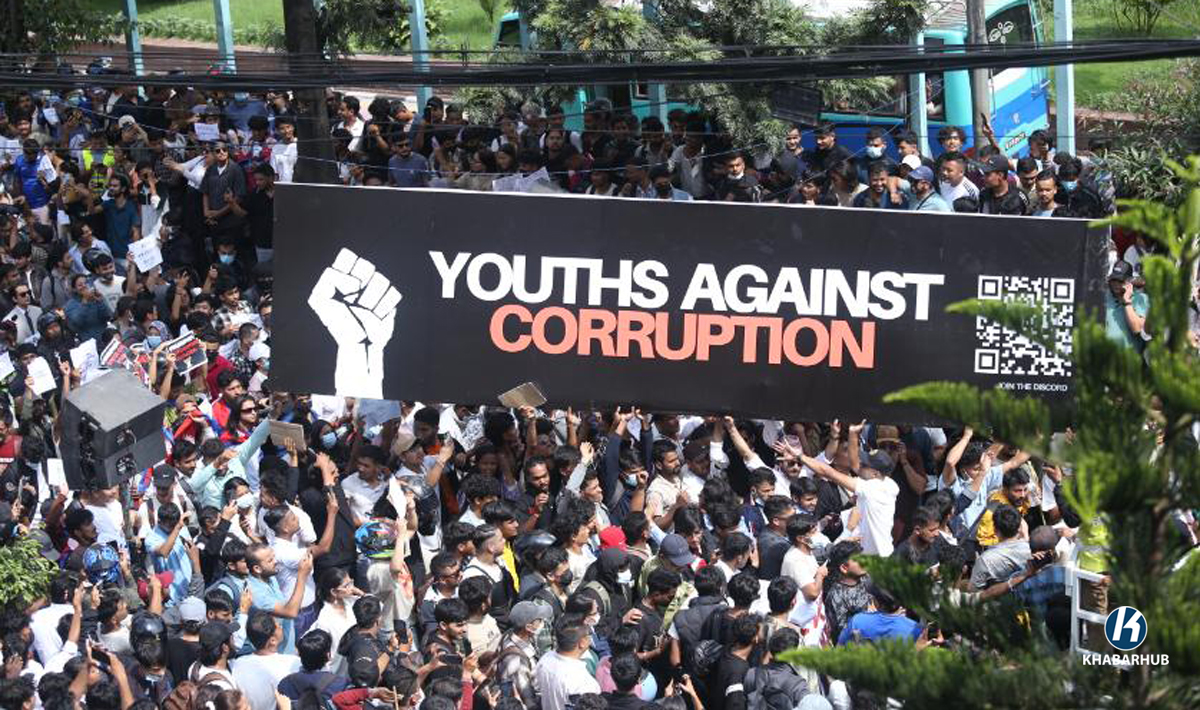
KATHMANDU: During the Gen-Z protests on September 8and 9, 2025, more than 500 phone calls were made among senior officials of the Nepal Police, Armed Police Force, Nepal Army, Ministry of Home Affairs, Prime Minister’s Office, and National Investigation Department, according to the 898-page report of the high-level commission led by former Justice Gauri Bahadur Karki.
The commission has recommended disciplinary action against then-Prime Minister KP Sharma Oli and other senior security officials, highlighting that a central command was actively directing measures to control the protests.
According to the report’s Chapter 12.6, CDR analysis shows dense communication among DIG Bishwa Adhikari, DIG Om Rana, former IGP Chandra Kuber Khapung, Armed Police IGP Raju Aryal, NID Chief Hutaraj Thapa, Home Secretary Gokarna Mani Duwaadi, former Home Minister Ramesh Lekhak, and Kathmandu CDO Chhabi Rijal. The network also included the PAs of the Prime Minister and Home Minister, Army Major Ganesh Khadka, and Army Chief Ashok Sigdel.
DIG Bishwa Adhikari alone made over 100 calls during the protests from two mobile numbers. He contacted Home Minister Lekhak’s PA Janak Bhatt four times, CDO Rijal five times, Army Major Khadka 23 times, DIG Om Rana 53 times, former IGP Khapung 42 times, AIGP Siddhi Bikram Shah 30 times, IGP Dan Bahadur Karki 14 times, and the Prime Minister’s PA Rajesh Bajracharya once.
DIG Om Rana’s hotline shows 53 calls to Bishwa Adhikari, in addition to 11 calls to former IGP Khapung, 39 to AIG Shah, and 22 to IGP Karki. Coordination was also observed with NID Chief Thapa, Home Ministry spokespersons, and Metro Control.
Former IGP Khapung’s numbers connected him with multiple top officials: four calls to AIG Karki, three to Chief Secretary Eknarayan Aryal, 42 to DIGP Adhikari, 28 to AIGP Shah, 11 to DIGP Rana, eight to former Home Minister Lekhak, two to Army Chief Sigdel, and nine to Home Secretary Duwaadi. He also contacted Home Minister Lekhak’s PA three times and the Prime Minister’s PA once, indicating political leadership’s direct involvement.
Armed Police IGP Raju Aryal maintained 11 calls to former Home Minister Lekhak, six to Sudan Gurung, four to Home Secretary Duwaadi, four to Janak Bhatta, four to NID Chief Thapa, and two to the Army Chief. NID Chief Thapa’s numbers connected him to former IGP Khapung, DIGP Rana, and IGP Aryal multiple times. Home Secretary Duwaadi also maintained repeated contacts with the Prime Minister’s PA, Army Chief, Chief Secretary, and former Home Minister Lekhak.
Former Home Minister Lekhak’s two numbers reached Armed Police IGP Aryal, former IGP Khapung, CDO Rijal, and both of the Prime Minister’s PAs. CDO Rijal’s calls connected him to DIGP Adhikari, the Chief Secretary, Home Secretary Duwaadi, and AIGP Shah multiple times.
The commission concluded that the sheer volume and timing of these calls indicate that central-level directives were issued to manage the protests. Using this coordination as a basis, the commission recommended disciplinary action against then-Prime Minister KP Sharma Oli, Home Minister Ramesh Lekhak, the Chief Secretary, senior officials at the Police Headquarters, and the Army Chief.
The report underscores that this “phone chain” was directly responsible for the violence, shootings, and casualties during the protests. The frequent exchanges between DIGP Adhikari and DIGP Rana, Khapung’s multi-party communication, and former Home Minister Lekhak’s direct involvement suggest close collusion between political leadership and security agencies.
Following the report’s release, reactions came from both ruling and opposition parties. Families of the injured and deceased Gen-Z protesters demanded swift accountability. Analysts noted that the CDR trail provides an unprecedented transparency in Nepal’s history, revealing detailed communication among top security officials during a national investigation. The commission report, alongside the raw CDR data, shows that those responsible for the violent suppression of Gen-Z protesters on the streets of Kathmandu on September 8 and 9 were not the people on the ground but the decision-makers at Baluwatar and Singha Durbar.



Comment