




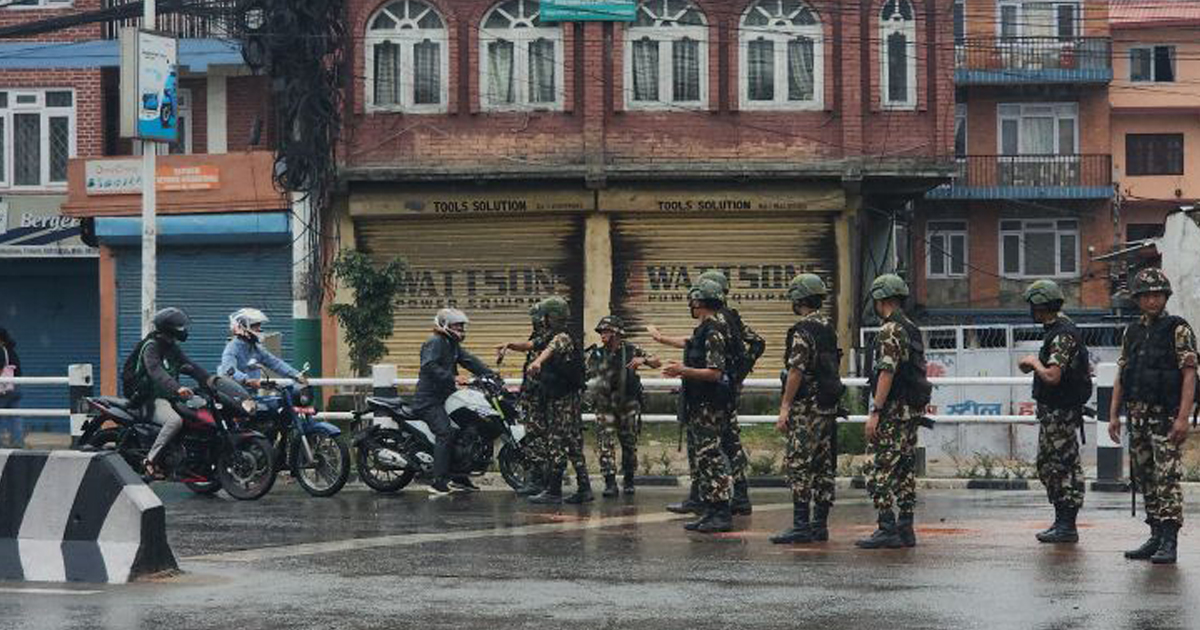
KATHMANDU: A probe commission formed following the Gen-Z protests on September 8 and 9, 2025, has concluded that the role of the Nepali Army was ineffective in controlling the situation.
According to the report prepared by a commission led by former justice Gauri Bahadur Karki, a lack of coordination among security agencies and delays in decision-making led to significant damage.
The report states that, as per constitutional provisions, the army can only be mobilized following a recommendation from the National Security Council and a decision by the Cabinet. However, it noted that necessary decisions were not taken in time despite the seriousness of the situation, allowing it to spiral out of control.
The protests, which began at Maitighar Mandala on September 8, turned violent as they reached Baneshwor, with attempts made to attack the Parliament premises.
Despite police using tear gas, water cannons, and firing in the air, the crowd could not be controlled, forcing the use of live bullets, the report said. Following the escalation, Kathmandu Chief District Officer Chhabilal Rijal imposed a curfew.
The report mentions that the army was deployed only in a limited capacity after the situation around Parliament worsened, and initially returned after arriving in trucks. It was only later in the evening that the army was redeployed to the Parliament area under police escort.
On the second day, September 9, although curfew remained in place, the army was not effectively mobilized, the report found. Incidents of arson, looting, and vandalism were reported across the country, with even sensitive areas such as Singha Durbar and the Presidential residence suffering damage, while the army’s role remained largely inactive.
The commission also pointed out that despite provisions in the National Security Policy 2016 assigning the army responsibility for protecting key and sensitive areas, this was not effectively implemented.
Highlighting serious coordination gaps among security agencies, the report stated that the lack of clear division of responsibilities and cooperation among Nepal Police, Armed Police Force, and the army resulted in heavy losses for both the state and the public.
It also identified the National Security Council’s decision not to declare a state of emergency on the evening of September 8 as a major weakness. The report noted that failure to impose emergency measures and mobilize the army in time led to further damage on the following day.
The commission further pointed out weaknesses in curfew implementation, stating that curfew should have been continuously enforced from the morning as per the army’s recommendation. Instead, intermittent lifting of restrictions allowed protesters to regroup, worsening the situation.
The report has recommended amendments to existing laws to clarify provisions related to army mobilization, citing ambiguities in the current legal framework.
It also stressed the need for regular audits of the security system, stronger protection of sensitive areas, and periodic parliamentary discussions on National Security Council reports.
Concluding, the commission stated that delays in coordination and decision-making, along with the army’s failure to provide expected support, resulted in significant loss of life and property.




Comment