




Abhishek Pratap Shah, deputy leader of the Nepali Congress Parliamentary Party, raised the issues of Lipulekh and Limpiyadhura in Parliament on May 14. He questioned the current RSP government, asking, “Why hasn’t Nepal taken the initiative to find a solution, even though the Indian side is ready for solution-oriented talks?”
Shah also added, “Nationalism should be practiced, not just demonstrated on social media.” MP Shah made this statement in light of recent developments involving India and China.
In response to the Indian Ministry of External Affairs’ agreement with China on April 30 to use Lipulekh as a checkpoint for cross-border trade and the Kailash Mansarovar pilgrimage, Nepal’s Ministry of Foreign Affairs sent a formal diplomatic note to both countries on May 3. This is not the first time India and China have agreed to resume cross-border trade and the Kailash Mansarovar pilgrimage through Lipulekh.
In fact, the status of this territory has long been debated — during the Nepal-Anglo War, the period when China annexed Tibet, and the Sino-Indian War of 1962. In this article, the writer does not intend to suggest that the Government of Nepal should back down from its position.
So far, Nepal has not been able to hold meaningful diplomatic negotiations with India on the matter. It also appears that China has largely accepted Indian control over the Lipulekh Pass.
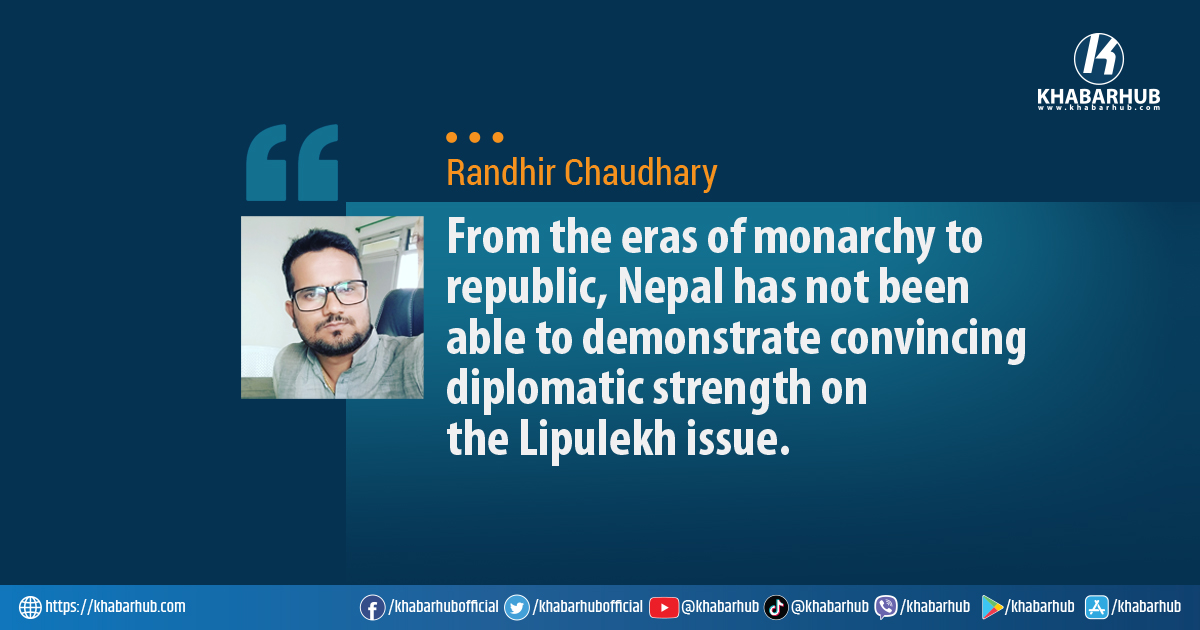
However, from the eras of monarchy to republic, Nepal has not been able to demonstrate convincing diplomatic strength on the Lipulekh issue. Nepal’s claim has not been effectively sustained despite amending its Constitution to include Limpiyadhura, Lipulekh, and Kalapani in the national map and coat of arms, which created only a temporary wave of nationalism within the country.
Both of Nepal’s giant neighbors have their own history of agreements related to the Lipulekh Pass. India and China reached an agreement on trade through the Lipulekh Pass in 2015 during Indian Prime Minister Narendra Modi’s visit to China.
Looking further back, the China-India Agreement on Trade and Intercourse with the Tibet Region (1954) stated that traders and pilgrims from both countries could travel through passes including Shipki La and Lipulekh. Relations between the two nations deteriorated after the Sino-Indian War of 1962, and there was no communication regarding the Lipulekh region for years.
Eventually, the two countries decided to restore border trade and signed a new agreement during Rajiv Gandhi’s visit to Beijing in 1988. They signed a memorandum to restart border trade in 1991 during Chinese Prime Minister Li Peng’s visit to New Delhi. Additionally, in July 1992, China and India signed a protocol on entry and exit procedures for border trade to improve commerce through mutually approved routes. Lipulekh was recognized as a mutually agreed border trading point in both agreements.
Similarly, in 2005, Chinese Premier Wen Jiabao and Indian Prime Minister Manmohan Singh signed an agreement in which both sides agreed in principle to expand border meeting points to include Kibithu-Damai in the eastern region and Lipulekh Pass in the central region. This chronology clearly shows a long and legitimate history of trade activities between China and India through the Lipulekh Pass.
On Nepal’s side, there is no significant record of diplomatic exchanges between the Shah kings and India or China regarding Nepal’s claims over this territory. In 1998, journalist Sudheer Sharma asked Rishikesh Shah in the weekly publication Buddhabar, “Why was the Indian Army’s presence in Kalapani so grossly overlooked?”
Shah replied, “At that time, King Mahendra was in power. Yes, I was a council minister, but not the foreign minister. When I raised the issue with the King, he told me it was none of my concern or my ministry’s business, so I should remain silent.” King Mahendra ignored the issue throughout his reign.
His 1960 coup against B.P. Koirala’s democratically elected government showed that he was ultimately more concerned with preserving the monarchy and the Shah dynasty’s absolute rule. The same was true of King Birendra, who also prevented ministers from discussing the matter during his reign of absolute power (Sam Cowan: p. 19). Similarly, Gyanendra Shah was ruling Nepal under absolute monarchy in 2005 when Manmohan Singh and Wen Jiabao agreed on the use of Lipulekh Pass.
Interestingly, neither Gyanendra nor any of his ministers publicly objected to the agreement. Likewise, China would not have signed such arrangements with India if it had considered Lipulekh to be Nepali territory.
Nevertheless, the Lipulekh issue has periodically influenced Nepal’s internal politics. In 2020, when the KP Oli-led Nepal Communist Party government released a new political map — commonly known as the “Chuche Map” — all members of Parliament voted in favor of it.
The speed with which the Constitution was amended and the map incorporated suggested that the Oli government possessed sufficient evidence to support Nepal’s claim. However, the government later had to form an expert team to gather proof for its position.
As MP Abhishek Pratap Shah rightly stated, the issues of Kalapani, Limpiyadhura, and Lipulekh should not be reduced to social media content. In other words, Nepal should move forward only with careful and skillful diplomatic preparation.
Today, the question of whether Nepal truly has adequate evidence to substantiate its claim is no longer openly discussed. Even after the map was included in the Constitution, KP Oli again became Prime Minister, yet he failed to bring any decisive breakthrough on the Lipulekh issue. Whether due to Nepal’s weak diplomatic preparation or other reasons, the issue has continued to become increasingly complicated for successive governments.
So far, Nepal has not been able to hold meaningful diplomatic negotiations with India on the matter. It also appears that China has largely accepted Indian control over the Lipulekh Pass.
Around twenty-five Asian countries currently face territorial disputes with their neighbors. Many countries, however, have successfully resolved such disputes over the past decade. In the context of Nepal and India, the Nepal-India Boundary Joint Technical Committee was established in 1981 to complete boundary demarcation between the two countries. Over the past two decades, the committee has completed 182 strip maps, with 98 percent of the demarcation work successfully concluded.
Balendra Shah, who is currently leading the RSP government, may have had his own reasons for displaying a map of Greater Nepal in his office while serving as Mayor of Kathmandu. But today, Balendra is sitting in the Prime Minister’s chair.
As MP Abhishek Pratap Shah rightly stated, the issues of Kalapani, Limpiyadhura, and Lipulekh should not be reduced to social media content. In other words, Nepal should move forward only with careful and skillful diplomatic preparation.
(The opinions expressed herein are the author’s own and do not necessarily represent the editorial position of Khabarhub)




Comment