



Cynthia Enloe argues in Bananas, Beaches and Bases that the real question is not whether women are present in global politics, but why we have not been trained to see them. Her question, “Where are the women?” is not about absence. It is about invisibility.
Women were never missing; the system simply learned not to count what they were doing. To understand where women stand in global diplomacy today, we have to look at how the system was built. The modern international order, often traced to the Peace of Westphalia, defined sovereignty and state authority in ways that excluded women from the start.
These ideas were never neutral. States drew legitimacy from domestic systems where women had no political or economic rights. They could not vote. In many places, they could not own property or hold office. So the rules of global politics were written before women were allowed to participate in them.
The exclusion carried into the 20th century. When the League of Nations was created after World War I, women still had little to no political representation in most countries. At the same time, suffrage movements were growing across Europe, North America, and parts of the Global South.
These movements were not just asking for rights; they were questioning who gets to represent a nation in the first place. Even the academic field of International Relations reinforced this exclusion. Traditional theories like realism defined global politics as a competition for power between rational states. Gender did not appear in that framework.
The state was treated as neutral, but the thinking behind it was not. It reflected ideas of control, dominance, and security that aligned with masculine norms.
Nepal reflects both progress and limitation. The political system has changed significantly since 2008. The Constitution of 2015 requires at least 33 percent representation of women in state structures. This has increased numbers in parliament and local government.
As J. Ann Tickner argues, security cannot just mean protecting borders; it has to include people and their lived realities. Once you see that, the old definition of diplomacy starts to look incomplete.
Women’s Presence Was Ignored, Not Absent
Women have always been part of international politics. The system simply refused to recognize their role as political. Early transnational movements make this clear.
The International Council of Women and the Women’s International League for Peace and Freedom worked across borders to influence peace and policy long before women entered formal diplomatic spaces. They built networks, shared strategies, and pushed governments, even when those governments refused to listen.
The Hague Congress of 1915 is a strong example. More than 1,000 women from 12 countries gathered during World War I to propose mediation and negotiated peace. Governments dismissed them at the time. Today, those same ideas sit at the center of United Nations peacebuilding efforts.
The ideas were not unrealistic; they were simply coming from the “wrong” people. Women were also deeply connected to global economic systems. By the early 20th century, they made up a large share of the textile and garment workforce, linking them directly to global trade.
Still, these roles were not seen as part of international politics. If it did not look like diplomacy, it was not treated as diplomacy. What women did, often without recognition, was expand what counts as politics. They brought in issues like education, welfare, and human security. These are now central to global development agendas, but for a long time they were dismissed as secondary. That dismissal says more about the system than it does about the issues.
Representation Alone Does Not Change Power
Getting more women into diplomacy matters, but it does not automatically change how the system works. Sometimes representation simply teaches women how to behave like the system they entered.
As of 2024, women hold about 26 percent of parliamentary seats worldwide. That is progress, but it does not mean equal influence. Women remain underrepresented in areas that define hard power, especially defense and security.
Institutions reward certain behaviors. Assertiveness, competition, and strategic dominance are still seen as signs of leadership. So people adapt. The system does not just include women; it trains them. Not all women in power challenge existing structures. Some learn to operate within them; some benefit from them. Still, patterns are hard to ignore.
Data from UN Women shows that countries with higher female representation tend to invest more in social services and show stronger support for multilateral agreements. This does not prove direct causation, but it does suggest that different experiences shape different priorities.
Feminist foreign policy tries to push this further. Countries like Sweden, Canada, France, and Mexico have started applying gender analysis to foreign policy decisions. The results are uneven, and sometimes disappointing, but the shift in conversation is real. As Jacqui True argues, gender inequality is not a side issue; it is built into the system itself. Adding women into that system without changing its structure will only go so far.
Global South Perspectives and Structural Barriers
Most discussions about women in diplomacy still focus on Western experiences. That leaves out a large part of the story. In many parts of the Global South, women face structural barriers that go beyond representation.
Limited access to education, lower economic participation, and restricted political networks shape who gets to enter diplomacy. UNESCO estimates that women make up nearly two-thirds of the world’s illiterate population. That alone affects who can participate in political life.
At the same time, women in these regions are shaping global debates in very real ways. Grassroots movements have pushed issues like climate change, labor exploitation, and indigenous rights onto international agendas. Women-led environmental movements in South Asia and Latin America have influenced climate negotiations by promoting community-based approaches.
That perspective matters, especially now. A diplomacy that focuses on people, trust, and long-term survival is not weak; it is necessary. Women are already in the room. The real question is whether the room is willing to change, or whether it will simply reshape them instead.
Intersectionality helps explain why these experiences differ. Not all women face exclusion in the same way. Class, ethnicity, and geography matter. A single solution focused only on numbers will not fix deeper inequalities. Women have also practiced diplomacy outside formal institutions.
When official spaces excluded them, they built alternative networks. These included peacebuilding efforts, educational exchanges, and civil society movements. This form of engagement, often called track two diplomacy, has played a real role in conflict resolution. During the Cold War, informal channels sometimes kept communication alive when official diplomacy broke down.
Nepal and the Question of Influence
Nepal reflects both progress and limitation. The political system has changed significantly since 2008. The Constitution of 2015 requires at least 33 percent representation of women in state structures. This has increased numbers in parliament and local government.
But numbers alone do not guarantee influence. Women still face barriers in leadership roles, especially in foreign policy and diplomacy, where established networks continue to dominate. At the same time, Nepal offers a different way of understanding diplomacy.
In many communities, negotiation does not happen in formal rooms or official meetings; it happens in local gatherings, in conversations that stretch over days, where relationships matter more than authority.
Women have long been part of these processes. They mediate disputes, manage resources, and maintain social balance. These are diplomatic skills, even if they are not labeled that way.
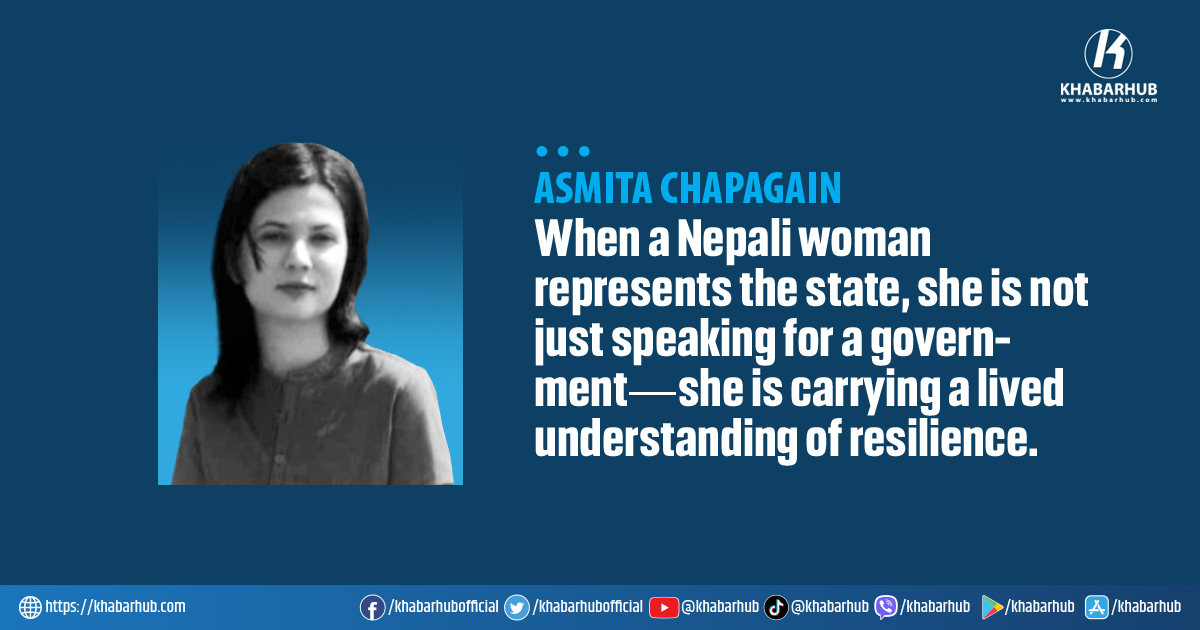
There is also a different mindset at play. Nepali diplomacy often reflects survival rather than dominance. Geography forces it; history reinforces it. When a Nepali woman represents the state, she is not just speaking for a government—she is carrying a lived understanding of resilience.
That perspective matters, especially now. A diplomacy that focuses on people, trust, and long-term survival is not weak; it is necessary. Women are already in the room. The real question is whether the room is willing to change, or whether it will simply reshape them instead.
(Source: This article is based on publicly available sources and established academic literature.)





Comment