




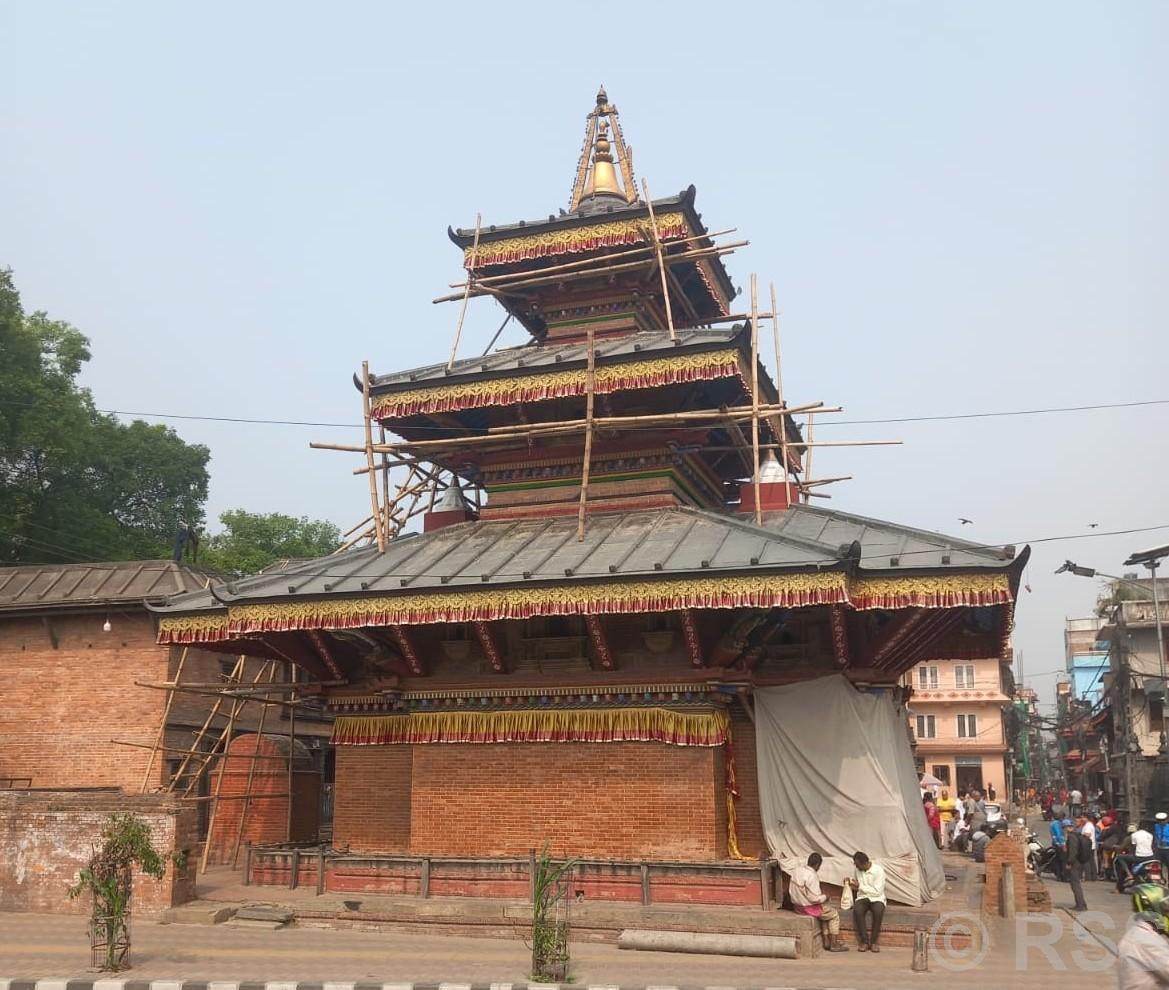
KATHMANDU: Restoration work is underway to revive the outer structure of the Jayabageshwori Temple in the Pashupati area, with completion expected by May 1. As part of the renovation, new clay idols of Goddess Jayabageshwori, along with Lord Ganesh and Bhairav, are being prepared.
According to Anita Bhatta, Information Officer at the Pashupati Area Development Trust, the temple’s structure is traditionally renewed every 12 years. She said the current restoration work is expected to be completed within two weeks.
The temple houses the idol of Adi or Nar-Mukha Vinayaka, representing the original human-faced form of Lord Ganesh before the elephant head replacement by Lord Shiva. Notably, the Ganesh idol here does not feature an elephant head.
Historical records suggest that construction of the temple began in 3232 Kaligat Sambat and was completed 47 years later in 3274. The structure was damaged in the 1990 BS earthquake and later renovated, and it was again severely affected by the 2015 Nepal earthquake before being restored.
In Hindu tradition, Jayabageshwori is worshipped as a goddess of knowledge and is considered a combined form of Saraswati, Kali, and Laxmi. She is also revered in Tantric practice as a deity representing the culmination of spiritual attainment.
The nearby Sundhara (golden spout), once an important water structure, is now in a state of neglect. The Taleju Bhawani Temple stands in close proximity to the site.
Locals describe the Jayabageshwori area as one of the oldest settlements in the Kathmandu Valley. According to resident Sandesh Manandhar, it is believed to have once included nine castes, nine ponds, nine resting places, and nine gates. The site is also said to have served as a capital during the Gopal and Kirat periods, before shifting to Handigaun in the Lichchhavi era and later to Hanuman Dhoka during the Malla period.





Comment