




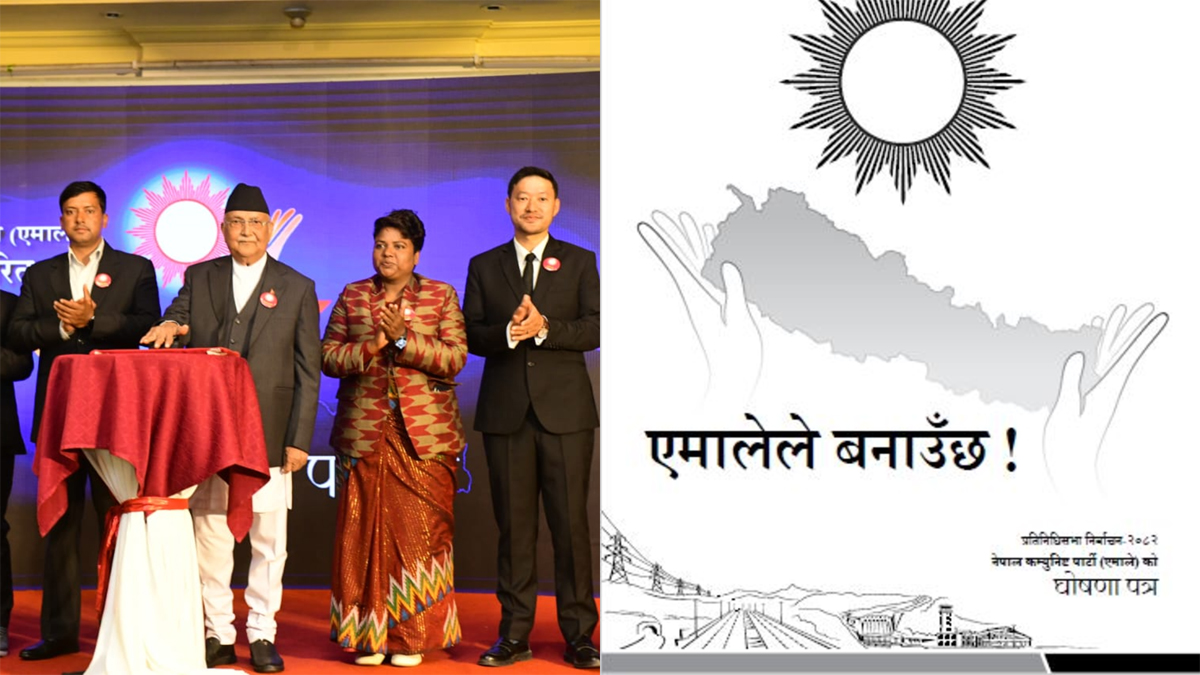
KATHMANDU: The UML has unveiled its election manifesto for the March 5 polls, placing strong emphasis on economic transformation, employment generation and industrial expansion.
The manifesto was made public by party Chair KP Sharma Oli at a program held in Kathmandu on Thursday.
Describing the upcoming election as a decisive moment for the country’s future, the UML has outlined an ambitious roadmap aimed at turning Nepal into a high-growth economy within the next decade.
Target of Rs 20 trillion economy in a decade
Under its prosperity pillar, the UML has set a target of expanding Nepal’s economy to Rs 10 trillion within five years and Rs 20 trillion within 10 years by maintaining an annual economic growth rate of 7–9 percent.
The party has pledged to drive rapid progress in agriculture, energy, industry and information technology. It has also set a goal to raise per capita income to 3,000 US dollars and eliminate extreme poverty through increased investment in productive sectors.
500,000 jobs annually
Under its “dignified labor” pillar, the UML has pledged to create 500,000 jobs annually within the country to reduce the compulsion of foreign employment.
Employment opportunities will be expanded in agriculture, green industries, IT and infrastructure projects. The party has also committed to enhancing youth skills and entrepreneurship, boosting private sector confidence and creating an investment-friendly environment.
Housing for vulnerable communities
The UML has promised safe and dignified housing for landless people, squatters and marginalized communities with access to basic services.
It has proposed a “Citizen Housing” program for disaster victims and senior citizens, along with concessional loans and land on lease. The manifesto also mentions the establishment of a “Citizen Housing Fund” to encourage private sector participation.
Dynamic villages, modern cities
The party has pledged to develop villages as production hubs and cities as centers of capital and services, claiming this model would usher in a new wave of economic growth.
It has committed to transforming sub-metropolitan cities into “mega cities” and developing corridor cities. The manifesto also envisions strengthening rural-urban partnerships to build a self-reliant economy and develop value chains for domestic production.
Industry to contribute 20 percent to GDP
The UML aims to double the industrial sector’s contribution to reach 20 percent of the Gross Domestic Product (GDP).
Plans include expanding manufacturing industries, mining and construction sectors, guaranteeing industrial security and developing an “industrial ecosystem” to foster investment.
The manifesto also outlines plans to begin commercial production of gas in Dailekh and iron from the Dhaubadi mine in Nawalparasi.
Tripling exports in five years
The UML has pledged to reduce imports and boost exports to bring the balance of payments in Nepal’s favor.
It has set a target to double exports within three years and triple them within five years, with a focus on agricultural products, electricity and information technology services. The party has also committed to utilizing ports in India and China to expand international trade and position Nepal as a “land-linked exporter.”
Modernizing agriculture
The manifesto emphasizes transforming agriculture from a traditional occupation into a modern enterprise to ensure adequate income and employment within the sector.
The UML has proposed concessional loans, insurance schemes and a land bank system. It has also pledged to deploy agricultural technicians to farms and establish agro-processing zones to strengthen agricultural value chains.
The party maintains that the proposed economic roadmap, coupled with political stability and disciplined governance, will lay the foundation for sustained national prosperity.



Comment