




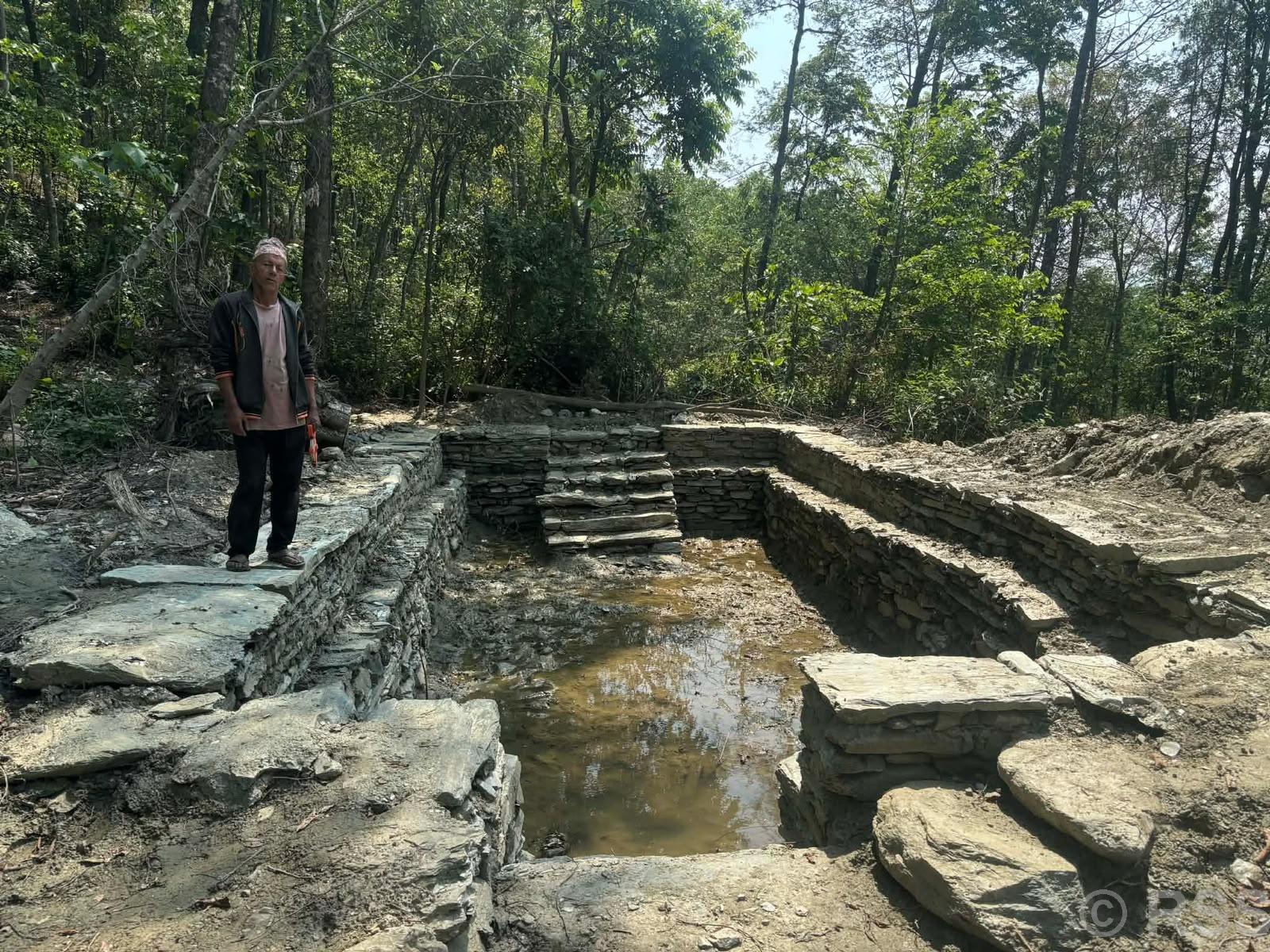
MYAGDI: Six recharge ponds have been constructed in community forests across Myagdi district this year to help conserve water sources in the region’s high hills and strengthen forest and wildlife management.
The ponds were built by community forest user groups with financial and technical support from the Divisional Forest Office, Myagdi.
According to Divisional Forest Officer Basanta Keshav Adhikari, the recharge ponds are expected to help replenish groundwater, provide water for wildlife, reduce human-wildlife conflict, and support firefighting efforts during the dry season.
Forest Officer Shanti Kumari Shahi said the ponds will discourage wild animals from entering nearby settlements in search of water and food by ensuring adequate water availability within forest habitats. She added that the ponds also help retain soil moisture and serve as an important water source for controlling forest fires.
The Divisional Forest Office has been implementing the recharge pond program continuously for the past four years. Officials say the initiative has already contributed to reducing human-wildlife conflict by improving water availability inside forests.
This year’s ponds were constructed at Simpakho in Beni Municipality-5, Dahapatal in Dhaulagiri Rural Municipality-3, Baranja Bhotekhola in Mangala Rural Municipality-3, Thadakhani-Kalo Salleri in Raghuganga Rural Municipality-6, Sano Dhaireni in Malika Rural Municipality-6, and Dana in Annapurna Rural Municipality-3.
Each pond has a storage capacity of approximately 61,000 litres of water and was built with a grant of Rs 100,000 provided to each community forest user group.
Since fiscal year 2021/22 (2078/79 BS), the Divisional Forest Office has constructed a total of 31 recharge ponds in Myagdi’s community forests.
With natural water sources gradually drying up across the district, officials believe the recharge ponds will help improve water security, protect forest ecosystems, and provide a reliable water source for wildlife. The initiative is also expected to reduce crop damage caused by animals such as deer, monkeys, and leopards, which have increasingly ventured into farming areas in recent years.






Comment