




We concur with Melendez (2021) on the contemporary threats to democracy. Rather than a sudden regime collapse, he identifies the main issue as democratic backsliding—the gradual erosion of vital institutions and norms. This decline is driven by growing support for political groups with illiberal tendencies.
Populism, in particular, has fueled misinformation and reinforced false political beliefs, widening the gap between voter expectations and politicians’ responses. While some view populist parties as a threat to liberal democracy, Held (1996) suggests in ‘Models of Democracy’ that participatory democracy would require a significant restructuring of liberal states to address deep inequalities that concentrate power among elites and marginalize others.
This creates a paradox: although populist parties may challenge liberal norms, many agree they can also enhance democracy by boosting citizen participation. Although this idea is debated and examined empirically, growing research examines how voters hold corrupt politicians accountable, especially those from dominant parties that have shaped political and national history.
The decline of traditional parties and the rise of the Rastriya Swatantra Party (RSP) in Nepal offer valuable insights into the evolving landscape of democracy today.
A core insight of the democratic literature, Hobbes’s opposition to democracy is ultimately significant in structuring key elements of his political philosophy, especially the monarchical sovereign forms. Advancing literature on democracy offers a fresh and comparative assessment of human rights.
Ordinary citizens—especially the poorest social groups and those in rural, deprived areas—often feel disconnected from government processes. Again, partisan disputes are ubiquitous in democracies, but as Machiavelli reminds us, contested authority can serve rhetorical functions, shaping how legitimacy is perceived and defended.
Yet significant variation exists in the degree to which different countries endorse different rights that had to overcome disagreement concerning necessary institutional reforms. Most scholars have described political leadership as playing a key role in maintaining democratic life.
In addition, Tocqueville’s political thought has inspired more in light of feudal democracy, such as heritability, membership, privilege, and exclusion, providing the foundation for an implicit account of a wide range of theories. Much of the confusion and debate surrounding the rational basis of democracy stems from the fact that the liberal democratic order is understood as the ruler’s rationality being extended to the ruled.
When an actor discovers a state engaging in objectionable covert actions, it inevitably faces a diplomatic dilemma. Such situations are often compounded by broader crises of human deprivation, raising the question of how individuals can maintain hope in the face of overwhelming suffering.
Addressing these complex challenges requires unpacking the concept of legitimacy to understand its multidimensional nature among various stakeholders. Furthermore, while proponents of deliberative democracy argue that such discourse fosters reflective political reasoning, tackling profound despair also requires exceptional moral leadership—figures like Jimmy Carter and the Aga Khan, who dedicate themselves to helping others rediscover purpose and renewed hope.
Historically, scholars and policymakers doubted Nepal’s capacity to sustain liberalism. Yet, efforts to accelerate democratic institutions and collective action inherently generate political pluralism. This diversity produces complex disagreements regarding the state’s legitimacy—disagreements fueled not only by injustice, but also by the complex causal relationship between economic development and democracy.
Today, Nepal’s political system is in upheaval, directly calling national cohesion into question. In this volatile context, a critical question emerges: Can the RSP’s regime foster a fundamentally new form of political participation? Specifically, can it achieve this by promoting order, good governance, and human rights, while simultaneously cultivating democratic orientations like political knowledge, efficacy, and tolerance?
In Nepal’s case, it is crucial to recognize that the domestic political and economic situation, together with rational political actors, not only fosters mutual understanding but also helps create a peaceful environment for coexistence, with significant implications for development. This provides a supportive foundation.
Yet economic growth or prosperity alone has never been sufficient to transform conflict into cooperation, nor are they always necessary to initiate rapprochement. Nepal’s geo-strategic position has historically exposed it to diverse influences, particularly from the south. These dynamics, however, cannot be understood in isolation from their broader context. For Nepal’s new regime, examining these relations is essential to grasp the interplay shaping its varied political and social development paths.
In many countries, constitutional amendments require the direct approval of voters. However, the ramifications of fundamental changes to the powers and operations of the state are often difficult to predict. In their 2021 study, ‘The proposer or the proposal?
In an experimental analysis of constitutional beliefs,’ McElwain, Eshima, and Winkler argue that ordinary citizens find it increasingly challenging to maintain or improve their living standards. Their research indicates that these citizens tend to favor idealistic constitutions that embody national traditions and are more likely to support proposals expanding governmental powers.
In contrast, populists—who advocate for direct democracy—prefer pragmatic constitutions that introduce substantial changes aimed at constraining government authority.
Nepal, currently experiencing rapid political change, faces increasing demands for a fundamental reevaluation of its economic and political strategies. Without careful and nuanced management, the RSP—which has gained electoral support largely due to the historically dominant roles of the Nepali Congress, UML, and Maoist parties—must act thoughtfully, especially by considering how this shift could benefit everyone.
From past regimes, the RSP has learned that illiberalism and authoritarianism pose major threats to democracy. Although existing parties have created many paradoxes within democracy and, at the same time, struggle to clearly define and defend their political and economic positions, this weakness could further harm the chances of a stable and effective government. Significant efforts are needed to improve governance and ensure effective delivery.
In Nepal, each political era has seen incumbents decide how much to rely on patronage versus the civil service. Many citizens assume that a professional civil service is essential for producing public goods, while patronage delivers private benefits and strengthens an incumbent’s re-election prospects. For the Balen regime, the challenge is to demonstrate genuine public responsiveness—ensuring that citizens have access to clear, accurate policy information and that representation safeguards the well-being of the people.
It remains difficult to measure whether power conflicts exist between Rabi Lamichhane and Balen Shah, or whether their ideological positions are compatible with liberal democratic attitudes such as pluralism and elitism. What is clear, however, is that trust in Nepal’s democratic institutions is alarmingly low.
Essentially, the RSP has numerous opportunities and choices to address issues like poverty, corporate scandals, and government misconduct. They can aim to build a socially productive, healthy society or, more broadly, strengthen democratic development.
Ordinary citizens—especially the poorest social groups and those in rural, deprived areas—often feel disconnected from government processes. Again, partisan disputes are ubiquitous in democracies, but as Machiavelli reminds us, contested authority can serve rhetorical functions, shaping how legitimacy is perceived and defended.
Moreover, while Maurice Duverger’s influential laws describe the general impact of electoral rules on party systems, these formulations remain ambiguous and open to contestation. Because electoral structures alone do not dictate outcomes, there is a crucial need for deliberative persuasion rather than political manipulation.
In Nepal, this means leaders like Rabi Lamichhane and Balen Shah must articulate a concrete, coherent, and ambitious program. They must also recognize the interdependence of their political trajectories: without Balen, the RSP’s current electoral strength would have been unattainable, and without the RSP, Balen’s prime ministerial aspirations would remain a distant dream.
The fall of the ‘ODD’ trio—Khadga Prasad Oli, Pushpa Kamal Dahal, and Sher Bahadur Deuba—has brought a wave of cautious optimism, largely centered on the rise of the RSP. For too long, these three treated democracy like a game, taking turns in power to serve themselves and normalizing corruption at every turn. The RSP’s rise suggests voters are finally demanding accountability, though it is still too early to define this new political landscape.
Public skepticism remains pervasive. Many Nepalese doubt that elections alone can dispel the enduring fog of political uncertainty. This cynicism is rooted in a historical cycle of popular movements and crises dating back to 1951. Because tensions have often been deferred rather than resolved, they have produced chronic instability that now threatens the consolidation of Nepal’s federal democratic republic.
Overcoming this requires more than the mechanics of voting—it demands a long-term program of social, economic, and political reforms, justified independently of electoral cycles.
Corruption further complicates the picture. Nepal’s history shows that while voters express a willingness to punish corrupt politicians, they are often lenient when offered jobs or favors in clientelist exchanges. Yet the parliamentary elections of 5 March 2026 marked a turning point, largely preventing corrupt figures from winning office.
This raises a pressing question: can Nepal’s democratic shift move beyond clientelism to follow a genuinely principled political track? The answer will determine whether the current transition consolidates democracy or merely repeats the cycles of instability that have defined Nepal’s past.
When looking more closely at democracy and deliberation, following the overthrow of the oppressive rule by ODD, the key question is whether the new RSP leaders will develop a vision that is just, compassionate, sustainable, and free from violence and hatred.
Obstacles still prevent new political leaders from finding common ground to reform the political process. Until they overcome these hurdles, widespread public disaffection with politicians and institutions will continue to stifle economic and governmental progress.
If he commits himself to the path of civic duty, engages in thoughtful and informed dialogue on current issues, and steers public affairs with transparency, he has the potential to play a significant role in advancing democracy through meaningful and effective public policy.
They must seize every opportunity to make decisions aligned with the people’s hopes, thereby fostering democratic progress. It is well understood that the RSP has been granted a crucial window to implement necessary democratic reforms and form a government of national salvation.
Essentially, the RSP has numerous opportunities and choices to address issues like poverty, corporate scandals, and government misconduct. They can aim to build a socially productive, healthy society or, more broadly, strengthen democratic development.
The RSP regime must build its capacity to credibly move beyond its erratic past, marked by frequent change and substantial concentration of power, to inclusively institutionalize a democratic political culture that creates a political marketplace in Nepal.
It is widely believed that in a representative democracy such as the federal republic, the ordinary person empowers the elite, enabling them to craft a narrative that may, in turn, influence public thinking. The strong ‘blind confidence’ the general public places in Balen can, in itself, serve as a powerful catalyst for socio-economic transformation.
Yet, for this potential to be fully realized, that confidence must first be grounded in tangible outcomes. In other words, its true value will emerge only if Balen delivers a palpable sense of good governance—visible improvements in transparency, accountability, and public service delivery.
Once people experience concrete results, their trust shifts from blind belief to informed, sustained support, creating a virtuous cycle that amplifies the very transformation they seek.
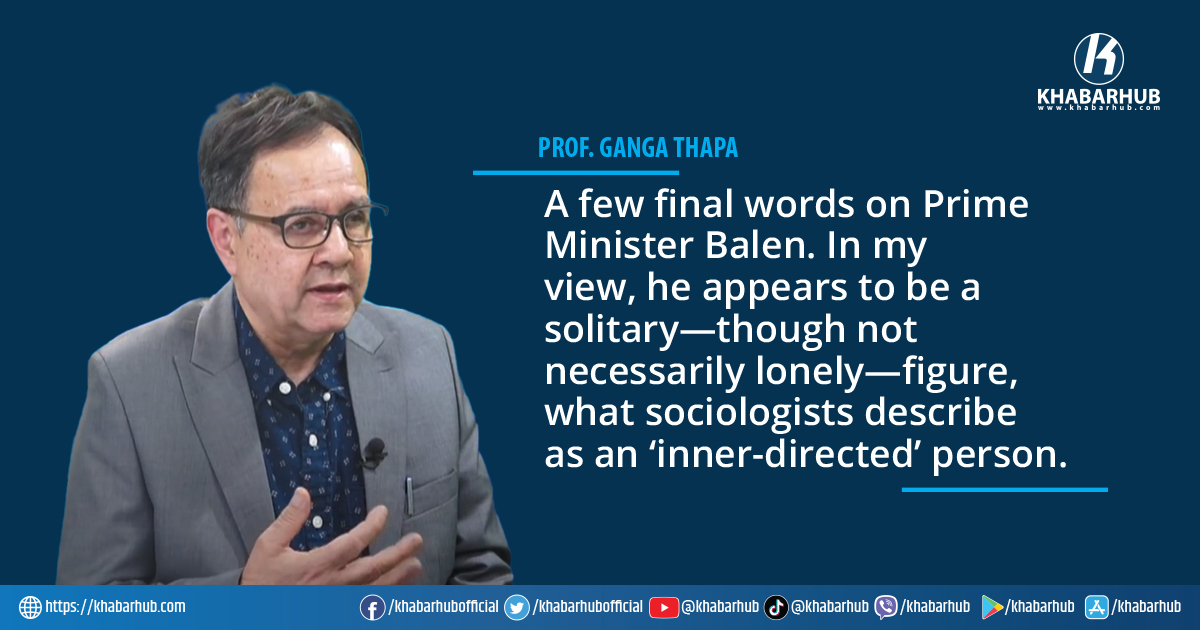
A few final words on Prime Minister Balen. In my view, he appears to be a solitary—though not necessarily lonely—figure, what sociologists describe as an ‘inner-directed’ person.
If he commits himself to the path of civic duty, engages in thoughtful and informed dialogue on current issues, and steers public affairs with transparency, he has the potential to play a significant role in advancing democracy through meaningful and effective public policy.
(Views expressed in this article do not represent Khabarhub’s official stance)





Comment