




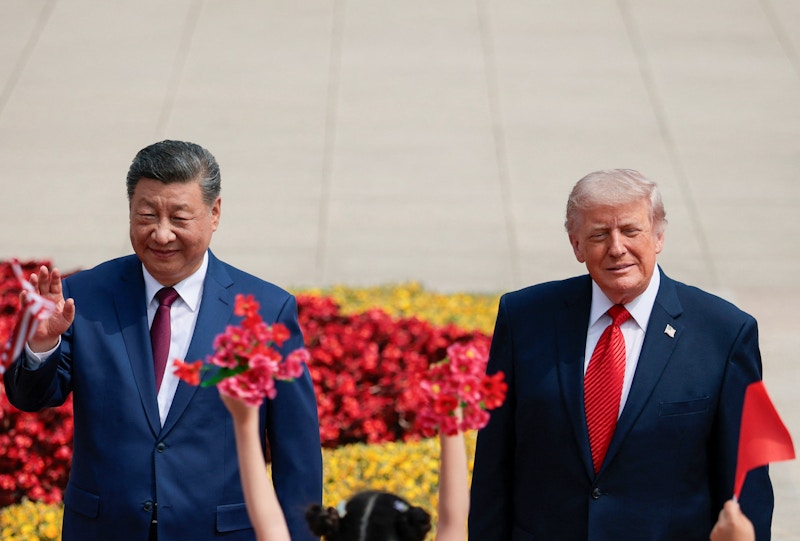
BEIJING: Beijing hosted a highly symbolic day of diplomacy on Thursday, filled with carefully planned ceremonies and political messaging, but the meeting between US President Donald Trump and Chinese President Xi Jinping ended without any major trade deal or significant business agreements.
Trump and Xi held talks for more than two hours, with Trump describing US-China ties as “the world’s most important economic relationship.” The White House later called the discussions “highly productive,” while Trump referred to the summit at the Great Hall of the People as potentially “the biggest summit ever.”
According to China’s foreign ministry, Xi acknowledged that earlier trade negotiations held in South Korea had produced “progress,” BBC reported. However, he also issued a strong warning regarding Taiwan, cautioning that mishandling the issue could push the two countries toward confrontation or conflict.
Focus on technology and trade
The visit placed strong emphasis on symbolism, especially during Trump’s arrival in Beijing. One of the most closely watched moments came when billionaire entrepreneur Elon Musk exited Air Force One ahead of several senior US officials, including Pete Hegseth, Marco Rubio, and US Trade Representative Jamieson Greer.
Musk was accompanied by Nvidia CEO Jensen Huang during the official welcome ceremony, highlighting the growing importance of technology in US-China relations. Both figures represent industries at the center of tensions between the two countries, including electric vehicles, artificial intelligence (AI), and semiconductor technology.
Tesla remains deeply tied to China through its Shanghai Gigafactory and Chinese consumer market, while Nvidia plays a critical role in the global AI race and faces restrictions from US export controls aimed at limiting China’s access to advanced chips.
Huang’s attendance drew particular attention because he was not initially listed as part of the delegation, fueling speculation that discussions around AI and semiconductor access had become more important than previously anticipated.
No major trade breakthrough
Despite the high-profile nature of the visit, neither side announced a comprehensive trade agreement or structural economic deal. Instead, both governments reaffirmed support for the trade truce reached in October, under which the United States paused sharp tariff hikes on Chinese products while China eased restrictions on rare earth exports.
The White House said both leaders agreed to create a new “Board of Trade” to help manage bilateral economic relations without reopening tariff negotiations. However, US officials acknowledged that significant work remains before the mechanism becomes fully operational.
US Treasury Secretary Scott Bessent said he expected announcements involving major Boeing aircraft orders, along with expanded Chinese purchases of American agricultural and energy products.
Market access and economic cooperation
According to the White House, the discussions also covered broader market access for US companies in China and the possibility of increased Chinese investment in American industries.
Beijing signaled plans to buy more US agricultural and energy products, including soybeans, beef, poultry, and liquefied natural gas (LNG), although no detailed commitments were disclosed.
Bessent downplayed expectations of major agricultural breakthroughs, noting that some soybean agreements had already been addressed under previous arrangements. However, he suggested China could still increase imports of US energy products.
During meetings with American business leaders, Xi said China would continue opening its markets further and promised greater opportunities for US companies, according to Chinese state media outlet Xinhua.
Xi also called for stronger cooperation in trade, agriculture, healthcare, tourism, and law enforcement, describing the US-China relationship as mutually beneficial and capable of producing “win-win” outcomes.
Despite the positive diplomatic language, many American firms continue to view China as both an essential market and a challenging business environment due to regulatory hurdles, bureaucratic restrictions, and ongoing geopolitical tensions.
(Inputs from BBC)





Comment