




The election of March 5 was a historic political event in Nepal’s political history. The election and the results it brought have given Nepali voters a red seal on the issue of generational change, which is considered necessary in Nepali politics.
The election, held against the backdrop of the Gen-Z revolt on September 8–9, 2025, has given the Rastriya Swatantra Party (RSP) a mandate to fulfill its promises with a majority of almost two-thirds.
When we recall the political scenes before September 8, the two parties called CPN-UML and the then Maoist Centre were comfortable doing any activity to turn the reins of Nepali politics around them. The political statements of CPN-UML and its chairman, Comrade KP Sharma Oli, were heard in such a way that it was as if Oli were the only one who existed in the Nepali political ecosystem.
Oli’s influence was also instrumental within the old and democratic party, the Nepali Congress. But the same Oli was defeated by former Kathmandu mayor Balendra Sah (Balen) by a large margin.
In Jhapa, which is considered a stronghold of UML and KP, the voters there did not trust Oli this time. In an attempt to position itself as the only defender of communism in Nepal, the UML has suffered a significant defeat in this election due to its propensity to overly favor China and mock other democratic and friendly nations.
In a similar vein, RSP anticipates making exemplary interregional competitiveness concerns, state-directed goals and programs for economic and social growth, and world-class infrastructure creation the cornerstones of collaboration.
The UML chairman, who recognized foreign influence in the Gen-Z uprising more than Nepal’s own domestic and political factors, was not trusted by the majority of people in Jhapa-5. KP Oli’s provoking propaganda, which has earned him a reputation for being sarcastic toward Nepal’s genuine democratic allies, was ineffective in the election. Conversely, it appears that this election has turned out to be a curse for those lobbyists trying to establish powerful communist blocks in Nepal.
Communist countries like China, which have always paid close attention to Nepal’s so-called leftist forces, have been penetrating Chinese narratives through various exercises. As a matter of fact, in order to foster ideological alignment and increase China’s influence in Nepal’s political landscape, the Chinese Embassy in Nepal played a significant role in facilitating the exchange of “Xi ideology” between the Chinese Communist Party (CCP) and the Nepal Communist Party (NCP). In 2019, it organized training for more than 200 NCP leaders.
The Chinese Embassy in Kathmandu was widely seen as directly interfering in Nepal’s politics during the tenure of KP Oli as prime minister and Bidyadevi Bhandari as president, particularly in an attempt to keep the then-ruling NCP united. It is impossible to say that the claims that the UML was tilting into a party focused on China are unfounded.
China dared to disregard Nepal’s sovereignty during Oli’s final term as prime minister, to the point where the Chinese foreign minister interestingly stated at the Shanghai Cooperation Organization Plus Summit in 2025 that Nepal supports China’s Global Security Initiative (GSI), although Nepal’s support for the same was explicitly denied by the concerned delegates accompanying Oli during the visit. Perhaps, based on such polemical postures of China toward Nepal, some geopolitical experts now claim China must be surprised by the current election outcomes.
China has a history of cooperating with political forces other than the communists in Nepal. In the past, whether it was a powerful monarchy or a liberal democratic force like the Nepali Congress, the China-Nepal relationship has shown cooperation in many positive dimensions. It would be in Nepal’s interest to cooperate as much as possible with China, which is rapidly advancing on the path to becoming a global power economically and strategically.
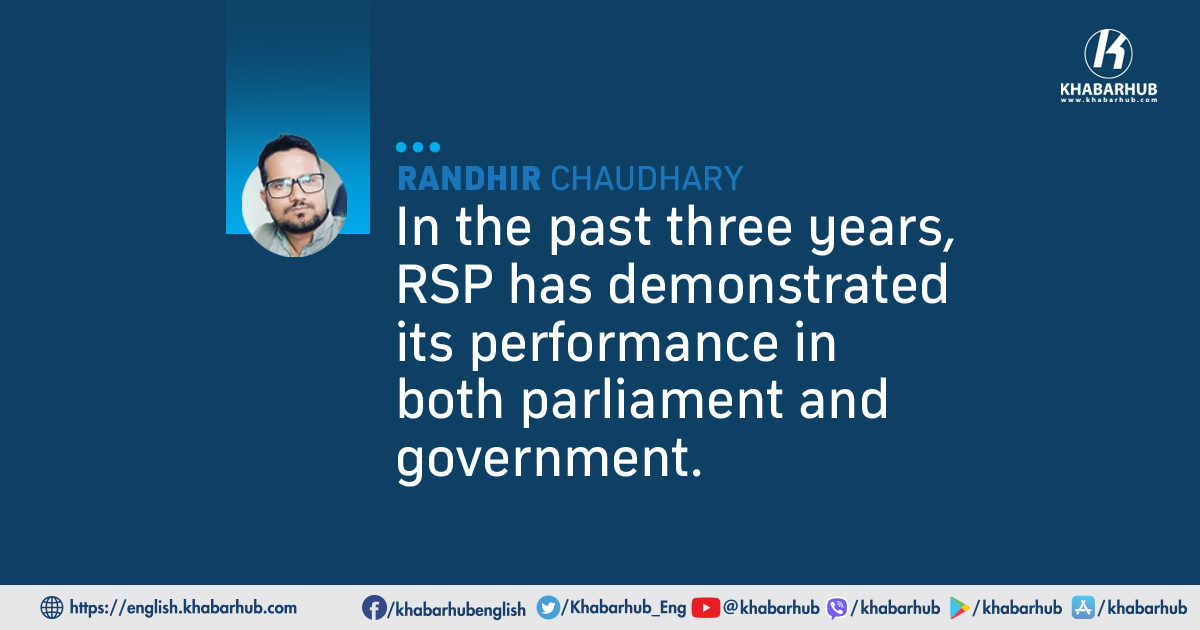
The RSP has emerged as a decisive political force in parliament with a supermajority. RSP itself is not a new party. In the past three years, RSP has demonstrated its performance in both parliament and government. Questions are still being raised about the core political principles of RSP; however, RSP is basically a democratic political force—it is not a radical leftist force.
According to the RSP’s foreign policy commitment list in its election platform, “a balanced and dynamic diplomacy will be adopted to transform the changing global geopolitics and the rise of neighboring powers into an opportunity for Nepal’s development.”
RSP will transition Nepal from a “buffer state to a vibrant bridge” and protect national interests through trilateral economic partnership and connectivity, taking into account the strategic interests of neighboring nations and shifts in the global balance of power.
The new RSP government in the making will first have to deal with the baggage that the UML and other political parties have left Nepal with. While Nepal was in the election process, the Chinese Embassy in Kathmandu issued a statement urging that “China stands ready to work with Nepal to implement the Global Security Initiative (GSI) along with three other initiatives.”
In a similar vein, RSP anticipates making exemplary interregional competitiveness concerns, state-directed goals and programs for economic and social growth, and world-class infrastructure creation the cornerstones of collaboration.
In his book Himal Pariko Huri, writer Sudhir Sharma notes that historically the sea route was the primary means of connection between China and India, with Nepal emerging as the most convenient and expedient land route. Kathmandu had developed as a center of North-South intermediary trade (entrepot). Similar to the RSP, other parties have long said that Nepal, which is sandwiched between two enormous nations, ought to be a ‘vibrant bridge’ of progress rather than a yam between two rocks.
During his reign, King Gyanendra had also declared that Nepal would become a ‘transit point’ between China and India but failed to translate this into reality. However, it appears certain that RSP’s vision of a “vibrant bridge” will be extremely difficult to materialize given China’s expanding strategic objectives over the past few decades.
Although the RSP’s agenda, which emphasizes Nepal’s sovereignty and territorial integrity, seems quite sensible, it is extremely difficult to implement. China’s geopolitical aspirations are growing at this moment. Beijing has already adopted more confrontational measures with the majority of its neighbors in keeping with its pursuit of global dominance.
Xi Jinping, who calls himself a “child of red destiny,” made the highly unusual announcement of the “China Dream” shortly after becoming the center of power in 2012.
The new RSP government in the making will first have to deal with the baggage that the UML and other political parties have left Nepal with. While Nepal was in the election process, the Chinese Embassy in Kathmandu issued a statement urging that “China stands ready to work with Nepal to implement the Global Security Initiative (GSI) along with three other initiatives.”
Last but not least, China has gained expertise working with so-called communist forces to accomplish its strategic objectives for nearly a decade. It will be important to witness how quickly and thoroughly China can integrate into the RSP government-in-waiting and how profoundly the RSP can interact with China’s strategic goals. How easy it will be for the Balen government to carve out a northern lane remains to be seen.






Comment