





KATHMANDU: Economic Digest presents a brief yet comprehensive roundup of major business developments in Nepal, delivered in clear and accessible summaries.
Nepal’s economy reflects a mixed picture of financial caution, weak public investment efficiency and uneven development. While Nepal Rastra Bank continues aggressive liquidity management by absorbing surplus funds through bond issuances, the stock market remains under pressure despite strong trading turnover, signaling persistent investor uncertainty.
Provincial governments continue to struggle with budget execution, returning billions of rupees in unspent development funds that highlight implementation bottlenecks. At the same time, rising construction costs, infrastructure constraints at key transport hubs, and disruptions to hydropower and regional air connectivity underscore structural challenges affecting growth.
Conversely, positive developments in agriculture, clean energy, infrastructure investment and industrial revival point to ongoing efforts to strengthen productive sectors. Overall, the day’s developments suggest that although policy interventions and public spending initiatives are continuing, translating them into stronger investor confidence, efficient project delivery and sustained economic momentum remains Nepal’s key challenge.
Inflation nearly doubles to 5.22 percent
Nepal’s annual inflation rate nearly doubled in the month of Jestha compared to a year ago, even as the country’s external sector strengthened with record remittance inflows, a soaring balance of payments surplus and the highest-ever foreign exchange reserves. According to the Current Macroeconomic and Financial Situation Report released by Nepal Rastra Bank (NRB) on Monday, year-on-year consumer inflation rose to 5.22 percent in Jestha (mid-June), up from 2.72 percent in the same month last year. However, the average inflation rate for the first 11 months of the current fiscal year stood at 2.89 percent, down from 4.24 percent during the corresponding period of the previous fiscal year.
NEPSE falls 30.60 points despite Rs 7 billion turnover
The Nepal Stock Exchange (NEPSE) declined by 30.60 points, or 1.17 percent, on Monday to close at 2,570.18, with all 13 sectoral indices ending lower. The Sensitive Index also dropped 3.04 points to 450.55. Despite the market decline, trading activity remained robust, with 41.73 million shares of 368 companies changing hands in 51,295 transactions worth Rs 7.468 billion. Share prices of 22 companies gained, while 249 declined and four remained unchanged. Samudayik Laghubitta Bittiya Sanstha posted the highest gain of 5.37 percent, whereas Upakar Laghubitta Bittiya Sanstha recorded the largest loss, falling 11.28 percent.
Gold and silver prices decline in domestic market
Prices of both gold and silver fell in Nepal’s domestic market on Monday. According to the Federation of Nepal Gold and Silver Dealers’ Association, gold dropped by Rs 2,800 per tola to Rs 285,200 from Rs 288,000 in the previous trading session. Silver also declined by Rs 100 per tola, falling to Rs 4,375 from Rs 4,475. The latest revision reflects a decline in precious metal prices after recent gains.
NRB issues Rs 15 billion bond to manage excess liquidity
Nepal Rastra Bank has issued bonds worth Rs 15 billion under the “NRB Bonds 2084 Chha” programme to absorb surplus liquidity from the banking system. Eligible participants include Class ‘A’, ‘B’ and ‘C’ banks and financial institutions. The one-year bond matures on July 13, 2027, with interest payable every six months. Bids were accepted in multiples of Rs 50 million, with the final interest rate determined through competitive bidding.
NRB absorbs Rs 170 billion from banking system
Nepal Rastra Bank (NRB) has withdrawn Rs 170 billion from the banking system through six liquidity management instruments to address persistent excess liquidity. Following the operation, the central bank also announced the issuance of an additional Rs 15 billion under the “NRB Bonds 2084 Chha” scheme. Only Class ‘A’, ‘B’ and ‘C’ banks and financial institutions are eligible to participate, with a minimum bid of Rs 50 million. The one-year bonds will pay interest semiannually and can also be used as collateral for loans.
Sudurpashchim leaves Rs 12.59 billion unspent
Sudurpashchim Province returned Rs 12.593 billion after failing to utilize a significant portion of its development budget during the fiscal year. Of the total budget of Rs 33.432 billion, the province spent Rs 20.839 billion, achieving a capital expenditure rate of only 62 percent. The Ministry of Physical Infrastructure Development managed the largest allocation of Rs 15.28 billion but spent only 60 percent of its budget, leaving more than Rs 6.1 billion unused.
Koshi Province spends Rs 26.25 billion in fiscal year 2025/26
Koshi Province recorded total expenditure of Rs 26.252 billion during the fiscal year 2025/26. Although the province initially approved a budget of Rs 36.098 billion, it was revised to Rs 32.45 billion during the mid-year review. According to preliminary figures, recurrent expenditure reached Rs 13.821 billion and capital spending totaled Rs 12.385 billion, resulting in an overall budget execution rate of 72.24 percent. The Ministry of Physical Infrastructure Development accounted for the highest expenditure at Rs 7.453 billion.
Karnali returns over Rs 12.6 billion in unspent budget
Karnali Province utilized 61.97 percent of its total budget during the fiscal year 2025/26, spending Rs 20.571 billion out of an available Rs 33.193 billion. The remaining Rs 12.622 billion was returned to the state treasury as unspent funds. Recurrent expenditure reached 73.48 percent, while capital expenditure stood at 55.74 percent. The Ministry of Internal Affairs and Law recorded the highest budget utilization at 93.67 percent, while the Ministry of Physical Infrastructure posted the lowest at 49.20 percent.
Property inquiry commission continues probe into politicians
The Property Inquiry Commission has clarified that it will continue investigating politicians and public officials despite a recent interim order from the Supreme Court. Formed on April 15 to collect property disclosures, the commission said the court’s July 10 order only halted investigations involving officials subject to separate constitutional oversight, including judges, constitutional office bearers and Nepal Army personnel. The commission stated that its investigations into political leaders remain unaffected.
Insurance Authority invites complaints over delayed claims
The Nepal Insurance Authority has asked policyholders and other stakeholders to report insurers, surveyors or employees involved in irregularities or unjustified delays in claim settlements. The regulator said those found violating the Insurance Act, 2022, including by providing false information or conducting biased assessments, would face legal action. Complaints must include relevant personal and policy details and may be submitted with supporting evidence through physical delivery, email or postal service.
Army receives Rs 3.3 million to revive Hetauda Textile Industry
The Ministry of Finance has released Rs 3.3 million to the Nepal Army to prepare the long-idle Hetauda Textile Industry for trial production. Established in fiscal year 1975/76 with Chinese assistance, the factory shut down in 2002/03 because of financial losses. A recent feasibility study found that the industry still possesses functional infrastructure and more than 84,000 square meters of land suitable for revival. The long-term plan envisions producing uniforms for security personnel and civil servants using domestic raw materials.
House construction costs in Kathmandu exceed Rs 10 million
The cost of building a standard residential house in Kathmandu has increased by around 14 percent over the past year, largely because of higher fuel, transport and construction material prices. Constructing a typical two-and-a-half-storey house with an 800-square-foot footprint now costs approximately Rs 10.7 million, compared with about Rs 9 million a year earlier. According to the National Statistics Office, brick prices rose by 13.41 percent, while electrical wire prices increased by nearly 25 percent due to higher copper costs. Daily wages for skilled construction workers have also climbed to around Rs 2,000.
Rasuwagadhi Hydropower halts generation after flood threat
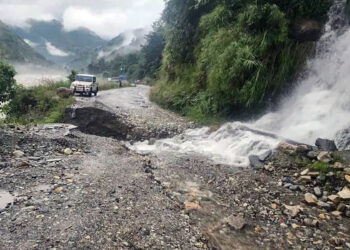
Power generation at the 111-megawatt Rasuwagadhi Hydropower Project has been temporarily suspended after rising water levels in the Lhende Stream triggered a mud-filled flood. Project officials closed the intake gate as a precaution to protect infrastructure, which had already undergone repairs following last year’s flood damage. Increased water flow in the Bhote Koshi River also prompted the relocation of cargo and newly imported vehicles from the Rasuwagadhi Customs Yard. Authorities have advised travelers to Kerung to avoid the Mailung road and use alternative routes.
Simara Airport struggles with limited infrastructure
Simara Airport in Bara is facing declining flight operations due to outdated infrastructure, including a short runway and a cramped terminal building. The existing facilities restrict night operations and prevent ATR-72 aircraft from operating at full capacity, particularly during poor weather. As a result, Yeti Airlines and Shree Airlines have suspended services on the Simara-Kathmandu route, leaving Buddha Air as the only carrier with four daily flights. Passenger traffic has fallen to around 400 per day from more than 1,500 in previous years, while airport authorities continue to await approval for expansion from the Civil Aviation Authority of Nepal.
Free 24-hour bird flu hotline launched
The Nepal Veterinary Association has introduced a free 24-hour hotline and teleconsultation service after bird flu cases were confirmed in several districts, including the Kathmandu Valley. The service provides official information, scientific guidance and emergency technical support related to bird flu, focusing on animal health, public health and the poultry industry. Farmers, poultry entrepreneurs, consumers and the general public can access the service through the toll-free number 1159. The association has urged people to rely on expert advice and verified information instead of rumors.
Salyan’s vegetable farming generates Rs 520 million annually
Commercial vegetable farming is contributing more than Rs 520 million to Salyan’s economy each year. Farmers cultivate vegetables on around 8,200 hectares of land, producing nearly 119,765 metric tons annually. More than 65,500 metric tons of seasonal and off-season vegetables are exported to markets in Dang, Butwal, Pokhara, Kathmandu and border towns in India via the Rapti Highway. Although improved irrigation systems and polytunnels have increased production, farmers continue to face challenges from unstable market prices and crop diseases.
Belauri installs 250 household biogas plants
Belauri Municipality in Kanchanpur has installed biogas plants in 250 households during the current fiscal year to promote clean energy and reduce dependence on firewood and liquefied petroleum gas. The Alternative Energy Promotion Centre covered 76 percent of the project cost, while the municipality contributed 14 percent and beneficiaries financed the remaining share. The programme mainly targeted livestock farmers, with Ward No. 10 receiving the highest number of installations. Deputy Mayor Jogram Chaudhary said the initiative will help protect the environment, improve public health and increase the use of organic fertilizer.
Ghorahi sets aside Rs 859 million for infrastructure
Ghorahi Sub-Metropolitan City has allocated Rs 859.1 million for infrastructure development in the fiscal year 2026/27. The budget prioritizes road blacktopping, drinking water supply, irrigation systems and electricity expansion. More than Rs 541.7 million has been earmarked for completing long-delayed priority projects, while Rs 205 million will support community-level projects through cost-sharing arrangements. The city has also allocated Rs 6 million for drainage construction to reduce monsoon flooding along the Kathekhola corridor.
Om Megashree Pharmaceuticals approves Royal acquisition
Shareholders of Om Megashree Pharmaceuticals have approved the acquisition of Royal Pharmaceutical at a special general meeting. To comply with Securities Board of Nepal regulations, Royal Pharmaceutical converted its business into a limited company before the merger process. Om Megashree, which has already listed 30 percent of its shares through an initial public offering, said the acquisition will strengthen production capacity and help meet regulatory requirements for pharmaceutical manufacturing. The transaction will proceed after the completion of the final audit.
Sukilumba Airport flight suspension hurts Ilam’s economy
Commercial flight services at Phalgunananda Sukilumba Airport in Ilam have remained suspended since March, disrupting transportation and affecting the local economy. Following the halt in regular operations, Nepal Airlines recalled its station staff to Kathmandu and transferred airport equipment to its Biratnagar office. Built with an investment of around Rs 400 million, the airport had served passengers from Ilam, Panchthar, Taplejung and nearby Indian border areas. The prolonged suspension has weakened tourism activity and discouraged new investment in the region.





Comment