




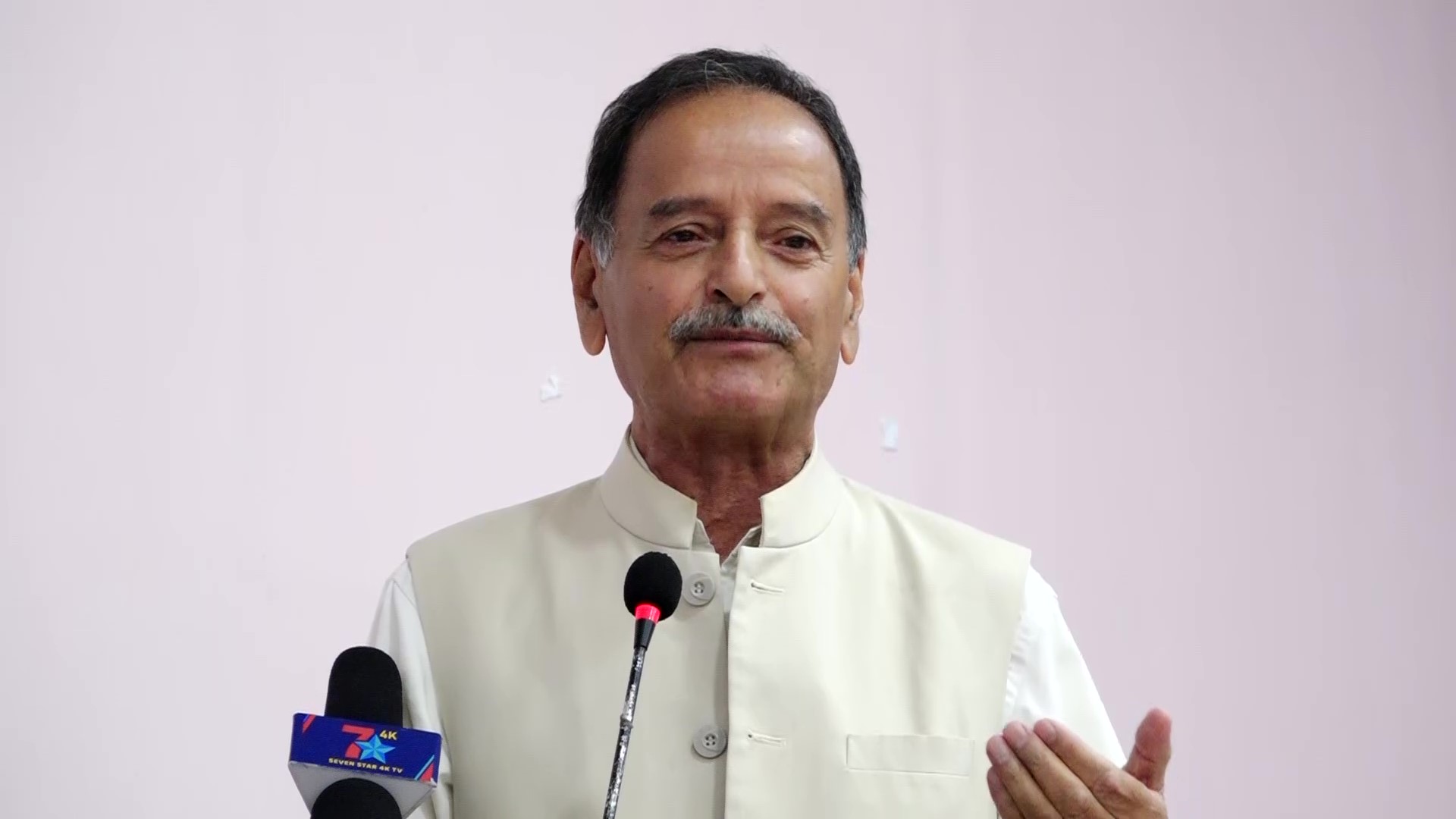
KATHMANDU: Former General Secretary of the Nepali Congress, Krishna Prasad Sitaula, has called for an end to the internal debate over a special general convention and urged party leaders to maintain organisational unity.
Addressing a gathering of the non-establishment faction of the Nepali Congress in Biratnagar on Sunday, Sitaula urged party President Gagan Kumar Thapa and Vice President Bishwo Prakash Sharma to resolve differences over holding a special convention versus the regular convention.
“You hold both the chalk to write and the duster to erase. You must erase the fragmented condition of the Congress,” Sitaula said. “If the 15th general convention is held as planned, as happened with the 10th, 11th and 12th conventions, everything can be resolved. There is no need to continue with unnecessary drama.”
He said internal divisions within the party would prevent it from providing direction to the country and stressed that unity within the Nepali Congress is currently essential.
“A divided Congress cannot safeguard the country. For the country to move forward, Congress leaders must be united,” he said.
Sitaula also argued that democracy and governance are facing growing challenges and said political parties have a responsibility not only to win elections and govern but also to remove fear and uncertainty among the public.
Warning that instability and complexity could deepen in the country, he said the party should launch a new campaign of political awakening. According to him, solutions to current challenges are possible only if the party rebuilds the same courage, commitment and public connection seen during the democratic movement of 1951.
Sitaula emphasized that agreement among top leaders could be reached through direct communication rather than written exchanges.
Referring to letters reportedly sent by Vice President Sharma to leaders including Bijaya Kumar Gachhadar and Shashanka Koirala, Sitaula said face-to-face discussions could produce solutions more quickly.
He stressed that all sides within the party must take responsibility for ending internal disputes and strengthening organisational unity.






Comment