




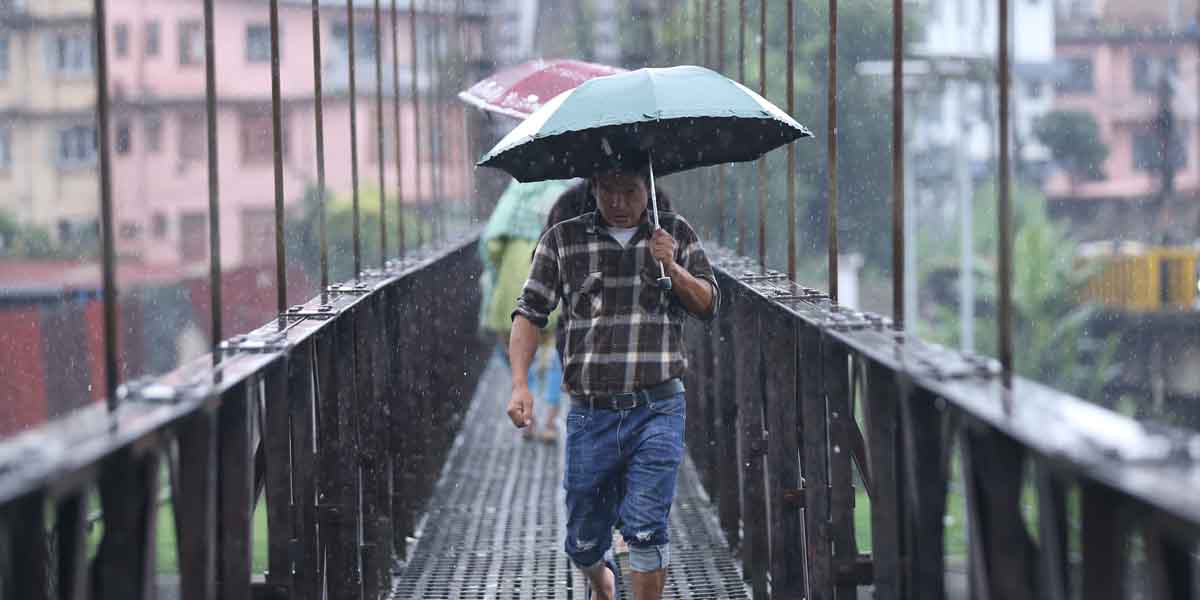
KATHMANDU: Rainfall is currently occurring across most parts of Nepal, including the Kathmandu Valley, with several areas receiving heavy to extremely heavy rain, according to the Department of Hydrology and Meteorology.
Senior meteorologist Min Kumar Aryal said rainfall has been reported in most provinces except for only a few areas of Sudurpaschim and Karnali provinces. While some locations have witnessed heavy to very heavy rainfall, others have received moderate rain.
He warned that the rainfall is likely to continue and may intensify further tonight, urging the public to remain alert.
According to the latest records available at the Department, Makwanpur Gadhi of Makwanpur and Myagdi received the highest rainfall in the past 24 hours, with both recording 121 millimetres of rain, classified as extremely heavy rainfall. Sunsari recorded 117 mm and Udayapur 106 mm during the same period.
Kathmandu has also received heavy rainfall. The Chandragiri rainfall measurement station recorded 93.6 mm of rain.
Heavy rainfall was also recorded in several other districts, including Sindhuli (93 mm), Jhapa (84 mm), Sankhuwasabha (52 mm), Taplejung (64 mm), Solukhumbu (58 mm), Sindhupalchok (68 mm), Chitwan (84 mm), Nawalpur (85 mm), Nawalparasi West (69 mm), Palpa (98 mm), Banke (57 mm), and Kailali (57 mm).
Rainfall is currently continuing in Kathmandu, Udayapur, Lamjung, Sindhupalchok, Chitwan, Khotang, Baglung and Parbat, among other districts.
The Department said monsoon winds are currently influencing weather conditions across the country. The monsoon low-pressure line has shifted slightly above its average position and is currently located close to Nepal’s Tarai region, causing widespread rainfall.
The Department has forecast the possibility of heavy to extremely heavy rainfall at a few places in the hilly and Tarai areas of Koshi Province tonight, while one or two locations in the hilly and Tarai areas of Bagmati and Gandaki provinces may also receive heavy rainfall.
Meteorologist Aryal said the weather system responsible for rainfall is likely to become more active during the night compared to daytime.





Comment