




A global debate persists on how democratic governance promotes civility, meaningful discussions, and real political participation. Nepal exemplifies this issue: although citizens are increasingly active on major platforms such as social media, protests, and voting, these loud voices seldom translate into real power or lasting change.
Political conversations are lively, but voters frequently face limited choices because of elite dominance, fragile institutions, and deep-rooted accountability issues.
About twenty years ago, I came across a book, its title now forgotten, that suggested the internet could serve as a potent tool for social freedom. The main idea was simple: greater connectivity, easy access to information, and open conversations would weaken authoritarian regimes and naturally support democracy.
Even in countries without strong democratic roots or high levels of civic participation, digital technology was seen as shifting the balance toward freedom. This perspective believed that democracy would naturally develop from the extensive online exchanges.
This optimism stems from a long-held belief in technological determinism, the idea that technological progress directly causes political change. However, this perspective often neglects how power structures, institutions, and cultural factors influence technology’s political effects.
Merely possessing information doesn’t generate agency, and simply being connected doesn’t guarantee collective power. Further studies have demonstrated that the relationship between digital media and democracy is intricate and not inherently empowering.
Max Weber’s sociological insights offer a valuable perspective on this paradox. Recognized as a visionary, Weber predicted over a century ago that traditional rituals, religious beliefs, and magical thinking, mainly aimed at maintaining social stability, would diminish in favor of science, technological rationality, and bureaucratic systems.
These ongoing issues are intensified by the lack of efforts to promote meaningful public discussion and to tackle longstanding unemployment and underemployment, especially among youth. The expectation that political change alone would directly enhance living standards has not been realized, as key egalitarian and liberal reforms remain largely unimplemented.
These modern structures, defined by formal rules, procedures, and instrumental logic, would increasingly influence power relations and daily life organization. Weber called this change the ‘disenchantment’ of the modern world, a shift toward systems driven more by calculation than shared moral values.
Weber understood that disenchantment is ongoing. Although rationalization may diminish traditional authority, it doesn’t fulfill the intrinsic human desire for meaning, belonging, and moral guidance. These needs tend to resurface in new, fragmented, or sometimes distorted forms.
In the contemporary digital era, social media serves as a platform where individuals pursue meaning, reaffirm their identities, and express grievances, often without the ethical boundaries or institutional responsibilities that previously regulated public conversation.
Democracy is more than a spectacle or a popularity contest; it entails moral judgment of actions, outcomes, and restraint. In a republican system, political authority is justified by results and accountability, not visibility or applause. Elections bring uncertainty, which can be advantageous if it aligns with competing values, clear political goals, and robust institutions. As Zakaria (2024) notes, electoral processes can foster social change when they prioritize the needs of marginalized groups rather than simply reinforcing elite control.
It is therefore understandable why meritocracy and transparency are now key moral principles in modern political discourse. These principles enhance trust by emphasizing fairness, accountability, and competence in governance.
However, meritocracy also presents inherent challenges. In ‘The Second Mountain: The Quest for a Moral Life’ (2019), David Brooks describes meritocracy as a system in which widespread talent competes fiercely, shaping society based on qualities such as grit, productivity, and self-discipline. In this system, achievement is subtly linked to social worth, creating a hierarchy that equates success with virtue.
Many Nepali analysts argue that the upcoming general elections may alter the political landscape but are unlikely to address Nepal’s core challenges. They emphasize that democratic progress requires not just well-informed voters, but also a political system that effectively transforms voter preferences into accountable governance.
The central issue, they contend, is a governance structure that remains disconnected from and disempowering to ordinary citizens. Political parties are expected to repeat familiar promises, such as economic growth, job creation, reform, and social justice, but the deeper problems of corruption, weak institutions, and elite dominance are likely to persist.
The proposed legal reforms, analysts note, lack the necessary ambition and depth to build a truly egalitarian society. As a result, voter frustration may lead to higher turnout or protest votes, but without credible policies and genuine internal party democracy, significant change appears improbable.
Analysts conclude that only a government truly committed to institutional accountability, decentralization, and effective public service—rather than elite interests—can break this pattern. Unless such transformative change occurs, the elections will perpetuate the status quo, leaving Nepal’s economic and governance crises unresolved.
Drawing on John Mueller’s (1999) minimalist view of democracy, as the formal right to criticize and replace leaders, elections remain crucial for ensuring accountability. In Nepal, as the upcoming election approaches, political competition appears pluralistic on the surface, with no single leader or party dominating campaign finance, media access, or electoral narratives.
However, this superficial diversity masks a deeper concentration of power. Informal gatekeepers, who use financial resources, media influence, and institutional ties, shape the political landscape like a monopsony: many competitors, but with terms set by a small group of informal power brokers.
This analysis does not imply that Nepal’s current political system is ideal or fully representative. Instead, it highlights how concentrated power obstructs fair competition, marginalizes small parties and independent candidates, and ultimately restricts voters’ electoral options.
Nepal’s experience with democracy challenges the common view, revealing a more complex picture. Policies favoring market forces and elites have widened economic and social gaps, eroding key democratic principles. Wolfgang Merkel (2019), in ‘Past, Present and Future of Democracy,’ identifies five pillars of strong democracy: free and fair elections, political rights, civil liberties, horizontal accountability, and good governance.
While Merkel notes that economic growth can support democratic stability, he warns that issues arise when corporate interests heavily influence policy decisions. In Nepal, the gap between democratic institutions and business interests has increased inequality and weakened accountability. For democracy to function effectively, there should be provisions for modifications to existing policies and institutions to ensure adaptability and responsiveness to changing societal needs.
Democracy ideally involves inclusive participation through elections, creating representative bodies that enable politicians to serve the collective good. Societies express their political, social, and economic goals mainly through political processes.
Although Nepal is officially a democracy, it’s reasonable to expect a new government to focus on core democratic principles—such as accountability, decentralization, and service delivery—rather than on elite dominance, promoting equal rights, opportunities, and responsibilities.
The decline of democratic norms is worsened by a media landscape dominated by profit-focused corporations with close ties to political power, thereby limiting critical scrutiny and public accountability. Social media intensifies these issues, not only through their existence but also because of their structural design and strategic political use: they emphasize visibility over understanding, performance over meaningful dialogue, and sensationalism over careful deliberation.
Consequently, rational debate gives way to polarization and algorithm-driven amplification, increasingly visible in Nepal’s current political scene. Merkel has offered detailed analyses of how democracy erodes in Europe, warning that elected officials can undermine democratic institutions from within while pretending to uphold democratic legitimacy. His work is often cited in discussions of populism, the rule of law, and state capture, topics that are especially relevant to transitional democracies like Nepal.
Conditions in Nepal are worsening across almost all key indicators. Politicians not only deny these problems but also deliberately create confusion about the meaning of democracy. By avoiding responsibility, blaming others, and flooding public discussion with distractions, political leaders shape and restrict public understanding of politics.
This manufactured confusion erodes accountability. Nepal is not experiencing a sudden collapse; rather, it is slowly deteriorating as governmental failures become normalized and public consent is manipulated. Throughout this decline, politicians consolidate power beyond their formal roles, increasingly insulating themselves from consequences and pursuing greater personal ambition.
In Nepal, this disconnection from institutional purpose has led to a political culture increasingly detached from long-term planning, policy coherence, and collective responsibility, resulting in a crisis of legitimacy.
Meanwhile, public participation shrinks, and the quality of democracy declines. Consequently, elections primarily result in changes of political personnel without addressing the underlying structures of power. Weak and arbitrary governance continues both between elections and through entrenched informal networks, highlighting the urgent need for reforms beyond elections to empower citizens genuinely.
These ongoing issues are intensified by the lack of efforts to promote meaningful public discussion and to tackle longstanding unemployment and underemployment, especially among youth. The expectation that political change alone would directly enhance living standards has not been realized, as key egalitarian and liberal reforms remain largely unimplemented.
As a result, historical inequalities endure. Simultaneously, the decline in consensus-building within Nepal’s political culture has widened social and political divisions. Misinformation, rumors, and hate speech spread quickly, driven by digital platforms. Instead of encouraging thoughtful dialogue, social media has become a fragmented environment dominated by sensationalism, often obscuring the truth. All these factors contribute to a political climate characterized by conflict and rising toxicity.
Growing evidence emphasizes the limitations of early digital optimism. While it’s still unclear if Nepal’s recent Gen-Z protests are comparable to the Arab uprisings, often called ‘Facebook Revolutions’, these past events remind us: spontaneous, digitally connected mobilizations, though inspiring, cannot lead to lasting democratic change without proper organization, ongoing effort, and institutional backing.
Mobilization alone does not result in power. Without strong leadership and governance, collective energy diminishes. Connectivity without structure results in visibility, not influence; expression without institutions rarely causes permanent reform. Despite this, the myth of digital liberation persists.
Digital platforms are viewed either as inherently democratic or as threats to stability. In Nepal, this illusion was clear during Khadga Prasad Oli’s government. As social media escaped direct state control, it was often seen as threatening to centralized authority.
Through regulation, platforms faced restrictions and censorship, not to foster democratic principles or safeguard public discourse, but to evade accountability, personalize power, and control dissent via curated narratives.
What was portrayed as regulation, or even as a democratic safeguard, actually shifted control. These measures didn’t empower citizens; rather, they equated participation with unwanted noise and governance with constant surveillance. The state’s reaction reflected a deeper concern: even polarized dialogue can undermine authoritarian tendencies by exposing contradictions, enabling collective oversight, and challenging official narratives. The real issue was not chaos but accountability.
Ultimately, Nepal’s key democratic challenge lies more in institutions and ethics than in technology. While digital tools can amplify voices, they cannot replace political organization, civic discipline, or core democratic values. Without accountability, restraint, and sustained spaces for discussion, communication risks creating division rather than resolving issues collaboratively.
The aim is not to idolize or restrict digital platforms but to incorporate them into a democratic framework that favors dialogue over control, understanding over sensationalism, and governance over superficial performance.
Max Weber’s warning remains relevant here: rationalization without meaning creates empty systems, and participation without a clear purpose turns into noise rather than true democracy. When democracy lacks purpose, it becomes a system trapped in procedural routines, open in appearance but stagnating in substance.
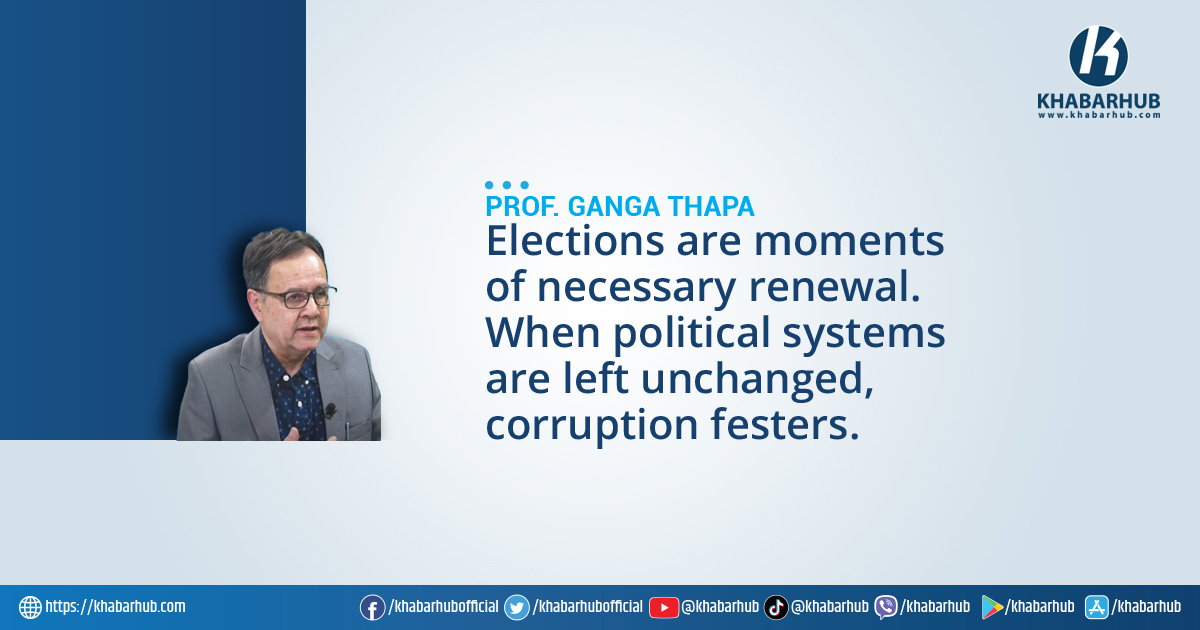
Elections are moments of necessary renewal. When political systems are left unchanged, corruption festers. Voting allows us to assess leaders by their true worth and remove those who have become liabilities—because, as Mark Twain put it, diapers must be changed regularly, and for the same reason.
In Nepal, this disconnection from institutional purpose has led to a political culture increasingly detached from long-term planning, policy coherence, and collective responsibility, resulting in a crisis of legitimacy.
Over a century ago, Mary Woolley noted that “character is the main object of education.” Today, while politics acknowledges moral diversity and rejects singular moral doctrines, it fails to address a key political question: what gives public life its meaning? In Nepal, political leaders have largely sidestepped this question. Instead of defining a moral vision for social change, politics has become focused on procedural disputes, personal gain, and short-term survival. Ethical goals have been replaced by tactical maneuvers, leading to widespread public disillusionment.
Nepal’s current political culture is characterized by extreme individualism and a growing social divide. This rift has deepened as ethical lapses among leaders are increasingly tolerated instead of condemned. As Jawaharlal Nehru warned, when moral failings are accepted at the highest levels, they trickle down and erode institutions from within. Once corruption and impunity become routine, public outrage fades, accelerating the decline of democratic systems.
History shows that democratic decline rarely happens suddenly; instead, it advances through acceptance, justification, and silence. This slow moral decline erodes the core principles of republicanism. If Nepali society had addressed these issues earlier, the current democratic decline might have been less severe.
Ignoring honest self-reflection now risks worsening the crisis beyond governance, endangering the nation’s moral and civic values. Rather than uniting around a common ethical goal, Nepali politics today has become more fragmented, cynical, and distrustful.
Nepal’s democracy features lively debates and some unfulfilled promises, indicating that elections alone can’t solve the country’s core issues. To genuinely address deep-rooted structural challenges, reforms must extend beyond the electoral process.
Elections are moments of necessary renewal. When political systems are left unchanged, corruption festers. Voting allows us to assess leaders by their true worth and remove those who have become liabilities—because, as Mark Twain put it, diapers must be changed regularly, and for the same reason.
(Views are personal)





Comment