




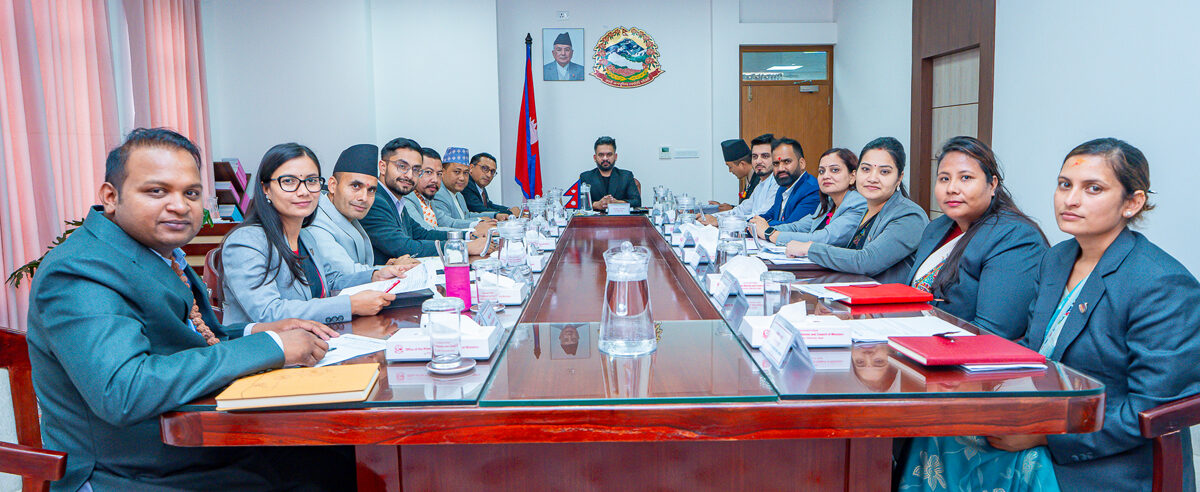
KATHMANDU: The government led by Prime Minister Balendra (Balen) Shah has raised women’s representation in the Cabinet to nearly 40 percent, reflecting a focus on inclusive governance.
Six women have been appointed to the 16-member Council of Ministers, accounting for 37.5 percent representation.
Prime Minister Shah’s press and research expert, Deepa Dahal, said this marks a new benchmark for women’s participation at the cabinet level in Nepal.
“The current government is committed to inclusive and equitable governance. The presence of 37.5 percent women ministers demonstrates that our commitment to transformative politics is being implemented in practice,” she said.
Rights advocates and activists have welcomed the move. When the new government was formed, Sobita Gautam was appointed Minister for Law, Justice and Parliamentary Affairs, Geeta Chaudhary as Minister for Agriculture and Livestock Development, Sita Badi as Minister for Women, Children and Senior Citizens, and Nisha Mehta as Minister for Health and Population.
On the recommendation of the Prime Minister, President Ram Chandra Paudel later appointed Gauri Kumari Yadav as Minister for Industry, Commerce and Supplies.
While Nepal’s Constitution mandates at least 33 percent representation of women in state bodies, previous governments often failed to meet this threshold. The current cabinet has exceeded that requirement, which rights groups view as a positive step toward inclusive governance.
They believe this increased representation will contribute to more women-friendly policies and strengthen inclusive democracy. Former National Human Rights Commission member Mohana Ansari described it as a historic achievement, noting that such a high level of female participation in the Cabinet is unprecedented in Nepal.
“Numerically, this is the highest participation of women in the Council of Ministers so far,” Ansari said. “Having six women in a 16-member cabinet is an exemplary step toward inclusive leadership.” She also noted that the election of Rubi Thakur as Deputy Speaker signals a broader commitment to inclusion.
Senior advocate Meera Dhungana said the increased participation not only meets expectations but also provides an opportunity to make policymaking more responsive to women’s issues. She suggested that women’s representation should be further increased to 50 percent in the future.
Advocate Bhawana Dahal emphasized that diversity is as important as representation, stating that the current cabinet sends a positive message by promoting both numerical and inclusive diversity in women’s leadership.






Comment