




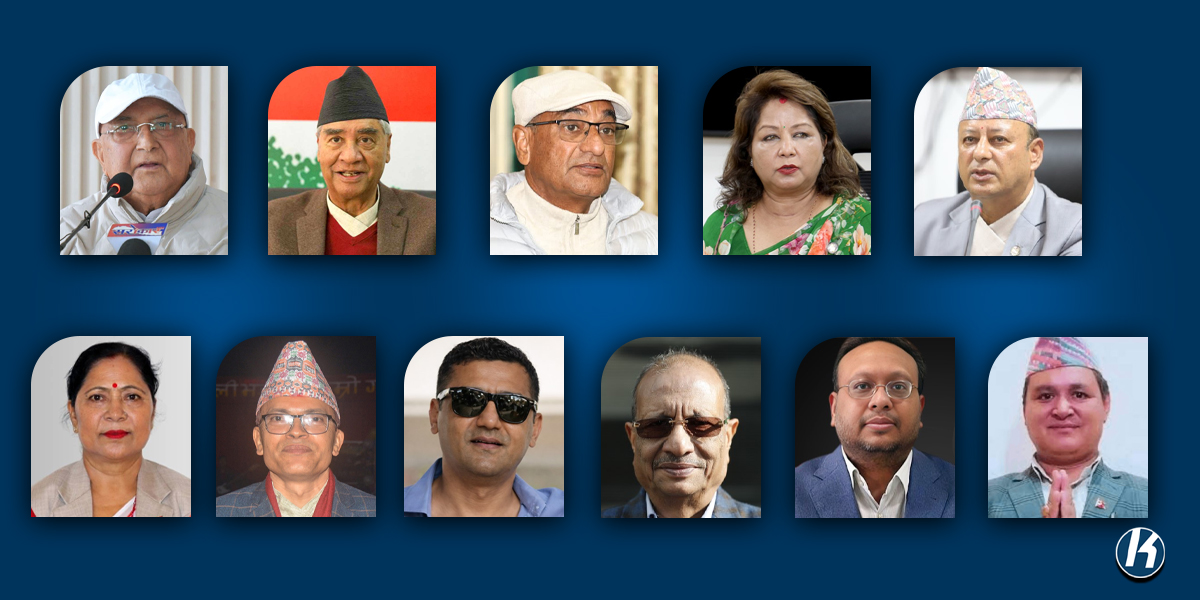
KATHMANDU: The government has stepped up law enforcement measures following the recent Gen-Z movement, launching a sweeping crackdown that has reached high-profile political figures, businesspersons, and individuals accused of serious criminal and financial offenses.
The campaign gained momentum after the Cabinet meeting on March 27 decided to implement recommendations of a commission led by Gauri Bahadur Karki, which had held several senior political and administrative officials responsible for alleged repression during the movement.
In a major development, the Kathmandu District Court issued arrest warrants against former prime minister Sher Bahadur Deuba and his wife Dr. Arzu Rana Deuba on charges related to money laundering. On similar grounds, former prime minister KP Sharma Oli and former Home Minister Ramesh Lekhak were also taken into custody.
Authorities described the arrests as highly sensitive, with security agencies reportedly advising caution and due legal process before proceeding. However, Home Minister Sudan Gurung is said to have instructed swift action under urgent arrest provisions.
Oli was detained from his Bhaktapur residence early in the morning under a special security plan and is currently undergoing treatment at Tribhuvan University Teaching Hospital due to health issues. Meanwhile, the Supreme Court has ordered that the detainees should not be held beyond April 8.
As investigations continue, attention is now focused on how the courts will respond, how cases will proceed legally, and whether the government can maintain a balanced approach. The outcomes are likely to play a crucial role in shaping public trust and the overall political climate in the coming months.
In a related case, former Kathmandu Chief District Officer Chabi Rizal was arrested on March 31 on allegations of ordering the use of force during protests in the Baneshwar area. Rizal has denied the allegations, stating he did not authorize the use of lethal weapons. He has since been released on bail, though investigations continue.
The government’s crackdown has also expanded beyond protest-related cases. UML provincial committee member Karna Bahadur Malla has been arrested on rape charges following a complaint by a young woman.
Similarly, action has been taken in high-profile financial crime cases. Former minister Deepak Khadka, businessman Deepak Bhatta, and industrialist Sulabh Agarwal of the Shanker Group have been arrested over alleged money laundering offenses. Another businessman, Shankerlal Agarwal, was detained and later released after giving a statement.
These developments indicate that the government is pursuing an aggressive approach against both political accountability and economic irregularities, signaling a broader push to tighten governance and law enforcement across sectors.
The government’s ongoing crackdown has expanded further, with new developments involving a sitting lawmaker and intensified police operations against organized crime, adding fresh complexity to the country’s evolving political and security landscape.
Lumbini Province Member of Parliament Rekha Kumari Sharma has been implicated in a serious child rights case. She was arrested on allegations of physically and mentally abusing a minor girl employed in her household.
The victim has accused Sharma of prolonged mistreatment, forced domestic labor, and restricting her contact with family members. However, following a court order, Sharma has been released from custody and is currently cooperating with the ongoing investigation.
Meanwhile, police have stepped up action against criminal networks in Kathmandu. In operations conducted on April 3 and 4, a total of 33 individuals allegedly involved in criminal activities were arrested.
According to police, groups involved in extortion and middlemen have long been active in Kathmandu. Many suspects are currently absconding, and search operations are ongoing.
Several suspects are still absconding, and search operations are underway.
Security officials say such monitoring and preparatory work had been ongoing for months, but enforcement has intensified significantly since the formation of the new government. While the sweeping actions are being presented as a strong commitment to the rule of law, concerns and accusations of political vendetta have also begun to surface.
The government’s assertive “action mode,” initiated after the Gen-Z movement, is now having a broad impact on the country’s political, administrative, and security structures. On one hand, action against high-profile figures is being viewed as a sign of equal application of the law. On the other, it has heightened political tensions and sparked debate over motives and due process.
As investigations continue, attention is now focused on how the courts will respond, how cases will proceed legally, and whether the government can maintain a balanced approach. The outcomes are likely to play a crucial role in shaping public trust and the overall political climate in the coming months.






Comment