




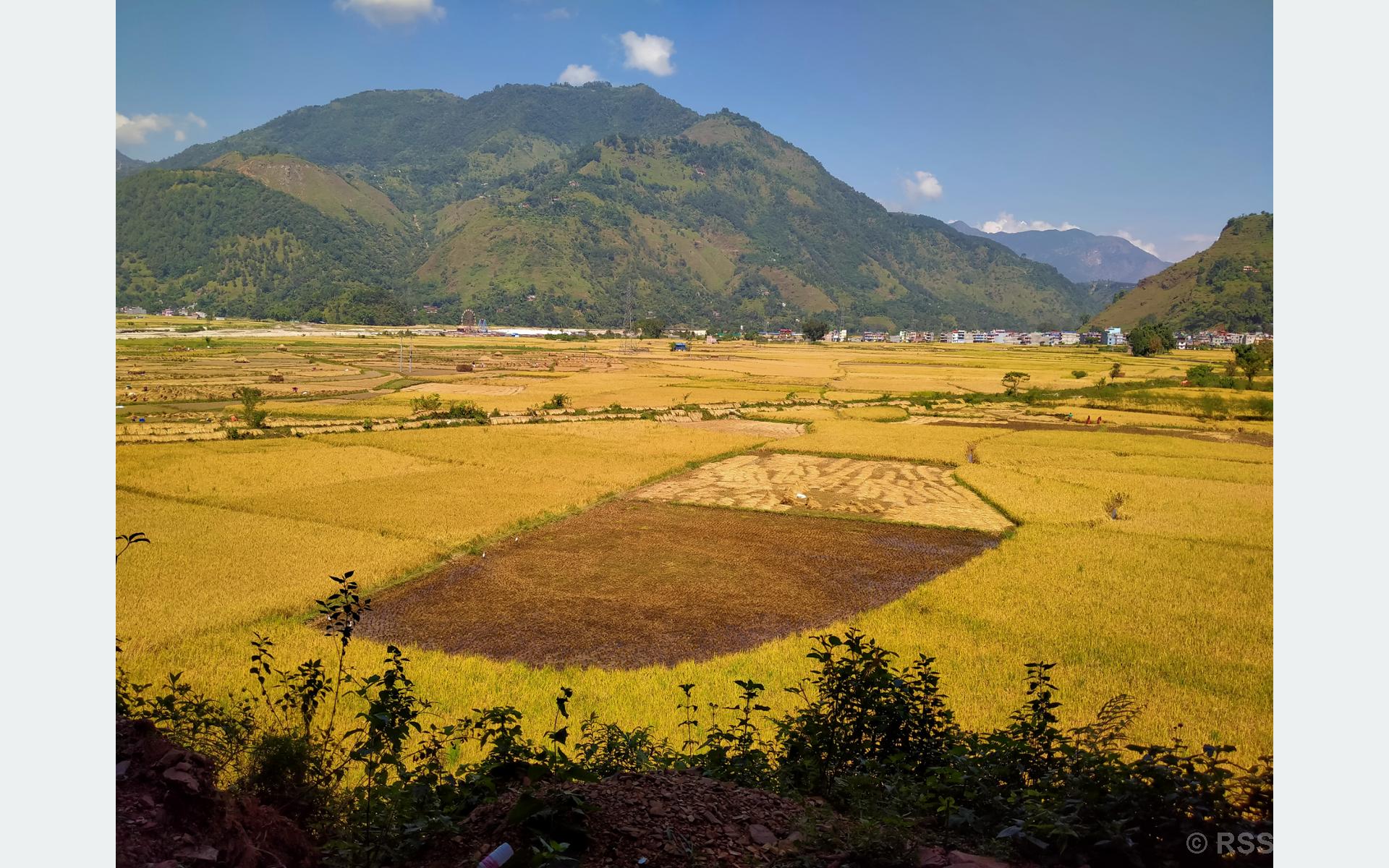
WALING: Paddy production in Syangja district has increased significantly this year compared to last year, rising by 13.8 percent.
According to Narayan Pathak, an agricultural economist at the District Agricultural Development Office, paddy output rose from 36,560 metric tons last year to 41,640 metric tons this year. Paddy was cultivated on 9,072 hectares of land in the district this year.
Although the total area under paddy cultivation in Syangja has been gradually declining, overall production has increased, the office stated. Pathak attributed the growth to increased use of improved seeds, modern machinery, and advanced agricultural technology, along with favorable weather conditions.
“In recent years, the use of improved seeds, modern equipment, and technology has increased,” Pathak said. “These factors, combined with a favorable environment, have boosted productivity.” He added that while unseasonal rainfall damaged paddy crops in some parts of the country, Syangja did not experience significant losses, helping maintain higher production levels.
Pathak said hybrid and improved seed varieties are used on about 40 percent of the total paddy-cultivated area in the district. Paddy productivity this year reached 4.59 metric tons per hectare, up from 4.3 metric tons per hectare last year. Last year, 306 metric tons of Chaite paddy were produced on 67 hectares of land in the district.
He further noted that farmlands along the banks of the Andhikhola, Jyagdikhola, Daraukhola, and Kaligandaki rivers serve as pocket areas for paddy cultivation. Paddy grown in these areas is used both for household consumption and seed production.
According to the Agricultural Development Office, farmers in Syangja earned approximately Rs 10 million last year from the sale of paddy seeds. Farmers have been producing and marketing various government-recommended improved paddy varieties.
The seeds produced by Syangja farmers are sold within the district and in other parts of the country through the government-operated electronic seed management system (DESIS), Pathak said. Local and improved varieties such as Ramdhan, Sabitri, Sawa Mansuli, Hardinath, and others are being cultivated in the district.




Comment