




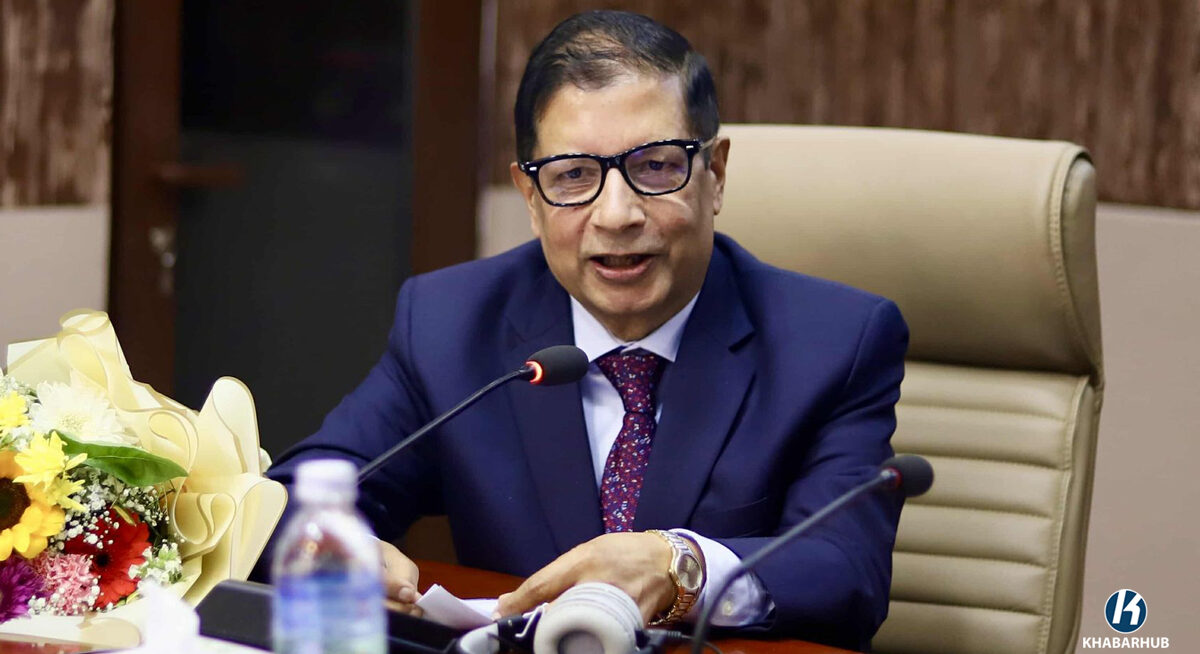
KATHMANDU: Former Nepali Ambassador to India Dr. Shankar Sharma has said that the warm reception extended to Rastriya Swatantra Party (RSP) Chair Rabi Lamichhane by the Bharatiya Janata Party (BJP) and Indian Prime Minister Narendra Modi has strengthened confidence in Nepal-India relations.
Lamichhane, who visited New Delhi at the invitation of the BJP, described his meetings with Indian leaders, including Prime Minister Modi, as positive and appropriate in the current political context. Sharma believes the visit has created a favorable environment for Nepal to pursue diplomatic engagement with India on longstanding bilateral issues.
According to Sharma, India’s treatment of Lamichhane and his delegation signals openness toward deeper cooperation with Nepal and should be viewed as an opportunity for Kathmandu to advance its interests through diplomacy.
He argued that while Lamichhane’s visit was conducted in a party capacity, it demonstrated India’s willingness to engage with Nepal’s emerging political leadership. However, Sharma stressed that sensitive matters such as border disputes and other bilateral concerns should be addressed through formal government-to-government channels rather than during a political goodwill visit.
Sharma said Lamichhane’s trip was both successful and productive, adding that India had effectively rolled out the “red carpet” for Nepal and conveyed a positive message regarding future cooperation.
Khabarhub spoke with Sharma about the diplomatic significance of Lamichhane’s India visit and its implications for Nepal-India relations.
How do you assess Rabi Lamichhane’s India visit from a diplomatic perspective?
First of all, Nepal now has a new government with a parliamentary majority, and Rabi Lamichhane leads one of the country’s major political parties. It is positive when the leader of a major political force accepts an invitation from a major party in a neighboring country.
Such visits help facilitate the exchange of ideas on governance, development, and public accountability. The willingness expressed by Lamichhane to strengthen cooperation with India appears to have been warmly welcomed. More importantly, India has signaled that it is ready to support Nepal’s development and prosperity through economic partnership.
The message from India is that it remains open to broader discussions and deeper engagement. That is a very positive development for Nepal.
Does the reception accorded to Lamichhane and his delegation leave any room for doubt about India’s intentions?
At this stage, there is little reason for doubt. The welcome extended by India can also be seen as a positive gesture toward Nepal’s current political leadership.
The key question now is how Nepal can effectively utilize this goodwill through diplomatic initiatives. We should use this opportunity to move forward on issues that have remained unresolved and to explore new avenues of cooperation that can contribute to Nepal’s prosperity.
This is a moment when Nepal needs to be more proactive. If India has extended goodwill and openness, Nepal should respond by building greater trust and seeking practical outcomes. Issues that could not be resolved in the past should now be pursued through diplomatic channels.
If opportunities like this are not utilized when they arise, they may not return easily. Lamichhane’s visit was successful, and the next step should be a meaningful and productive visit by Prime Minister Balendra Shah.
Could Lamichhane have done more during the visit?
Not really. Government spokesperson Sasmit Pokharel has already clarified that this was a goodwill visit undertaken in a party capacity. Once it is defined as a party visit, there are clear limitations regarding what can be formally discussed or agreed upon.
However, the visit did provide an opportunity to present the RSP’s vision for Nepal’s development and prosperity. Discussions on broader cooperation naturally touched upon issues such as connectivity and security. Meetings with senior Indian leaders, including Home Minister Amit Shah, were useful in that regard.
Lamichhane was able to explain his party’s priorities, and Indian leaders appeared receptive. Given the nature of the visit, this was appropriate. It was not the right forum for negotiating contentious bilateral issues.
What should have been discussed in the meeting between Prime Minister Modi and Lamichhane?
Since Lamichhane was visiting in a political and party capacity, the discussions appear to have been conducted appropriately.
The fact that Prime Minister Modi met him and allocated time for the meeting is itself significant. It sends a positive signal about India’s willingness to engage with Nepal’s political leadership.
Rather than focusing on what was or was not discussed during that meeting, the emphasis should now be on how the Nepali government follows up through official diplomatic channels. If India has extended goodwill and signaled openness, Nepal should seize the opportunity to address unresolved issues through dialogue.
The current government should pursue diplomatically what previous governments could not accomplish. Sensitive matters should be discussed at the negotiating table and resolved through mutual understanding rather than public controversy.
Opportunities of this nature do not arise frequently. When they do, both sides should work constructively to deepen cooperation and move toward practical solutions.
Some observers have linked Prime Minister Balendra Shah’s recent statement in Parliament regarding border issues with Rabi Lamichhane’s India visit. Do you see any connection, or was it merely a coincidence?
I believe it was most likely a coincidence. There had already been discussions about Rabi Lamichhane’s visit to India at least 10 to 15 days before it took place. In my view, there is no direct connection between the Prime Minister’s remarks and the visit.
That said, I do not think the Prime Minister should have made such a statement. I believe he may have realized that it was inappropriate, and I expect he will clarify or apologize for it.
However, the Prime Minister’s remarks were made during a question-and-answer session that was not part of the regular parliamentary schedule. Does that raise further questions?
He may have spoken spontaneously. In my opinion, he should have exercised greater caution. Such statements should be made only after careful consideration, particularly on sensitive matters involving national boundaries.
He appears to have made an error in judgment. It would be appropriate for him to acknowledge that and clarify his position. Public officials, especially the Prime Minister, need to remain aligned with established policy positions whenever they speak on issues of national importance.
Border disputes remain a contentious issue between Nepal and India. Given that context, why do you think the matter was not raised more strongly during Lamichhane’s visit?
At present, our focus should be on preparing thoroughly and engaging India through formal diplomatic dialogue. Before entering negotiations, Nepal must complete its own homework.
The Prime Minister himself has stated that Nepal is reviewing historical documents and consulting relevant sources, including records linked to the United Kingdom. Issues of this nature require detailed preparation and strong evidence.
Only after adequate preparation should Nepal move forward with substantive talks with India.
India has repeatedly stated that there is no need for third-party mediation in border disputes. How should Nepal approach this position?
I believe these issues should be resolved through direct bilateral dialogue. Border disputes are best addressed through diplomatic negotiations between the two countries rather than through public statements or external mediation.
Meaningful progress can be achieved if both sides engage seriously at the negotiating table. When the Prime Minister undertakes an official visit or dispatches a negotiating team, that process should be backed by comprehensive preparation and a clear strategy.
Was Lamichhane’s decision not to raise the border issue influenced by a lack of preparation?
That is certainly one possible reason. Another important factor is that his visit was a party-to-party engagement rather than an official government mission.
He was not accompanied by government officials or technical experts who would normally be involved in discussions on complex bilateral issues such as border disputes. Under those circumstances, it would not have been appropriate to enter into detailed negotiations.
His objective was to understand the political environment and strengthen relations. In that sense, the visit appears to have achieved its purpose. The atmosphere now seems more favorable for future engagement.
When border issues are formally discussed, government representatives and technical experts must be involved. Such matters are far too important to be addressed casually. Given the nature of his visit, I believe Lamichhane acted appropriately by not pursuing the issue in a substantive manner.
So, is it appropriate to raise such issues only during an official visit by the Prime Minister?
When the Prime Minister undertakes an official visit, all preparations should already be complete. The relevant teams should arrive beforehand, make the necessary arrangements, and hold preliminary discussions. The Prime Minister should travel only after comprehensive groundwork has been completed.
What we should understand from the current situation is that the environment appears favorable. The message for the government is clear: complete the necessary preparations and make the most of the positive diplomatic atmosphere.
It is likely that officials from the Ministry of Foreign Affairs will also engage after Chairman Lamichhane’s return. What kind of preparations should Nepal make regarding border issues?
The Border Working Group has been actively working on border-related matters. My understanding is that it has conducted extensive research and produced fact-based, well-documented studies. The Prime Minister should remain in close coordination with this mechanism.
In fact, the group resumed meetings last year after a six-year gap and has already prepared a detailed roadmap extending to 2028. Many border-related issues are resolved at the local level, while unresolved matters eventually become national concerns.
However, major disputes such as Kalapani, Lipulekh, Limpiyadhura, and Susta fall outside the scope of many routine mechanisms. Nepal should focus its preparations on these unresolved issues. When the Prime Minister visits India, he should do so with a clear strategy and a well-prepared agenda rather than approaching the visit in a routine manner.
Has India effectively given a green signal for the Prime Minister’s visit?
I believe that signal has already been conveyed. Prime Minister Narendra Modi’s recent engagement and India’s overall approach indicate that there are no obstacles from the Indian side regarding an official visit by Nepal’s Prime Minister.
Based on available information, it appears the Prime Minister may be preparing for a visit roughly three months after the formation of the government. At this stage, it is largely a matter of finalizing the date and formal arrangements.
So Chairman Lamichhane’s visit is unlikely to affect either the border dispute or the Prime Minister’s visit?
I do not think so. The hospitality extended during his visit was exceptionally warm. The respect shown to him does not in any way diminish the importance of the Prime Minister’s future visit or Nepal’s position on border issues.
Some observers argue that Lamichhane received a level of recognition rarely seen in Nepal-India political relations. There are even claims that it may have overshadowed the Prime Minister. How do you view that?
I think it is premature to make such comparisons. We should wait and see how the Prime Minister’s visit unfolds.
The respect shown to Lamichhane should be viewed as a positive gesture toward Nepal and its current political leadership. There is no reason to question the hospitality extended to a guest.
The Rashtriya Swatantra Party and the Bharatiya Janata Party have engaged in exchanges of political ideas and experiences. The warm reception accorded to the party president can also be interpreted as goodwill toward Nepal and the present government.
There is no indication that the Prime Minister’s visit will receive any less importance. On the contrary, an official visit by the Prime Minister will involve substantive discussions and a formal agenda. I am confident that preparations are already underway to ensure meaningful outcomes.
Overall, would you describe Rabi Lamichhane’s visit as successful and productive?
Yes. The visit had specific and limited objectives, and those objectives appear to have been achieved.
He traveled to understand the political environment and strengthen relations, and it seems the response he received was even more positive than anticipated. This creates an opportunity for both governments to pursue constructive diplomatic engagement.
By every measure, I would describe Lamichhane’s visit to India as successful and fruitful. India’s gestures reflected goodwill, trust, and friendship toward Nepal.
The next step is for both countries to address pending diplomatic and border-related issues through formal dialogue and negotiations. As I have said before, India appears to have extended a positive signal and created a favorable environment. The responsibility now lies with Nepal to prepare thoroughly and make the most of the Prime Minister’s eventual visit.



Comment