




One of Noam Chomsky’s enduring mottos—optimism over despair—reflects his intensifying concern for the future of American democracy. In his 2024 reflections, Chomsky expressed deep unease about a world increasingly fragmented by division, where mistrust festers not only within institutions but also among citizens.
He observed a troubling rise in authoritarian tendencies, with political elites openly flouting democratic norms and the rule of law. Academia and journalism, long pillars of democratic accountability, continue to face relentless attacks, often to mask government misconduct.
The literature on democracy underscores that its consolidation is inherently gradual and challenging, particularly in deeply polarized societies. Effective power-sharing institutions must be rooted in broad-based civic engagement.
Many studies reveal that autocrats routinely use repression to suppress dissent and weaken opposition. While elections offer formal avenues for citizen representation, their impact on genuine political participation remains limited, especially when entrenched ideological polarization distorts institutional responsiveness. In such environments, repression breeds fear and detachment, alienating citizens from public life.
Indeed, democratic consolidation is shaped by a range of interconnected forces: international pressures, shifting geopolitical alignments, and the internal legitimacy of political institutions. Crucially, one underexamined factor is how effectively these institutions heed public opinion.
Whether enacted with intent or misjudgment, these actions have yielded deeply damaging consequences. His populist self-stylization and aggressive use of constitutional power have not merely weakened democratic institutions and fractured national unity—they underscore a corrosive political culture that places personal dominance above democratic ideals.
Democratization may promise inclusive governance, but the reality often falls short. In transitional democracies, support for politically insulated institutions—those less accountable to the public—is often driven by elite consensus rather than popular involvement.
On the other hand, a robust liberal democracy depends on a law-abiding, morally ordered, and vibrant civil society. Without it, the principle of free and equal individuals loses meaning. Human lives are marked by intrinsic vulnerability—we are, metaphorically, born naked and hungry—but we also possess a distinctive capacity for moral reasoning and rational judgment. The modern democratic ideal—a state governed by reason, free from aristocratic or oligarchic rule—remains elusive but aspirational.
But even then, in politics, every situation is open to multiple interpretations. Where some see disaster, others see opportunity. The way we define a problem shapes how we attempt to resolve it—perception and strategy are inseparable.
Yet amid this subjectivity, political theory provides certain enduring values and frameworks: crises can serve as catalysts for national assertion, collective mobilization, identity formation, and the pursuit of preferred regimes.
These cycles of interpretation and action continuously recycle and evolve, giving politics its dynamic, ever-renewing character. The core responsibility of political leadership lies in steering the nation with a vision that prioritizes the interests of its people over the pursuit of power or the manipulation of propaganda.
This broader concern deserves scrutiny: across television and social media, Nepal’s political discourse is increasingly shaped by spectacle and saturated with propaganda. Rather than enriching debate, this climate signals a disturbing decay of the nation’s moral compass.
A trend of rising populism emerges, characterized by theatrical politics, incoherent narratives, and widespread disillusionment. The leadership’s obsession with spectacle consistently eclipses substantive reforms vital to the health of liberal democracy.
This shift has steered Nepal’s national conversation away from the core principles of democratic governance, trivializing civic responsibility in troubling ways. The country now contends with a mutation of the ‘banality of evil’ into what can only be called the evil of banality, where the façade of democratic culture conceals the erosion of ethical leadership.
Populist theatrics perpetuated by political figures not only deepen public disillusionment but also signal the rise of a troubling new zeitgeist defined by performative politics, institutional fragility, and widespread moral disengagement.
Extreme polarization has taken root as Nepal’s prevailing political norm, demanding urgent, strategic intervention. The dangers go beyond gridlock: scholars of authoritarianism warn that entrenched divisions corrode democratic institutions from within, accelerating democratic decline.
The country stands at a pivotal juncture—it must choose between cultivating shared values through constructive dialogue or surrendering to forces that fracture national unity. The former path strengthens democratic resilience; the latter risks a descent into instability.
Anyone invested in social justice, democratic freedoms, and the pursuit of a principled common good must confront an uncomfortable truth: democracy’s trajectory has not been consistently reassuring.
In Nepal, academic studies highlight the absence of the coattail effect, where popular figures influence lower-ballot votes in favor of ideologically aligned candidates. Electoral outcomes have yet to shift public sentiment toward inclusive political, cultural, or economic agendas, nor have they fostered sustained democratic participation.
Consequently, Nepal’s democratic mechanisms have struggled to produce the kind of inclusive, progressive egalitarianism needed for systemic reform. This is not to suggest that citizens—motivated by what Gairdner (2015) refers to as ‘felicific calculi’—naturally gravitate toward ideal governance. Rather, Nepal’s republican democracy increasingly appears detached from lived experiences, constrained by institutional limitations and elite-driven politics.
Countries such as Russia, Venezuela, and Bulgaria exemplify pseudo-democracies—systems that maintain the outward trappings of democracy while hollowing out its substance. As Larry Diamond notes, these ‘modern despots’ suppress independent media, manipulate business interests, and react to public dissent with repression.
While elections remain a vital democratic instrument, these examples reveal how authoritarianism flourishes in the absence of robust accountability mechanisms. Without meaningful safeguards, democratic processes devolve into empty rituals, allowing discontent to fester and authoritarian control to solidify.
In Nepal, democracy is a constant topic—from workplaces and public transit to academic forums and dinner tables. Yet these conversations often center on leadership personalities plagued by cognitive dissonance and impostor syndrome, eclipsing vital discussions about policy and institutional integrity. This skewed focus weakens the foundations of liberal democracy, diverting attention from substantive democratic structures and norms.
Electoral analyses confirm Nepal’s lack of a coattail effect: prominent leaders have not meaningfully influenced voter support for equity-focused candidates. As such, democratic engagement remains superficial, failing to yield the egalitarian transformation that the country so urgently requires.
Again, the point is not that citizens inherently pursue perfect governance out of moral satisfaction, but that Nepal’s democratic institutions have drifted away from ordinary lives—trapped in elite narratives and bureaucratic inertia.
Nepal’s democratic unraveling stems from a morally compromised, self-serving political elite—a perilous direction for any nation. Lord Acton’s insight that ‘power tends to corrupt, and absolute power corrupts absolutely’ rings true not because power itself is malign, but because integrity is absent among those who wield it.
This growing divide between democratic form and democratic substance threatens its capacity to meet public needs, uphold norms, and sustain long-term viability.
Although a comprehensive review of evidence-based politics lies beyond our current scope, the conduct of politicians such as psychopathic Khadga Prasad Oli, Pushpa Kamal Dahal, and corrupted, thuggish Sher Bahadur Deuba starkly illustrates how democratic institutions may be exploited to advance personal interests rather than serve the public good.
Their conduct has eroded public confidence, undermined constitutional integrity, and distanced democratic principles from the everyday realities of Nepali citizens who had been so blind and so wrong.
Among them, Khadga Prasad Oli—currently serving as Prime Minister—emerges as a central figure of contention due to widespread criticism. His rise as a new political hegemon has been marked not only by personal arrogance and lack of social refinement, but more troublingly by a sustained record of anti-people policies.
Whether enacted with intent or misjudgment, these actions have yielded deeply damaging consequences. His populist self-stylization and aggressive use of constitutional power have not merely weakened democratic institutions and fractured national unity—they underscore a corrosive political culture that places personal dominance above democratic ideals.
Nepal’s federal democratic republic, once seen as a windfall amid political drought, now presents a stark paradox: disorder and disillusionment have rendered it almost meaningless. Its consolidation resembles a gamble or lottery rather than a deliberate democratic project. Though the state retains the formal structures of democracy, it lacks genuine internal legitimacy.
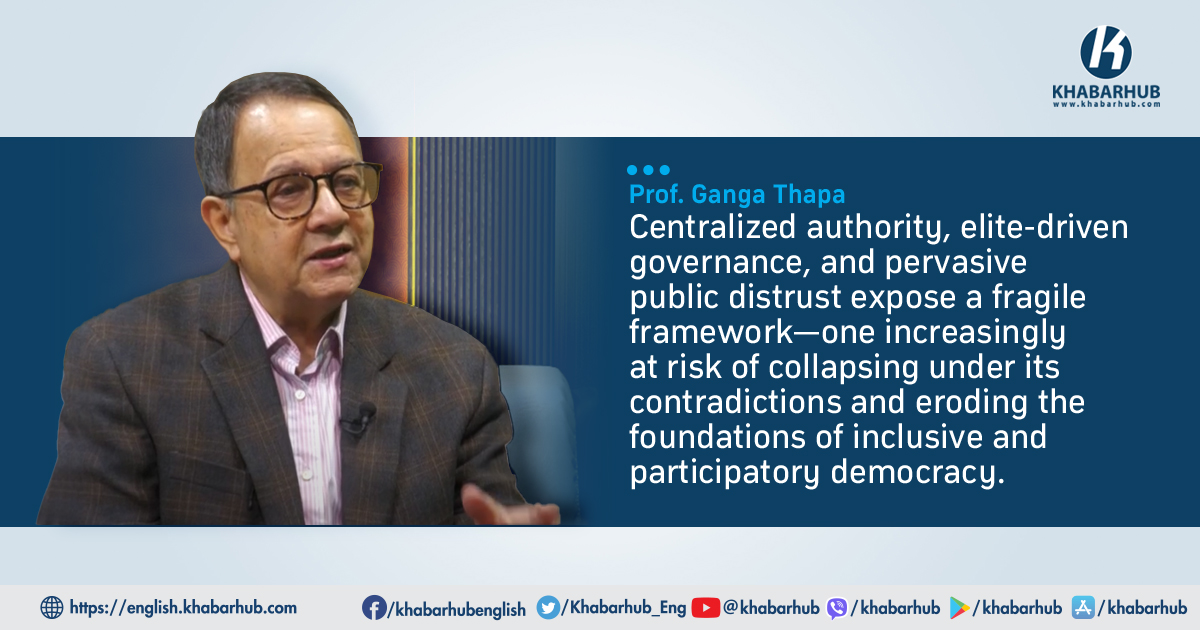
This growing divide between democratic form and democratic substance threatens its capacity to meet public needs, uphold norms, and sustain long-term viability. Centralized authority, elite-driven governance, and pervasive public distrust expose a fragile framework—one increasingly at risk of collapsing under its contradictions and eroding the foundations of inclusive and participatory democracy.






Comment