




The United States’ National Security Strategy 2025 (NSS-2025), Russia’s diplomatic recalibration, China’s expanding economic statecraft, India’s centrality, and Central Asia’s rising connectivity corridors collectively signal a transition toward a polycentric, infrastructure-driven global order in which India emerges as a pivotal strategic actor.
As Washington doubles down on New Delhi, Moscow pursues sanction-resilient diplomacy, Beijing intensifies its regional economic influence, and the Central Asian C5 (Kazakhstan–Kyrgyzstan–Tajikistan–Turkmenistan–Uzbekistan) reshape Eurasian transit, the international system is shifting toward a flexible multipolar structure defined not by blocs but by networks of connectivity, capability, and strategic autonomy.
Against the backdrop of deepening US–India defence integration, Russia’s renewed outreach to India, China’s economic activism, and the strategic rise of continental Eurasian corridors, a new world order is taking shape—one marked by multipolarity, multi-vector diplomacy, and the ascendancy of geoeconomic statecraft.
The international system in 2025 is undergoing a marked transformation. On the one hand, the US is recalibrating its engagement strategy, shifting from a broad multilateral framework toward targeted regional partnerships. On the other, China and Russia are expanding diplomatic and economic initiatives aimed at shaping a more multipolar Eurasian landscape.
This essay contends that the confluence of these developments signals a transition toward a multipolar, non-bloc, and increasingly continental global order, in which the strategic behavior of states is defined less by alliance commitments and more by intersecting networks of capability cooperation, economic interdependence, and connectivity corridors.
US NSS-2025: A Shift Toward Targeted Regionalism
Unveiled on 4 December, NSS-2025 reflects a significant departure from the multilateralist orientation model of NSS-2022 and prior years. Instead, NSS-2025 shifts toward a regionally concentrated, capability-driven Indo-Pacific strategy, with India elevated to a central strategic partner.
Emphasizing the need to modernize the CSTO’s joint capabilities, Putin proposed delivering modern, combat-tested Russian weapons to member states and highlighted the development of a unified air force and integrated air-defense system as priorities amid what he described as a shifting global security environment.
For Washington, New Delhi is now less a balancing option and more a core axis for defense co-production, sustainment, critical technologies, logistics integration, and energy security cooperation.
This approach embodies a broader trend in US statecraft: the recognition that the Indo-Pacific’s strategic balance cannot be shaped solely through traditional alliance structures. Instead, Washington seeks to cultivate capability partnerships that enhance resilience and interoperability without imposing alliance obligations on states that value autonomy.
This strategic reorientation underscores the US effort to maintain influence in an era of dispersed power, leveraging partnerships as a flexible tool rather than relying on the rigid logic of bloc politics. The long-term US aim is clear: to shape an Indo-Pacific where China’s influence is constrained not through containment coalitions but through distributed capability partnerships anchored in Indian growth.
The NSS reframes US grand strategy toward a narrower, more transactional “America First / Western Hemisphere–prioritized” posture while still stressing technological primacy, secure supply chains, and alliances where they directly serve US interests.
This produces a mixed result for US corridor-building in the Indo-Pacific. The NSS explicitly retains objectives—technological leadership, secure supply chains, and deterrence in Asia—that underpin the Indo-Pacific Economic Framework for Prosperity (IPEF), the Quadrilateral Security Dialogue (QUAD), the trilateral security pact between Australia, the United Kingdom, and the United States (AUKUS), as well as the Minerals Security Partnership (MSP), Clean Network logic, and the Blue Dot Network (BDN).
At the same time, the document’s emphasis on transactional partnerships, domestic economic advantage, and shifting attention to the Western Hemisphere creates political-economic volatility and conditionality for long-term multilateral corridors such as the India–Middle East–Europe Economic Corridor (IMEC) and the Partnership for Global Infrastructure and Investment (PGII).
The US is constructing a layered system of corridors, coalitions, and economic frameworks to counterbalance China’s rise, reconfigure global supply chains, and sustain influence across the Indo-Pacific, the Middle East, and the wider Eurasian rimland. Rather than relying on a single grand strategy, Washington is deploying overlapping instruments—security alliances, economic frameworks, and technology standards—each tailored to deliver tangible US strategic and economic returns.
The IPEF is a US-led economic initiative launched in 2022 with 14 partner countries, including Australia, India, Japan, South Korea, and Vietnam. It seeks to deepen economic cooperation in the Indo-Pacific through high-standard commitments across four pillars: trade (including digital rules), supply-chain resilience, clean economy initiatives (energy and decarbonization), and a fair economy (tax transparency and anti-corruption).
Unlike traditional free trade agreements, IPEF is a non-binding framework that emphasizes collaboration on future-oriented economic challenges rather than market access or tariff reductions, positioning itself as an alternative to China’s expanding regional influence.
At the connectivity level, initiatives such as IMEC and PGII serve as alternatives to China’s Belt and Road Initiative (BRI), linking India, the Gulf, Europe, and the Indo-Pacific through transport, energy, digital, and supply-chain networks. However, consistent with NSS-2025’s transactional orientation, US commitment to these corridors is selective: support is strongest where projects reinforce supply-chain resilience, reduce dependence on China, or anchor key partners—especially India—into US-aligned economic architectures.
Security partnerships form the hard-power backbone of this system. QUAD’s security-technology agenda (MDA, maritime cooperation, technology cooperation) is a natural fit with NSS deterrence and technological primacy goals, and AUKUS secures the Indo-Pacific maritime rimland, deters Chinese coercion, and binds allies into long-term military and technological cooperation.
These frameworks increasingly rely on partners to shoulder operational and financial burdens, reflecting the NSS emphasis on alliance-based burden-sharing rather than open-ended US commitments.
At the technological and standards-setting layer, initiatives such as the MSP, Clean Network logic, and the BDN protect US technological primacy by securing critical inputs, shaping digital and infrastructure norms, and limiting adversarial access to sensitive sectors. This layer is the highest priority under NSS-2025, receiving the most consistent political backing, regulatory authority, and funding momentum.
Taken together, this architecture operates across three mutually reinforcing layers: hard security deterrence, selective economic connectivity, and technology and standards control. Its unifying logic is not global development per se, but the creation of a trusted strategic ecosystem that delivers near-term US economic resilience, long-term technological advantage, and sustained influence without overextension.
Russia’s Recalibration: Diplomacy Under Sanctions and the India Vector
Russian President Vladimir Putin’s December 2025 state visit to New Delhi exemplifies Moscow’s strategy to counter diplomatic isolation and maintain relevance within Asia. During the 23rd India–Russia Annual Summit, both governments reaffirmed their “Special and Privileged Strategic Partnership,” while expanding cooperation in energy, defense, trade, and multilateral institutions such as BRICS and the Shanghai Cooperation Organization (SCO).
For Moscow, deepening ties with India serves three strategic objectives: diplomatic legitimacy and resilience in a sanctions-constrained environment; securing energy and trade flows buffered from Western pressure; and continued influence within India’s defense-industrial system.
For New Delhi, meanwhile, the summit yielded energy diversification and strategic autonomy, bargaining leverage vis-à-vis both Washington and Beijing, and renewed capital within BRICS and the SCO, among others—especially ahead of India’s BRICS chairship.
These dynamics illustrate a key characteristic of the new global order: states no longer choose camps; they choose combinations. The growing prevalence of dual-alignment strategies means India’s hydrocarbon purchases from Russia no longer contradict its defense-industrial partnership with Washington or its economic competition with China. Instead, India works with all three in multilateral forums while enhancing its bargaining position across the Indo-Pacific.
Russia’s RIC Revival Initiative and the Limits of Trilaterality
Moscow’s renewed advocacy, with a green light from Beijing in May, to institutionalize the Russia–India–China (RIC) trilateral mechanism reflects long-standing ambitions for a Eurasian counterweight to Western influence. While China has shown measured support and India conditional openness, structural constraints limit the potential of RIC as a cohesive strategic formation.
Three enduring barriers persist: entrenched and unresolved Sino-Indian border distrust; divergent economic priorities between China’s manufacturing-centric model and India’s developmental ambitions; and India’s non-negotiable commitment to strategic autonomy.
As a result, RIC is more likely to function as an issue-specific consultative platform than as a formalized geopolitical bloc. This again points to a defining feature of the emerging order: multipolarity without alliances. Cooperation advances in parallel with competition, and alignment is selective rather than comprehensive.
China’s Economic Statecraft and Counterbalancing the US–India Axis
As Washington and New Delhi deepen defense-industrial ties and Moscow courts Delhi, the Russia–China axis continues to deepen, with coordinated diplomacy and economic interdependence strengthening Beijing’s leverage. In addition, China has intensified its economic outreach across South Asia. China’s strategy rests on its ability to extend infrastructure financing, supply-chain integration, and trade linkages through the Belt and Road Initiative (BRI) and other associated bilateral mechanisms.
Simultaneously, China’s alignment with Russia has strengthened across security and diplomatic domains, reinforcing a Sino-Russian axis that challenges US structural influence even as Washington and New Delhi expand defense ties. Yet in South Asia, China’s approach remains primarily geoeconomic, seeking to maintain systemic influence. China understands that Indo-Pacific competition will be shaped not only by military capacity but also by connectivity and capital—by who finances roads, ports, data regimes, rare-earth supply chains, and green-transition infrastructure.
The result is a triangular dynamic defined less by ideological rivalry and more by competing systems of economic provision and infrastructure governance.
Eurasian Corridors and the Featured CSTO: Strategic Rise of Central Asia
Events in November 2025 underscore the growing relevance of continental Eurasia. The US attempt to reengage the C5 states—Kazakhstan, Uzbekistan, Turkmenistan, Kyrgyzstan, and Tajikistan—through a Washington summit coincided with the operationalization of a key segment of the International North–South Transport Corridor (INSTC), linking Russia to Iran via Kazakhstan and Turkmenistan.
The INSTC is modest in its initial logistical scale but profound in strategic implications. It exemplifies the emergence of sanction-resilient, non-Western connectivity routes, enabling Russia and Iran to bypass maritime chokepoints and Western-dominated transport systems. For the C5, such corridors transform their geopolitical role from peripheral buffer zones to central transit states in an increasingly continental trade architecture.
This reconfiguration is emblematic of a deeper shift: the rise of land-based Eurasian connectivity as a competitor—not a replacement—to maritime routes traditionally dominated by Western powers.
Putin used the 27 November Collective Security Treaty Organization (CSTO) summit in Bishkek to reinforce Russia’s leadership of the post-Soviet military bloc and to project a narrative of defensive intent, dismissing Western claims that Moscow plans to attack Europe as “lies” and “complete nonsense,” while presenting Russia as a stabilizing force committed to collective security.
The strategic shifts unfolding in 2025—reflected in the US NSS-2025, Russia’s renewed diplomatic outreach, China’s expanding economic activism, and the growing importance of Central Asian transit corridors—signal the emergence of a polycentric world order.
Emphasizing the need to modernize the CSTO’s joint capabilities, Putin proposed delivering modern, combat-tested Russian weapons to member states and highlighted the development of a unified air force and integrated air-defense system as priorities amid what he described as a shifting global security environment.
Despite Armenia’s continued boycott of the summit—its second consecutive absence in protest over the bloc’s failure to intervene during its conflict with Azerbaijan—the remaining CSTO members (Russia, Belarus, Kazakhstan, Kyrgyzstan, and Tajikistan) adopted a wide-ranging declaration reaffirming mutual defense commitments and outlining new initiatives to strengthen military coordination.
Through these measures and his public assurances of non-aggression, Putin sought to signal that the CSTO remains a viable security instrument, consolidate Russia’s influence over Eurasian security governance, and counter Western narratives about Moscow’s intentions, even as internal fractures—most notably Armenia’s disengagement—underscore the alliance’s structural limitations.
India’s Strategic Centrality in a Triangular Order
Across all developments—US strategy, Russian outreach, Chinese responses, and Central Asian integration—India occupies an increasingly pivotal position. India is uniquely situated to engage simultaneously with all major poles: through defense-industrial and technological partnerships with the United States; energy and defense procurement relationships with Russia; and a competitive yet interdependent economic relationship with China.
This multi-vector posture is not accidental but foundational to India’s long-standing doctrine of strategic autonomy. In a system no longer organized around bipolar or unipolar structures, India’s approach enables it to function as a balancer, facilitator, and agenda-setter across the Indo-Pacific and Eurasia.
Implications for the Emerging Global Order
The interplay of these strategic developments points toward a distinct configuration of global order with several defining characteristics:
First, multipolarity without bloc formation, as states increasingly pursue flexible alignments and avoid exclusive camps. Strategic autonomy is now widespread among both major and middle powers.
Second, infrastructure as geopolitics. Connectivity corridors, supply chains, logistics networks, and energy partnerships have become core instruments of statecraft, shaping influence through material interdependence rather than ideology.
Third, continental Eurasia’s elevation. Land corridors such as the INSTC and Trans-Caspian routes erode maritime dominance and reposition Central Asia and Iran as central nodes of global trade.
Fourth, India as a structural pivot. India’s centrality in US, Russian, and Chinese strategic calculations marks it as a systemic pole in the evolving multipolar order.
Under NSS-2025, US corridor and partnership initiatives prioritize tangible economic and security returns, elevate technology and supply-chain resilience over long-term development, and firmly position India as a central anchor in an increasingly competitive Indo-Pacific–Eurasian landscape.
Fifth, the declining relevance of zero-sum thinking. States reject binary choices and prefer diversified partnerships that maximize autonomy.
Finally, competition among systems, not ideologies. The contest is over technological ecosystems, supply-chain governance, critical minerals, and energy-transition pathways—not regime type.
Conclusion
The strategic shifts unfolding in 2025—reflected in the US NSS-2025, Russia’s renewed diplomatic outreach, China’s expanding economic activism, and the growing importance of Central Asian transit corridors—signal the emergence of a polycentric world order. This system is neither bipolar nor conventionally multipolar, but defined by fluid alignments, infrastructure-led geopolitics, and the reassertion of continental Eurasia as a central strategic arena alongside maritime power.
Within this evolving configuration, India occupies a pivotal position. Embedded simultaneously in major US-led security, economic, and technology frameworks, India occupies a unique position across all layers of this architecture—simultaneously embedded in IMEC, IPEF, QUAD, PGII, and MSP. It functions as the maritime anchor of the Indian Ocean, the connective bridge between the Middle East and Europe, and the principal industrial and demographic alternative to China.
This makes India indispensable to both US rimland security strategies and Eurasian connectivity ambitions. Its ability to operate across security, connectivity, and geoeconomic domains makes India indispensable to both US rimland strategies and broader Eurasian integration efforts.
For South Asia, this shifting balance elevates geoeconomic significance while narrowing strategic space. Intensifying US–China–India competition will increasingly shape regional choices in minerals, digital infrastructure, energy, and supply chains. Nepal and other smaller states may benefit from new investment and connectivity opportunities through alignment with India-linked frameworks, but such gains come with reduced autonomy as infrastructure and technology decisions become more overtly strategic.
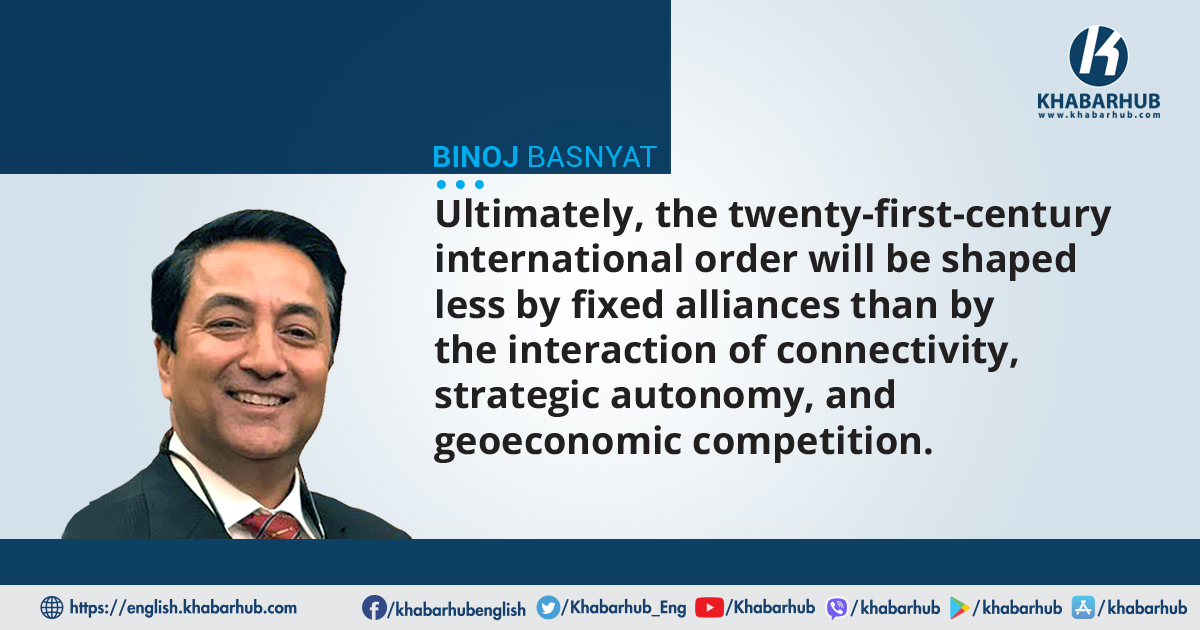
Ultimately, the twenty-first-century international order will be shaped less by fixed alliances than by the interaction of connectivity, strategic autonomy, and geoeconomic competition. Under NSS-2025, US corridor and partnership initiatives prioritize tangible economic and security returns, elevate technology and supply-chain resilience over long-term development, and firmly position India as a central anchor in an increasingly competitive Indo-Pacific–Eurasian landscape.
(Basnyat is a Maj. Gen. (Retd.) and a strategic affairs analyst based in Kathmandu. He writes on South Asian geopolitics, national security, and the intersection of governance, diplomacy, and stability.)






Comment