




KATHMANDU: After more than a year at the helm, Nepal’s Prime Minister KP Sharma Oli is preparing for a crucial official visit to neighboring India. This visit comes at a time when Nepal-India relations face longstanding challenges—from border disputes to trade imbalances and water resource management.
While the location of the meeting in Bodh Gaya—a site deeply connected to shared cultural and spiritual heritage—adds symbolic significance, the visit’s real test lies in addressing concrete bilateral issues.
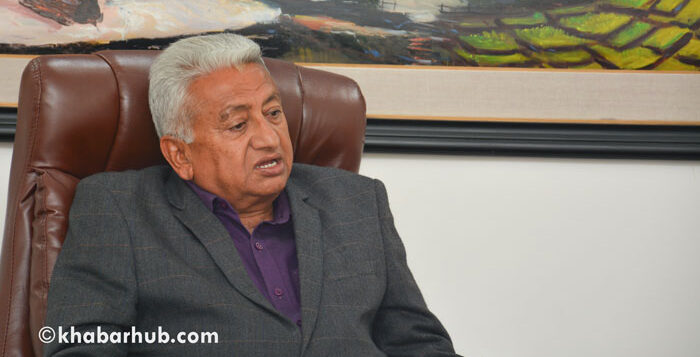
To shed light on what Nepal should prioritize and expect from this diplomatic engagement, Khabarhub spoke with Deep Kumar Upadhyaya, former Nepali ambassador to India.
Drawing on his extensive experience, Upadhyaya offers insights into the state of the relationship, the hurdles ahead, and the strategies Nepal must adopt to make this visit a meaningful step forward.
What issues should Prime Minister KP Sharma Oli raise during his upcoming visit to India?
The Prime Minister’s visit to India is certainly significant, especially after 15 months in office. However, we need to be realistic about expectations. Nepal-India relations are essentially where they were — I don’t see any major structural changes.
The global situation has changed, and so have the expectations from both sides. There have been questions in India as well about why relations with a close neighbor like Nepal have deteriorated in the past. This visit seems to be aimed at addressing that concern.
Still, I don’t expect major breakthroughs. The agenda cannot progress unless India is ready to discuss it. There are several long-standing issues that need to be addressed, and they must be raised clearly.
Could you elaborate on those issues?
Yes, for example, the border dispute is a serious matter. It should be discussed openly, and both sides should seek a constructive resolution. We are now in the 21st century — the century of water. Water today is not only about irrigation and drinking supply; it’s about energy, storage, and strategic resource management.
Nepal has immense potential for hydropower and water resource development, but India continues to exert a form of monopoly over its multiple uses. That’s something we feel deeply as a nation.
Another important point is trade. Nepal faces a huge trade deficit with India. We need to talk about reducing that imbalance, attracting technological and financial investment, and accelerating our economy.
There are frameworks in place, like agreements related to the Integrated Check Posts (ICPs), customs, and quarantine facilities. These are positive developments, but implementation has been extremely weak.
What does Nepal need to do to make this visit more effective?
Nepal must come prepared with clear priorities and ensure that India is willing to engage on those topics. Without that, the visit may become just a diplomatic formality. It’s easy to say the relations are warm and improving, but we should judge the visit by tangible outcomes, not symbolism alone.
Some see the choice of Bodh Gaya for the meeting — rather than New Delhi — as unusual. What is your take?
It is certainly an interesting shift. Usually, official meetings like this are held in Delhi. Choosing Bodh Gaya, where Lord Buddha attained enlightenment, may carry a symbolic message — perhaps one of spiritual and cultural affinity. But the substance of the visit matters more than the location. Let’s hope it leads to meaningful dialogue and results that serve Nepal’s interests.
It has been decided that Indian Prime Minister Narendra Modi will meet Prime Minister KP Sharma Oli in Bodh Gaya, Bihar, instead of the traditional venue in New Delhi. What message does this send?
From what I’ve observed, official state visits are typically hosted with ceremonial honors at Rashtrapati Bhavan in New Delhi. This has been a long-standing tradition. However, this time, that tradition is being bypassed. That itself is a symbolic change.
India Prime MInister Modi’s birthday also falls close to the visit, and perhaps more importantly, Bodh Gaya has immense spiritual and historical significance. Gautam Buddha, born in Nepal, attained enlightenment there.
Three of the four Buddhist pilgrimage sites are located in India. So, holding the meeting in Bodh Gaya may reflect an attempt to deepen cultural and civilizational ties, even if political relations fluctuate.
But let’s be clear — this symbolism cannot substitute for substantive diplomacy. The reality is that unless India agrees, many key bilateral issues won’t even be discussed.
That’s where Nepal’s diplomatic maturity, seriousness, and negotiation skill must come in. The time is short. What the government can accomplish remains to be seen.
What are the specific issues Nepal should raise during this visit? As a former ambassador to India, what would your recommendations be to the government?
The border dispute must be at the top of the agenda. We’ve already completed 97 percent of digital mapping, and there have been commitments to resolve it through the established mechanisms.
That’s a positive development. But let’s not forget: Kalapani, Lipulekh, Limpiyadhura, and Susta were all listed as disputed territories in earlier protocols.
Now, India has effectively brought them under its unilateral control — and they continue to be administered as such. That’s a major concern, and while resolution may take time, dialogue must begin. Silence only deepens the problem.
Another critical issue is water. We need to talk seriously about the Koshi and Gandak agreements. Are Nepali farmers receiving their fair share of water as per the treaties? No. Are they being compensated for flood damage and erosion caused by these structures? Again, no.
These concerns have been raised before — even during my tenure — including with Indian leaders. But progress stalls, and when pressured, India makes superficial gestures and then steps back.
India has built embankments and dams that violate international norms. I’m from the Terai myself — and I’ve seen the ground realities. During monsoon, unless India opens the gates, we can’t harvest rice or wheat. We must talk about these practical problems — not just the policy on paper.
What other areas should Nepal focus on during this visit?
Trade is another key issue. The deficit is unsustainable. We must also bring up the issue of connectivity. For instance, Nepal built the Lumbini and Pokhara international airports with great effort, partly responding to calls from the international community — including India.
Yet India has hesitated to make them fully operational by enabling flight routes or scheduling regular service. Why? That should be addressed directly.
We also need to speak up about initiatives like the Ramayana Circuit, Mahabharata Circuit, and Buddhist Circuit. These were India’s proposals. Nepal has taken steps, but India hasn’t reciprocated in full.
The broader problem is that India has increasingly been shaping the water and energy discourse to suit its interests. For example, it’s trying to bring all major projects in the Arun Valley under its control. Nepal must stay alert to this.
Our biggest strategic asset is water. We should insist on the involvement of a credible international mediator — one trusted by both countries — to prepare the Detailed Project Reports (DPRs). That ensures balance, transparency, and fairness.
Instead, India wants to prepare the DPRs on its own terms and keep control over execution. This kind of monopoly does not benefit either side in the long run. We must press for joint mechanisms based on international law — something that reflects a true partnership, not one-sided advantage.




Comment