




When the five Central Asian heads of government — Kazakhstan, Uzbekistan, Turkmenistan, Kyrgyzstan, and Tajikistan — gathered in Washington to meet President Donald Trump on 6 November, it signified more than a ceremonial summit. It represented a recalibration of global strategic geometry.
The U.S., after years of geopolitical distraction, reasserted itself in the heart of Eurasia — a region long considered the backyard of Russia and the expansion corridor of China. For the Central Asian republics, this was an opportunity to expand political space, diversify economic dependencies, and enhance strategic autonomy.
For smaller states such as Nepal, caught in their own geopolitical vortex, the C5 experience offers vital lessons in how to survive and succeed in an era of multipolar competition.
Context: A New Strategic Frontier
The Washington summit comes at a critical juncture. Russia, sanctioned and economically constrained by its war in Ukraine, has deepened its reliance on China. Beijing, in turn, has expanded its Belt and Road Initiative (BRI) through Central Asia, locking in infrastructure, energy, and digital dependencies.
Yet the arrival of the first Russian freight train to Iran via Kazakhstan and Turkmenistan — bypassing Western routes — underscores how new corridors are reshaping Eurasian logistics. The North–South Transport Corridor is being strategically integrated with Iran, the Caspian, and India, subtly challenging Western supply networks while opening new options for regional actors.
For small states, the binary choice is an illusion. What matters is selective engagement — using geography to attract, not submit. If the C5 can negotiate multiple partnerships without surrendering sovereignty, Nepal too can design a hybrid model of connectivity diplomacy rooted in transparency, domestic consensus, and regional cooperation.
In this flux, Washington’s decision to host the C5+1 summit reflects a recognition that influence in Central Asia cannot be conceded to Moscow or Beijing alone. The U.S. seeks to insert itself into the Eurasian equation — economically through supply chains, politically through engagement, and strategically through critical mineral access. The C5, in turn, leverage this engagement to enhance sovereignty and attract investment.
The U.S. Strategic Calculus
At the heart of the U.S. initiative lies a multidimensional strategic logic. First, Washington aims to secure access to critical minerals — particularly uranium, lithium, and rare earth elements — resources that underpin modern technologies, clean energy, and defense systems. Kazakhstan alone supplies nearly 40 percent of global uranium, a sector vital for U.S. energy security.
Second, the U.S. is building alternative trade corridors that bypass Russia and China — such as the Middle Corridor linking Central Asia through the Caspian to the South Caucasus and onward to Europe. This diversification of supply routes complements the broader Indo-Pacific economic vision.
Third, Washington seeks to reassert diplomatic influence in a region that has long drifted toward authoritarian consolidation and Sino-Russian dominance. By hosting the C5 in Washington, Trump signals a deliberate re-entry of American diplomacy into Eurasia’s inner circle, showing that Washington can still shape the global periphery.
Finally, the engagement forms part of a broader global balancing strategy. If the Indo-Pacific anchors U.S. engagement with maritime democracies, Central Asia represents the continental flank — where American credibility as a balancing power will be tested.
India’s Balancing Equation: Between Alignment and Autonomy
For India, Washington’s renewed push into Central Asia presents both strategic openings and structural dilemmas. On the positive side, deeper engagement with the United States strengthens India’s access to advanced technologies, defense cooperation, and energy partnerships — key enablers of its rise as a regional power. U.S. efforts to secure critical minerals and diversify Eurasian supply chains align closely with India’s own ambitions to reduce dependence on China and assert leadership in the Global South.
Moreover, a stronger U.S. presence in Central Asia indirectly enhances India’s connectivity prospects, particularly through the India–Middle East–Europe Corridor (IMEC) and potential complementarities with the North–South Transport Corridor.
Yet this partnership also carries constraints. India’s historical ties with Russia — from defense to energy — and its pragmatic relationship with Iran place it in a delicate position as U.S. sanctions and geopolitical rivalries intensify. Excessive alignment with Washington could limit New Delhi’s strategic autonomy, the very foundation of its foreign policy.
Balancing these competing imperatives — deepening U.S. cooperation while preserving space for maneuver with Moscow and Tehran — remains India’s central diplomatic challenge. For Nepal and other South Asian states, India’s balancing act underscores a vital lesson: strategic partnerships must enhance sovereignty, not erode it.
C5 Leverage and Strategy
For the five Central Asian states, this summit was neither an act of alignment nor defiance — it was an act of balancing. Each seeks to pursue “multi-vector” diplomacy, maintaining ties with Russia and China while cautiously courting the United States, the European Union, and the Gulf.
Politically, the meeting confers prestige. The image of five presidents welcomed at the White House elevates their diplomatic standing, showing domestic audiences and rival powers that they have options beyond Moscow and Beijing.
Economically, the C5 see potential in diversifying capital inflows. U.S. investments in technology, renewable energy, logistics, and the processing of minerals promise modernization. If backed by institutional follow-through, these engagements could reduce overreliance on Chinese infrastructure loans and Russian trade corridors.
Strategically, the C5 now occupy a unique position as connectors. Their geography allows them to act as a land bridge between Europe, South Asia, and the Middle East — giving them leverage over transit, energy pipelines, and new trade corridors.
In essence, the C5 states are converting geography into strategy — transforming landlocked vulnerability into land-linked advantage. This is a profound lesson for Nepal.
Lessons for Nepal: From Geographic Dependency to Strategic Autonomy
Nepal’s situation, though distinct, shares critical parallels. Like the C5, Nepal is a small state sandwiched between two major powers. It faces the same question: how can a small nation maintain autonomy amid competing great-power ambitions? The Central Asian experience offers several insights.
Lesson One: Diversify Strategic Partnerships.
The C5 leaders’ outreach to Washington demonstrates the power of diversification. Nepal’s foreign policy has historically oscillated between India and China. Yet in the emerging world order, dependence on two neighbours limits maneuverability. Kathmandu can broaden engagement — with the U.S., the EU, Japan, ASEAN, and regional forums such as BIMSTEC — without compromising core ties. Strategic diversification builds resilience.
Lesson Two: Build Economic Leverage through Connectivity.
Just as Kazakhstan and Uzbekistan are turning their geographic disadvantage into a logistical asset, Nepal can leverage its position as a Himalayan transit node between South and East Asia. Investment in cross-border railways, digital corridors, and clean energy exports (hydropower) could position Nepal as a corridor economy.
Aligning with trans-regional projects such as the India–Middle East–Europe Corridor (IMEC) or BRI’s green standards could yield tangible dividends if negotiated with transparency and balance.
Lesson Three: Institutional Professionalism in Diplomacy.
The C5 approach reflects coherence — each country prepared its policy teams with investment portfolios and clear agendas. Nepal’s diplomatic apparatus, by contrast, remains fragmented, politicized, and reactive.
Establishing a professional foreign service, clear economic diplomacy units, and a unified trade–investment authority is essential to extract value from high-level engagements.
Lesson Four: National Consensus on External Strategy.
In Central Asia, despite internal differences, there is broad consensus on multi-vector diplomacy. In Nepal, foreign policy remains hostage to partisan competition. Without internal consensus, external actors exploit divisions. The C5 experience underscores that small-state stability abroad begins with political unity at home.
Risk Matrix: Balancing in a Tight Corridor
The Central Asian states face risks that Nepal must heed:
Over-Commitment Risk: Aligning too closely with one power invites suspicion from others. For Nepal, an excessive tilt toward either India or China undermines credibility.
Economic Over-Exposure: Overreliance on external financing (as seen in some BRI projects) can generate debt dependency. Nepal must insist on transparent, competitive bidding and public accountability in all foreign-funded projects.
Institutional Weakness: Without governance capacity, foreign engagement becomes symbolic. Unless Nepal strengthens institutions of trade, investment, and diplomacy, it cannot convert partnerships into progress.
Geostrategic Fatigue: Small states risk being overwhelmed by constant great-power competition. The antidote lies in clarity of national priorities — economic security, infrastructure resilience, and political credibility.
Action Points for Nepal
Institutionalize Multi-Vector Diplomacy: Establish a National Strategic Council under the Prime Minister to coordinate policies across foreign affairs, commerce, and defense.
Create a Connectivity Blueprint: Develop a ten-year plan identifying key corridors — rail, energy, and digital — that integrate with both Indian and Chinese networks but preserve sovereignty.
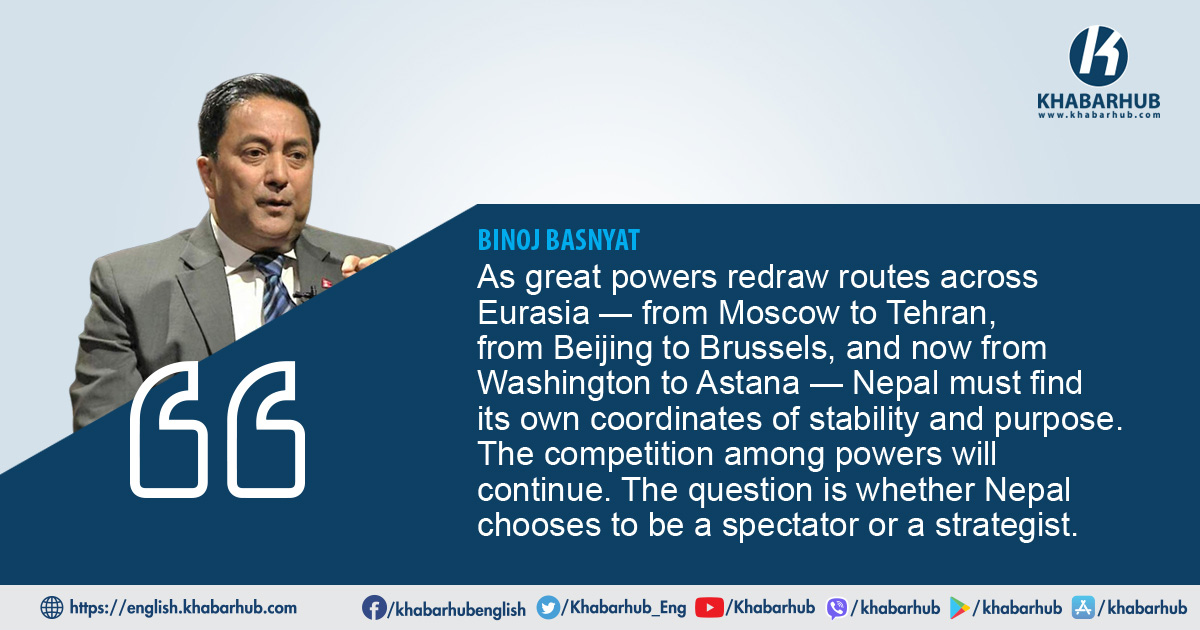
As great powers redraw routes across Eurasia — from Moscow to Tehran, from Beijing to Brussels, and now from Washington to Astana — Nepal must find its own coordinates of stability and purpose. The competition among powers will continue. The question is whether Nepal chooses to be a spectator or a strategist.
Revive Economic Diplomacy: Deploy professional envoys to target critical minerals, hydropower export, and tourism investment rather than ceremonial representation.
Leverage Regional Platforms: Engage actively with BIMSTEC, SCO observer status, and BRICS+ initiatives to project regional identity beyond South Asia.
Build Strategic Communication: Establish an information diplomacy unit to communicate Nepal’s neutrality, reform progress, and investment climate — countering misinformation and strategic manipulation.
The Broader Geopolitical Context
The Washington C5+1 summit coincides with the expansion of alternative Eurasian corridors — such as the Russian–Iranian North–South Transport Corridor and the China–Pakistan Economic Corridor extensions. This dual movement — one led by Washington, another by Moscow–Beijing–Tehran — defines the new great-power contest for continental Eurasia. Each aims to control the arteries of connectivity, energy, and digital networks.
For small states, the binary choice is an illusion. What matters is selective engagement — using geography to attract, not submit. If the C5 can negotiate multiple partnerships without surrendering sovereignty, Nepal too can design a hybrid model of connectivity diplomacy rooted in transparency, domestic consensus, and regional cooperation.
Conclusion: Turning Geography into Strategy
The lesson from Central Asia is neither to align blindly with one power nor to retreat into isolation. It is to act with strategic clarity, professional diplomacy, and national coherence. The C5 nations demonstrated that even in a zone of overlapping hegemony, small states can preserve agency — provided they are proactive, not passive.
Nepal’s challenge is similar: to redefine neutrality as strategic engagement, to replace dependency with diversification, and to turn its geography into a source of power. The Washington summit should therefore be read not as distant Eurasian theatre, but as a case study in how small nations carve space in a crowded geopolitical map.
As great powers redraw routes across Eurasia — from Moscow to Tehran, from Beijing to Brussels, and now from Washington to Astana — Nepal must find its own coordinates of stability and purpose. The competition among powers will continue. The question is whether Nepal chooses to be a spectator or a strategist.
(Basnyat is a Maj. General (Retd.) and a strategic affairs analyst based in Kathmandu. He writes on South Asian geopolitics, national security, and the intersection of governance, diplomacy, and stability.)






Comment