




On 6 November, U.S. President Donald Trump welcomed the leaders of all five Central Asian nations to the White House for a C5+1 summit, underscoring Washington’s renewed engagement with the region.
The discussions centered on deepening economic cooperation, bolstering energy security, and enhancing access to critical minerals — key priorities as the U.S. seeks to strengthen its regional footprint amid growing competition from China and Russia.
Just two days later, the first Russian freight train arrived at Iran’s Aprin dry port (near Tehran) on 8 November from a station north of Moscow — a 62-container convoy completing a 12-day, 900-kilometer journey through Kazakhstan and Turkmenistan. What may seem like a modest logistical success, in geopolitical terms, represents a fundamental realignment of Eurasian trade geography and strategic power.
This route, bypassing Western-controlled chokepoints, operationalizes a vital segment of the North–South Transport Corridor (NSTC) and embeds the Central Asian C5 states — Kazakhstan, Uzbekistan, Turkmenistan, Kyrgyzstan, and Tajikistan — into the evolving matrix of post-Western Eurasian connectivity.
A New Map of Power and Commerce
Since the Ukraine conflict and Western sanctions, Moscow has pursued aggressive diversification of trade routes to reduce dependency on Europe. The new freight line — running from Russia through Kazakhstan and Turkmenistan into Iran — establishes a direct land link between the Russian heartland and the Persian Gulf. For Iran, long isolated by sanctions, the corridor enhances its economic sovereignty by integrating it into continental logistics chains linking the Caspian to the Indian Ocean.
While opportunities are evident — increased trade, transit revenues, and geopolitical leverage — there are also risks of dependency and overreach. Russia’s economic weight remains significant, and Iran’s international standing is uncertain amid domestic and external pressures.
For Central Asia and South Asia, this is not merely about trade; it is about strategic centrality. The region has suddenly become the indispensable land bridge connecting the northern Eurasian economies with southern and western markets. It offers a rare convergence point where Russian strategic necessity, Iranian ambition, Chinese rivalry, Indian aspirations, and Central Asian pragmatism meet.
Russia and Iran: Sanctions as a Catalyst for Realignment
The Moscow–Tehran convergence is a case of adversity breeding strategic innovation. Both nations have been subjected to extensive Western sanctions, forcing them to create sanction-proof corridors and new financial mechanisms independent of the dollar. The corridor through the C5 states thus represents a resilient logistics ecosystem — one that cannot be easily disrupted by Western pressure.
This alignment is not confined to transport; it fits within a broader framework of Eurasian cooperation under the Eurasian Economic Union (EAEU), the Shanghai Cooperation Organization (SCO), and Brazil–Russia–India–China–South Africa Plus (BRICS+), where Russia and Iran are now key members. The new corridor physically manifests this multipolar strategy — a land-based alternative to maritime globalization historically dominated by Western powers.
The NSTC, once envisioned as a supplementary route, is now turning into a strategic artery of a new world order. With this train’s arrival, Russia and Iran are sending a clear message: the heart of Eurasia can sustain trade, growth, and political coordination independent of the trans-Atlantic system.
C5 States at the Crossroads of Multipolar Competition
The five Central Asian republics, long regarded as Russia’s backyard or China’s frontier, now stand at the intersection of multiple strategic projects — Russia’s NSTC, China’s Belt and Road Initiative (BRI), and Western efforts to revive Trans-Caspian connectivity. Each C5 state must now balance its diplomatic vector — engaging Moscow and Beijing without alienating Washington, New Delhi, or Brussels.
Kazakhstan: The Northern Gateway
Kazakhstan emerges as the immediate beneficiary of the new corridor. Its well-developed rail network and geographical contiguity make it the northern anchor of the NSTC. For Astana, this diversification enhances strategic leverage — allowing it to benefit from both east–west (China–Europe) and north–south (Russia–Iran–India) trade flows.
Kazakhstan’s long-standing “multi-vector diplomacy” gains new substance: it can now act as a balancing force between Russia, China, and the West while monetizing its transit geography.
Turkmenistan: The Neutral Bridge
Turkmenistan’s role is equally crucial. Traditionally isolationist and neutral, Ashgabat has become the pivotal land bridge linking Kazakhstan’s rail system to Iran’s. For Turkmenistan, this corridor promises not only transit revenue but renewed regional relevance.
It also reinforces its ambition to serve as a neutral logistics hub that can connect Caspian ports westward to the Caucasus and Europe — should the geopolitical climate permit.
Uzbekistan: The Balancer and Innovator
Uzbekistan, though not directly on this route, will seek to plug into it via spur lines through Turkmenistan and Afghanistan. President Shavkat Mirziyoyev’s policy of “open regionalism” envisions Tashkent as the economic pivot of Central Asia. Access to Iranian ports at Chabahar and Bandar Abbas — and, through them, the Indian Ocean — would give Uzbekistan an alternative to Chinese- or Russian-controlled outlets.
Kyrgyzstan and Tajikistan: The Peripheral Integrators
For Kyrgyzstan and Tajikistan, indirect benefits come through regional integration, energy transit, and investment inflows tied to new rail and road projects. Their participation in the SCO and BRI frameworks complements the north–south logistics grid, even if their terrain and limited infrastructure restrict immediate participation.
India’s Balancing Path: Navigating Between Washington, Moscow, and Beijing
For India, the deepening U.S. engagement in Central Asia presents both opportunities and challenges. On one hand, closer strategic alignment with Washington offers New Delhi access to advanced technologies, defense cooperation, and a stronger position in countering China’s influence across the Indo-Pacific and Eurasian corridors.
U.S. initiatives in critical minerals and energy security also complement India’s own efforts to diversify supply chains and reduce dependence on unstable regions.
Yet this partnership comes with complications: American priorities in the region do not always align neatly with India’s long-term strategic autonomy — particularly regarding Iran and Russia, two countries with which India maintains pragmatic ties.
The U.S. engagement with Pakistan also marks a shift from its previous stance of prioritizing India. Balancing these relationships while advancing its own regional influence will test India’s diplomatic dexterity in the evolving geopolitical landscape.
The C5 and the Art of Multi-Vector Diplomacy
For all five states, the greatest asset lies not in aligning fully with any single power, but in maximizing connectivity while preserving autonomy. The corridor gives the C5 leverage — a bargaining chip in their dealings with Moscow, Beijing, and Washington alike.
This is the essence of multi-vector diplomacy, pioneered by Kazakhstan and now adopted across the region: maintaining equidistance, promoting regional cooperation, and leveraging geography for political and economic gain.
Yet such a posture also invites complexity. Overdependence on Russian or Iranian transit routes could create vulnerabilities if sanctions regimes tighten or power dynamics shift. Balancing this with engagement in Western and Indo-Pacific initiatives such as the Trans-Caspian International Transport Route (TITR) and the India–Middle East–Europe Corridor (IMEC) will be essential to avoid strategic entrapment.
America’s Renewed Engagement: Competing Corridors
Trump’s reported re-engagement with the C5 heads of government reflects a U.S. realization that the heart of Eurasia cannot be ignored. Washington seeks to counter the emerging Russia–China–Iran triangle by offering investment, digital infrastructure, and energy partnerships.
However, the U.S. faces structural disadvantages: lack of contiguity, limited commercial logistics presence, and the perception that its involvement is episodic and reactive.
To be effective, U.S. policy would need to focus on building resilient supply chains and promoting private sector–led connectivity rather than purely military or sanction-based postures. Yet for most Central Asian leaders, Western corridors remain promises, while Russian and Chinese projects arrive with funding and physical infrastructure.
A Quiet Eurasian Revolution
Beyond immediate logistics, this new Russia–Iran corridor represents the crystallization of a post-Western Eurasian order. It encapsulates three major trends:
One — Sanction-Resilient Integration: Russia and Iran are creating economic arteries immune to Western control — from trade routes to financial settlement systems in local currencies.
As new corridors emerge across the steppe, desert, and Caspian shores, one truth stands out: the future of global connectivity is no longer maritime or Western. It is continental, multipolar, and decisively Eurasian — with the C5 at its strategic core.
Two — Multipolar Connectivity: The C5 states are transforming from peripheral spaces into strategic connectors in a land-centric globalization network.
Three — Erosion of Western Maritime Dominance: Land routes are increasingly replacing sea-based trade controlled by Western powers, reshaping supply chains from Europe to South Asia.
These developments carry long-term implications. The Caspian basin and Central Asia, once regarded as buffer zones, are turning into core transit and diplomatic hubs. Moscow and Tehran’s deepening cooperation may also accelerate BRICS+ integration, with Central Asia playing the role of logistical bridge between Russia, Iran, India, and China.
Risks and Opportunities
While opportunities are evident — increased trade, transit revenues, and geopolitical leverage — there are also risks of dependency and overreach. Russia’s economic weight remains significant, and Iran’s international standing is uncertain amid domestic and external pressures.
Central Asian states must therefore diversify their partnerships, modernize customs systems, and ensure that corridors do not become conduits of dominance.
Moreover, regional cooperation among the C5 themselves remains uneven. Without a coherent collective framework, individual states may negotiate in silos, undermining their collective bargaining power. A coordinated C5 approach to Eurasian connectivity could transform them from passive transit states into active architects of continental integration.
The Road Ahead
The inaugural freight train from Russia to Iran via Kazakhstan and Turkmenistan is far more than an engineering feat. It is a declaration of strategic intent — the manifestation of a new Eurasian geometry of power.
In this evolving landscape, the C5 nations are no longer landlocked; they are land-linked. Their choices — how to balance between Russia’s strategic pull, China’s economic gravity, and Western re-engagement — will shape the future of the Eurasian order.
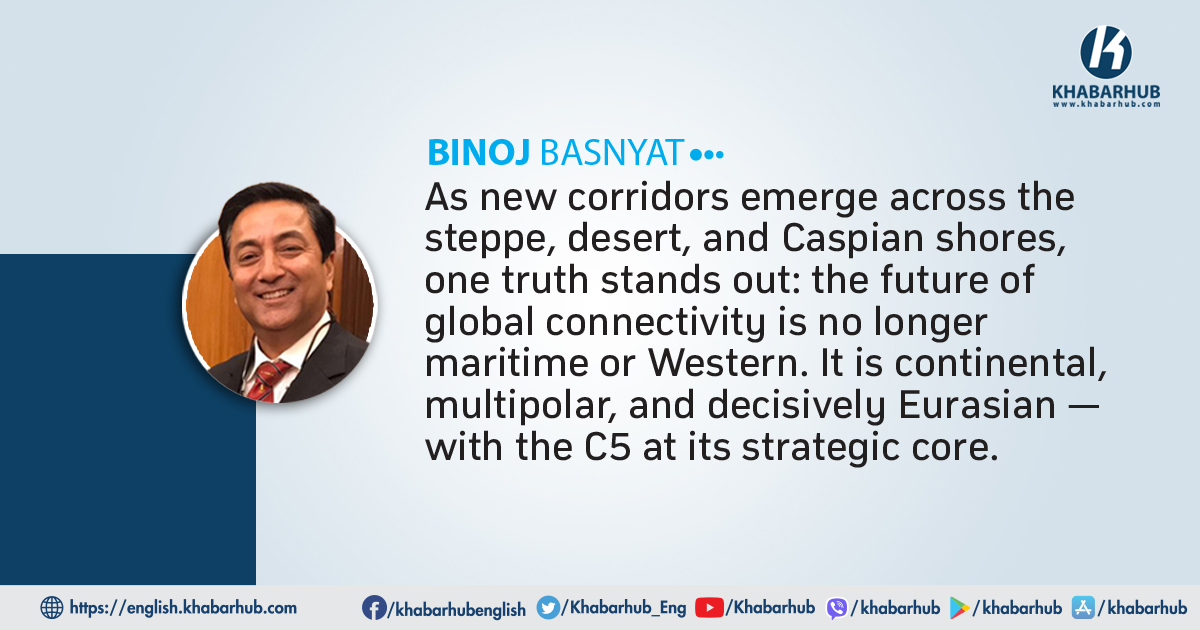
As new corridors emerge across the steppe, desert, and Caspian shores, one truth stands out: the future of global connectivity is no longer maritime or Western. It is continental, multipolar, and decisively Eurasian — with the C5 at its strategic core.
(Basnyat is Maj. Gen. (Retd.) and a strategic affairs analyst based in Kathmandu. He writes on South Asian geopolitics, national security, and the intersection of governance, diplomacy, and stability.)






Comment