




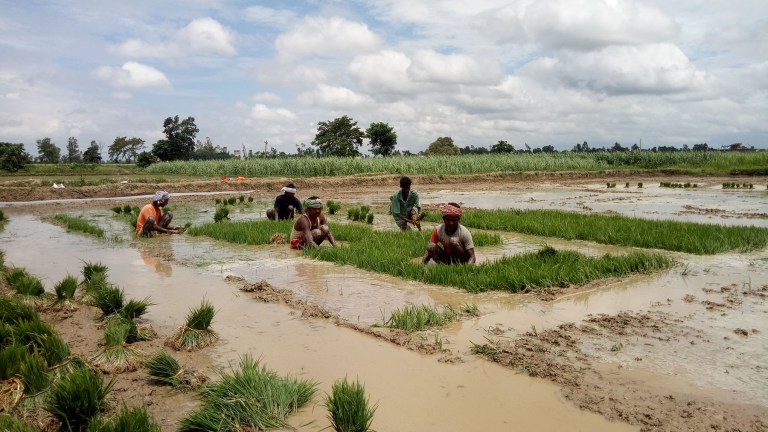
JHAPA: Farmers in Jhapa are growing increasingly anxious as the dry spell continues late into the month of July, traditionally the peak time for paddy plantation.
Govinda Ghimire, a farmer from Mechinagar Municipality-15, is disheartened by the lack of rainfall. “In previous years, planting would be completed by now, but this year, my two bighas of land remain dry. Ants are crawling where water should be,” he said. “We’ve prepared the seedbeds, but without rain, planting seems impossible.”
Shyam Adhikari, a farmer from Arjundhara Municipality-8, shares a similar plight. He has been cultivating paddy on one bigha of land under a yearly lease for the past five years, but the current drought is threatening his livelihood.
“I have to pay Rs 50,000 annually for the lease, but I may not even be able to plant this season,” he said, highlighting the financial stress farmers are under.
Much of Jhapa’s farmland lacks access to proper irrigation infrastructure. As a result, most farmers rely solely on monsoon rains.
According to Sagar Bista, head of the Agricultural Knowledge Center, only 21 percent of paddy planting has been completed in the district so far. “Only the areas with canal and underground irrigation have seen some planting. The rest are waiting for rain,” Bista said.
The monsoon officially arrived in Koshi Province on Jestha 15, but following heavy rains and flooding on Jestha 17—which submerged 22 homes in Jhapa’s Maikhola area—precipitation has sharply declined. This has left fields parched during the most crucial planting window.
Out of 98,716 hectares of cultivable land in Jhapa, 75,559 hectares are typically used for paddy cultivation. For early-maturing varieties, sowing must be completed by the end of July.
Although major irrigation projects like Kankai, Ninda, Tangting, Paliya, Khudunabari, Siddhinahar, and Bhuteni Khola are operational, many areas still lack sufficient water access.
Some municipalities such as Kachanakabal, Kankai, Kamal, Gauradaha, Mechinagar, Birtamod, and Barhadashi have limited underground irrigation, but much of the district still relies on rain-fed agriculture.


Comment