




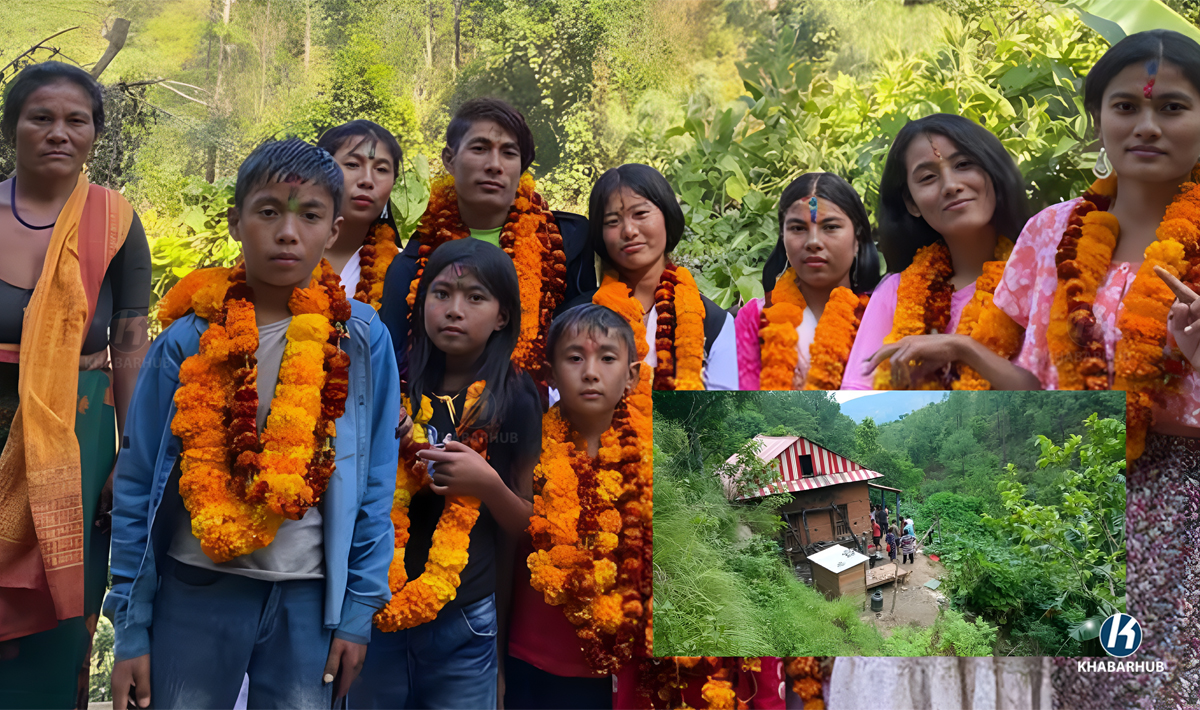
KATHMANDU: A Hayu family of 16 who mysteriously left their home in the middle of the night on July 24 has refused to return, citing fear that the spirit of the deceased father has possessed their 13-year-old daughter.
The incident, which initially sparked widespread concern over their sudden disappearance, has now taken a deeper turn, revealing a complex mix of spiritual belief, family tension, and financial hardship.
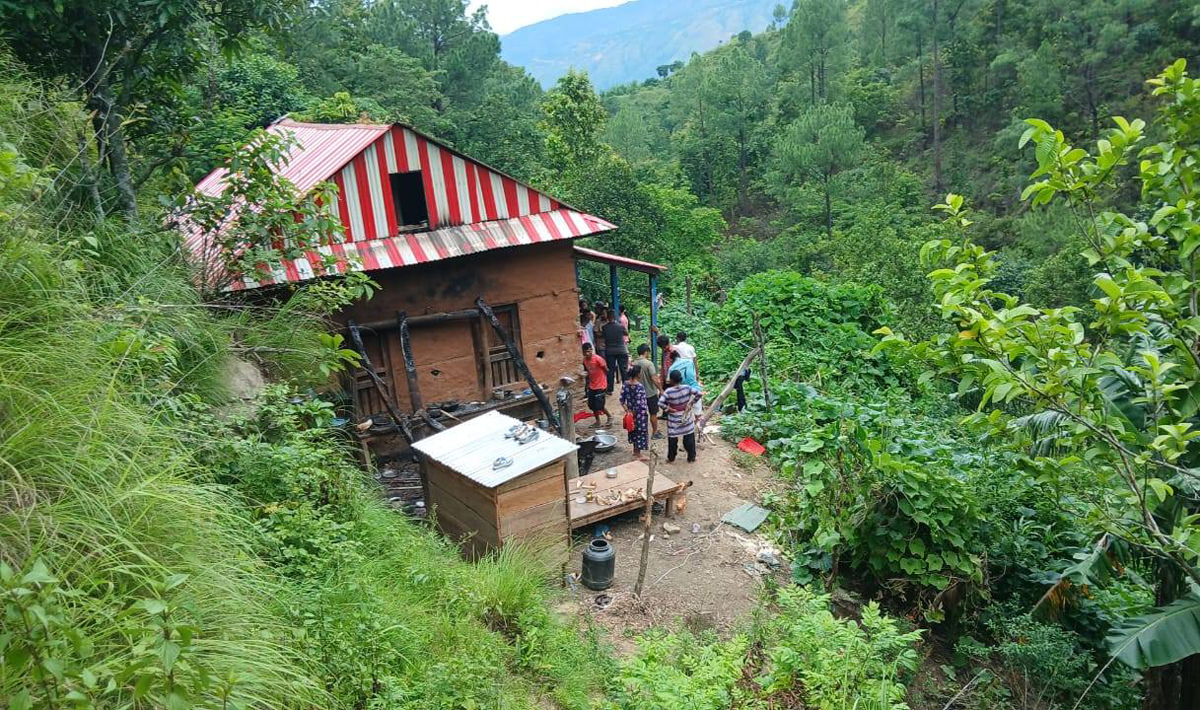
The family was later found safe in Pokhara, where they had taken refuge. Upon learning their whereabouts, Ward Chairperson of Golanjor Rural Municipality–6, Ravin Kumar Shrestha, traveled to Pokhara to bring them back to their village in Sindhuli. However, the family declined to enter their old home, claiming it is haunted by the restless spirit of the father, who passed away four years ago.
“We reached the village at 7 a.m. this morning (Tuesday), but they refused to step inside their house, saying the spirit is still present,” said Chairperson Shrestha. “Their daughter reportedly trembles at times, and shamans have told them it’s her father’s spirit.”
The family remains firm in their decision not to live in the old house. If forced to do so, they have threatened to leave the village again. In response, Shrestha has temporarily arranged for them to stay in his vacant house, which is large enough to accommodate the extended family.
Shrestha noted that, beyond spiritual fear, the family is also facing internal conflicts. One of the daughters and her husband still live in the original house, and it appears that the son-in-law is the driving force behind the decision to permanently leave.
“They say the house is in the jungle and the land isn’t legally owned. Also, most of the four ropani land they have is steep and not habitable,” he said.
Some suspect that the move may be partly motivated by financial pressures. The family is burdened with debt, and local officials suspect that relocating may be an attempt to escape repayment responsibilities.
“The son-in-law has a house in Pokhara. We believe he persuaded the others to move there, possibly to evade debts,” Shrestha added.
However, the local government cannot legally settle individual debts. “The municipality cannot use public funds to pay off personal loans. If we start doing that, others will expect the same. Still, we are also neighbors, not just elected officials,” Shrestha said. “We are exploring the option of raising a fund to cover a portion of their debt.”
According to Shrestha, the family is currently in a disorganized and difficult state. Relationships within the family are strained, and one of the daughters-in-law, who had taken a loan to go abroad, is paying it back on her own. Meanwhile, the family’s total debt is increasing.
While no official decision has been made, discussions are underway to allocate a few ropani of land to help the family build a new house and resettle elsewhere in the ward.
The Hayu family belongs to an endangered indigenous ethnic group in Nepal. Just two days before leaving their home, on July 22, they had collected their quarterly social security allowance from the ward office.
On July 25, they returned to the office to renew their social security registration. In total, the family received Rs. 191,520 in allowances for 16 members, Rs. 3,990 each for three months. After collecting the money, they reportedly slaughtered a pig and held a feast, leaving behind some raw meat before heading toward Pokhara.
Ward No. 6 of Golanjor is home to 30 Hayu families, totaling around 240 people. The community faces challenges in education and is economically disadvantaged.
The Hayu people are primarily settled in Murajor, a village in Ramechhap’s Sukajor region. According to tradition, they began living there after their ceremonial drums unexpectedly played on their own, which was interpreted as a divine sign.
The Hayu belong to the Kirat community and are known for their Mongoloid features, medium stature, and unique surnames, sometimes so unusual that they face social discrimination or are compelled to change them to secure government jobs.
Historically, the Hayu are said to be the youngest among five Kirati brothers, Surel, Sunuwar, Rai, Limbu, and Hayu. Their traditional instruments include domki (drums), jhyamki (cymbals), and bells.
In Nepal, only 2,925 people belong to this group, with just 1,520 speakers of the Hayu language remaining.






Comment