




MUSTANG: Thachyang is the original cultural practice of the Tangwe Gurung community, residing in Tangwe, Baragung Muktikshetra-3, Mustang.
Unlike a festival, Thachyang is a ritual that symbolizes a person’s liberation from societal responsibilities upon reaching a certain age. In the Tangwe Gurung community, individuals voluntarily perform Thachyang after turning 57.
The term ‘Thachyang’ literally translates to freedom from social bonds. It is an ancient cultural tradition that has been practiced for centuries among the Tangwe Gurung community in the Himalayan region.
Mustang still follows the headman system, where every social function is led by the headman. The headman organizes everything from village meetings and farming tasks to the duties of the Katuwal (chho), who informs the community about ongoing matters. Social responsibilities are shared among the villagers, and if someone fails to fulfill their duties, they are fined by the community.
The tradition of performing Thachyang after turning 57 to relieve oneself from such societal duties is still cherished in the Tangbe community, said Sangita Tangbe Gurung, a community leader.
“In our society, Thachyang can only be performed after reaching 57. It carries the message that after this ritual, one is freed from social responsibilities,” explained Geeta Tangbe Gurung.
“Although performing Thachyang frees a person from village duties, it does not prevent those who want to continue volunteering from doing so.” She added that Thachyang is not a compulsory event for everyone in the community upon turning 57.
Sangita also clarified that while some people can participate in Thachyang, it’s not mandatory. It’s a personal and family-centered cultural practice.
Sangeeta, another community leader, mentioned that those who were unable to marry earlier in life traditionally celebrate their later years with Thachyang.
“This practice isn’t limited to the Tangbe Gurung community alone. It is a custom in all 19 villages of the Baragung Muktikshetra Rural Municipality in Mustang, where people voluntarily celebrate Thachyang after turning 57,” he explained.
The Thachyang tradition involves worshiping ancestral deities, and it lasts for two days. During this time, traditional songs are sung, invoking blessings from deities ranging from the ancestral gods of the mountains to the depths of the ocean.
Thachyang is seen as a ritual to relinquish one’s bonds to worldly possessions, including animals and plants. On the first day, the community blesses the individual performing Thachyang by offering Chyang (alcohol) and khada (scarves) in a basket.
Sangeeta noted that the Tangbe community, along with relatives and friends, blesses the person with wishes for longevity, hoping for 99 years for men and 89 years for women.
There is a cultural belief that a woman should be 10 years younger than a man when getting married, according to the Tangwe community’s customs.
On the final day of Thachyang, the individual and their family are taken on horseback around the village. This ritual sends a clear message to the community that the person is now free from social obligations.
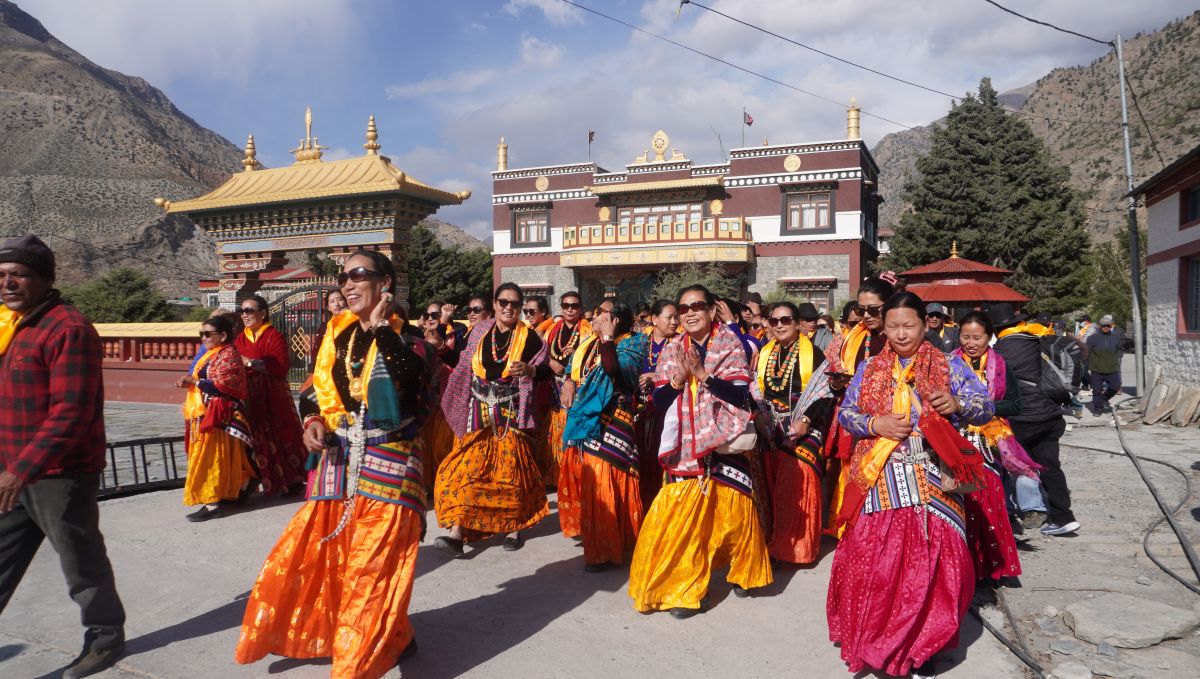
A parikrama (ritual circumambulation) was held in Jomsom, Mustang, on Monday, reflecting the Thachyang culture. During the ceremony, people sang songs in the Tangwe Gurung language, honoring the ancestral deity and marking the freedom from life’s dynamic tasks.
Local Dev Singh Tangwe shared that Thachyang has become a bridge that unites people from various communities, both local and abroad. He explained that men and women, dressed in traditional attire and jewelry, celebrate the occasion like a festival, singing, dancing, and enjoying each other’s company.





Comment