



There was a time when the mere mention of Prachanda—the nom de guerre of Pushpa Kamal Dahal—sent tremors through Nepal’s political and social landscape. Once hailed as the revolutionary commander who shook the very foundations of the monarchy and mainstream politics, Prachanda commanded not only a party but a movement—fueled by ideology, backed by arms, and carried forward by waves of disenchanted youth and marginalized voices.
Pushpa Kamal Dahal—better known by his nom de guerre, Prachanda—once strode Nepal’s political landscape like a man possessed by destiny. He was the face of a revolution, the architect of a republic, and the embodiment of a promise that Nepal could be radically different. In the heat of the insurgency, he wasn’t just a party chairman—he was a symbol, an idea, even a myth. And for a time, that myth felt real.
It’s doubtful that even Prachanda, in the peak of his glory, ever imagined a day when his own name would no longer hold the weight it once did. In a recent speech in Kathmandu, his words carried not only nostalgia but an unspoken grief:
“We once had a movement—power, strength, might, even glamor. We had the YCL, the PLA, and yes, we had guns—even while our army was confined to the cantonments. I remember two PLA vehicles escorting mine when I went to cast my vote. And just think—back then, the name Prachanda carried so much weight. People understood what it meant. Just imagine that time. But now….!” (quips)
His own answer may be hidden in one of his earliest confessions: “In my struggles I had always carried two weapons with me. Two most powerful weapons—determination and optimism.” Time will tell whether those weapons still serve him.
The raw honesty in these words is striking. They come not from a man who has forgotten his past, but from one who remembers it all too vividly. Once, he moved with convoys of fighters. Now, he moves within a tight circle of loyalists. Once, he could reshape alliances, outmaneuver seasoned politicians, and dominate headlines. Today, he fights for political relevance—not with bullets, but with statements that echo more in reflection than in influence.
A movement larger than a man
During the decade-long Maoist insurgency, Prachanda wasn’t just a military leader—he was a political force. His charisma was undeniable. He could articulate complex ideological visions in a way that inspired those long ignored by the state: the poor, the rural, the marginalized. He promised justice, dignity, and transformation. And for many, he delivered—at least symbolically.
He had the ability to sell dreams not just to the masses, but to hardened politicians who should have known better. He twisted the arms of experienced leaders, cut deals with monarchists and communists alike, and placed himself at the center of a new Nepal.
His declaration during that time, “During the war we machine-gunned our enemies, now we sit around a table and sip tea with them,” reflected a startling pragmatism. He recognized that revolution without results was hollow. The shift from the battlefield to the ballot box was not just strategy—it was survival.
Power in transition: charisma versus consequence
The post-conflict era sustained Prachanda’s relevance for nearly a decade. The signing of the Comprehensive Peace Accord in 2006 didn’t erode his charisma; it extended it. He was no longer a threat to the state but a central player in its reshaping. He helped abolish the monarchy, push for a republic, and lead the first Constituent Assembly election victory in 2008.
But revolutionaries rarely make effective administrators. Over time, his rhetoric began to sound distant from reality. His party, too, lost its ideological edge, torn between managing governance and maintaining the movement’s soul. Internal rifts, political missteps, and shifting alliances gradually chipped away at his influence.
As he himself admitted, “Our struggle for democracy has gone through several phases – through setbacks as well as achievements… Our agendas on economic development couldn’t get the undivided attention.” The very machinery that powered his rise began to rust under the weight of expectation and compromise.
Still fighting—for peace, justice, and relevance
Despite the loss of supremacy, Prachanda remains introspective. His speeches now focus more on justice, inclusion, and democratic reform than on revolutionary change. He still speaks of “social justice and peace as two sides of the same coin” and insists that “there is no sustained peace without comprehensive social justice.” These are not just rhetorical flourishes—they reflect a leader trying to reconnect with his ideological roots in a world that has moved on.
And yet, that same world still carries his fingerprints. Nepal’s federal structure, republican identity, and transitional justice agenda all trace back to the force he once was. “We concluded the peace process… We have strengthened the very base for development—that is democracy,” he declared, reinforcing that even if his personal power has faded, his historical impact has not.
His statement at the UN—“I am determined to secure enduring peace through resolving transitional justice once and for all”—was a reminder that his story is not over. But time is not on his side. The political stage he once dominated is now crowded with newer actors, and the party he once defined is no longer the vehicle it used to be.
A cautionary tale—and a question
Prachanda’s journey is as much about Nepal as it is about himself. It tells the story of a country that emerged from monarchy, war, and upheaval into a fragile democracy—led by a man who, at one point, embodied all those transitions. He was fierce, yes. He was flawed, undoubtedly. But he was also a figure of change, of audacity, and of ambition.
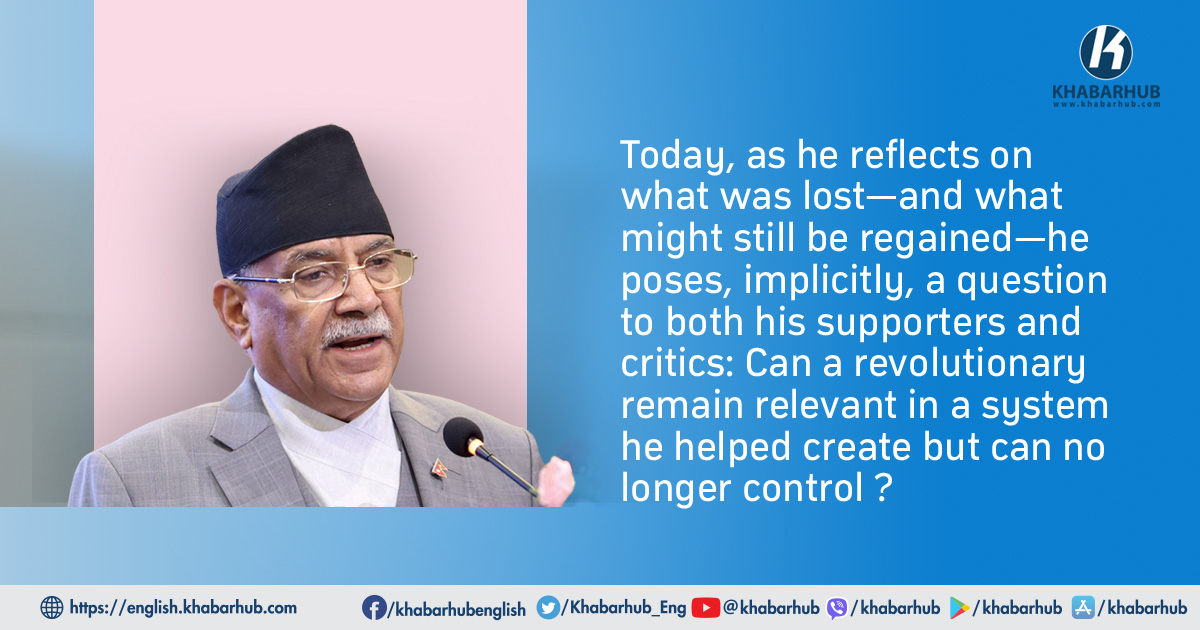
Today, as he reflects on what was lost—and what might still be regained—he poses, implicitly, a question to both his supporters and critics: Can a revolutionary remain relevant in a system he helped create but can no longer control?
His own answer may be hidden in one of his earliest confessions: “In my struggles I had always carried two weapons with me. Two most powerful weapons—determination and optimism.” Time will tell whether those weapons still serve him.






Comment