




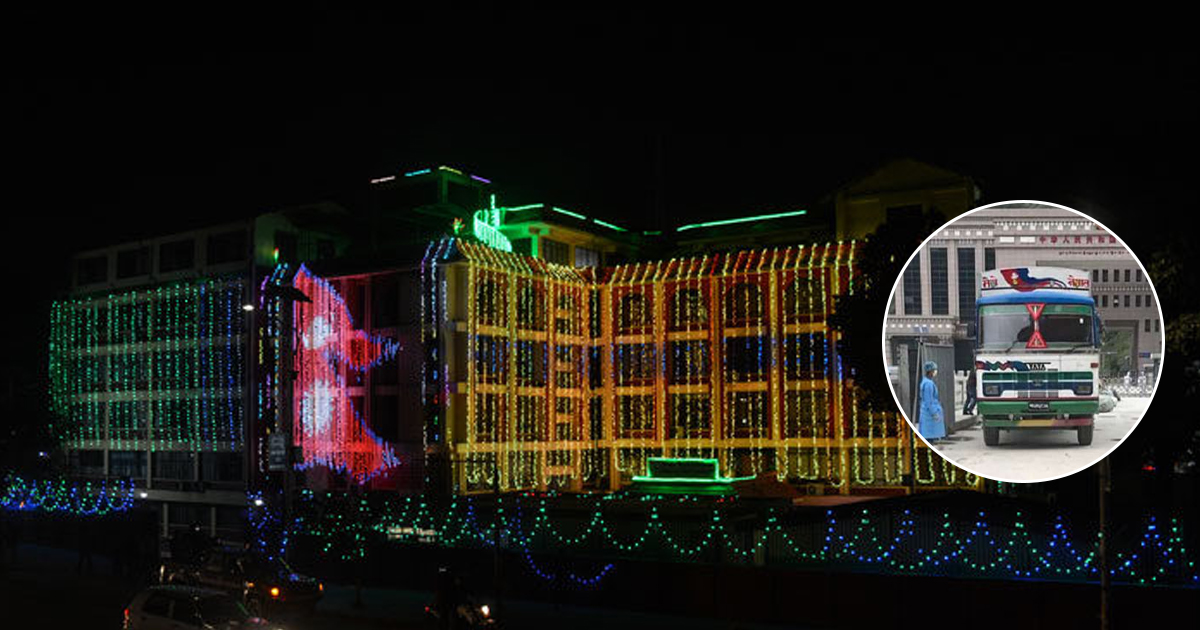
KATHMANDU: Tihar, Nepal’s second-largest festival, sparkles with the beauty of flowers and twinkling lights.
With increasing access to electricity and changing consumption patterns, many Nepalese now decorate their homes with electric lights during this festive occasion.
During Tihar, homes, temples, and even community spaces are adorned with electric lights.
Even traditionally mud-based decorations are now enhanced with flickering electric lights.
A few decades ago, most Nepalese illuminated their homes during Tihar using ghee-filled clay lamps and cotton wicks. In hilly regions, it was customary to light a candle or a lamp on a banana stick as offerings to animals and birds.
Today, electric lights have largely replaced traditional deepani (lamps) in many areas.
These twinkling lights, primarily used during Tihar, see little use at other times of the year.
However, these flickering lamps, which brighten Tihar celebrations, are not produced locally.
Businessmen argue that Nepali products struggle to compete with the prices of imported lights, which are produced in large quantities in neighboring countries.
To make the festival shine, Nepal relies on imports. This year, the importation of decorative lights began before Dashain, as Tihar approached.
Most of the lights imported into Nepal come from neighboring China.
Unfortunately, heavy rains in the last week of September impacted key trade routes, particularly the main ports of Tatopani and Kerung, disrupting the supply chain and limiting the availability of these lights in the market.
Some flickering lights have been imported via ships through India, but Resham Prasad Devkota, president of the Nepal Electrical Traders Association, noted that various items remain stuck at the border.
He anticipates lower demand for decorative lights this year compared to previous years.
According to the Association, around Rs 30 million worth of lights have been imported so far.
During Tihar, popular items include LED disco lights, net skirts, LED frame lights, and strap lights.
Devkota mentioned that the current demand is not as robust as in the past, partially due to a slowdown in the construction industry, which affects the sales of decorative lights.
Many businessmen have been unable to receive payments for construction projects, and they lack optimism for an increase in sales this year.
He expressed concerns that decreased market demand will lead to reduced imports of decorative lights.
Devkota stated, “This year, the business enthusiasm is low. With 40 percent of last year’s stock remaining unsold, there’s doubt that the imported lights will sell.”
He also pointed out that materials purchased can last three to four years, and the lack of new designs in the market contributes to low demand.
Last year, the imports during Tihar celebrations reached about Rs 45 million, while in 2079 BS, they were valued at approximately Rs 40 million.
Despite having skilled workers trained in electrical engineering, Nepal lacks an industry capable of manufacturing these decorative lights.
Although production is feasible, there has been little investment from young entrepreneurs in this sector.
Businessmen argue that Nepali products struggle to compete with the prices of imported lights, which are produced in large quantities in neighboring countries.
Devkota noted, “Producing the same product in Nepal would cost twice as much as it does now, which diminishes interest in domestic production.”
He emphasized that with government support and incentives, a manufacturing industry for decorative lights could potentially be established in Nepal.
Import trends
So far this year, lights worth around Rs 30 million have been imported.
Last year, the imports during Tihar celebrations reached about Rs 45 million, while in 2079 BS, they were valued at approximately Rs 40 million.
The imports saw a decline during the pandemic in 2078 BS.
Before the onset of the COVID-19 pandemic, Nepal imported lights worth between Rs 60 to 70 million annually.
However, in 2077 BS, imports fell significantly to only Rs 18 million due to the pandemic’s impact.





Comment