




KATHMANDU: Three senior lawyers are presenting their counter-arguments on the dissolution of the House of Representatives (HoR) today.
Lawyers of the writ petitioners began their counter-arguments on the (HoR) after the government side ended their pleading Sunday.
Senior advocates Shambhu Thapa, Badri Bahadur Karki and Harihar Dahal are presenting their counter-arguments on behalf of writ petitioners. Two hours out of three hours allocated for the counter-arguments is remaining.
Before Senior Advocate and former Attorney General Raman Shrestha began pleading on behalf of writ petitioners yesterday, the Constitutional Bench had posed six questions to the plaintiff’s side.
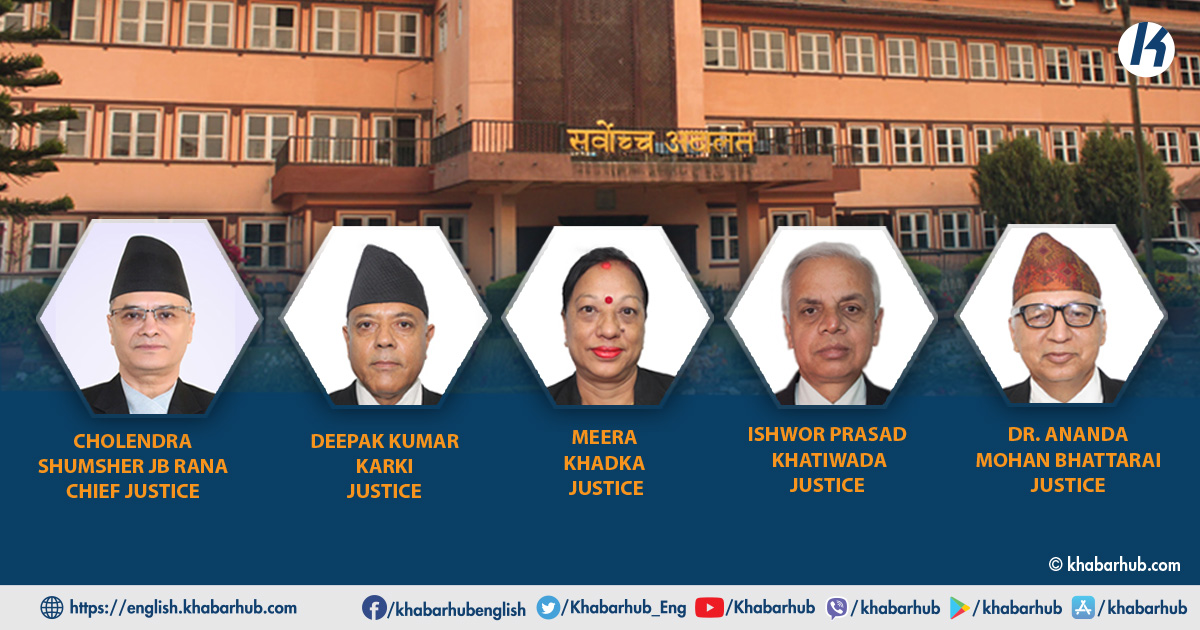
Justice Ishwor Khatiwada asked five questions other than those raised by the government side; three of which are focused on procedures. Similarly, Chief Justice Cholendra Shumsher Rana put forward a question to the writ petitioners.
Five questions asked by Judge Khatiwada:
• The documents presented to stake claim for Prime Minister’s post by the writ petitioners in accordance with Article 76 (5) of the constitution does not meet legal formalities. There is the use of tipex everywhere. It seems like a forgery, as if the paper readied for a different purpose was submitted.
• There were 146 petitioners, but only five have signed the petition. What law allows this? Hearing should not be conducted for such petition as it does not meet legal formalities. Such petition should be dismissed.
• Regarding the formation of the Constitutional Court, it is not a dispute of the situation as per Article 137 (2) of the constitution. The procedures for resolving disputes as per 137 (3) have not been met.
• If the petitioner’s interpretation of Article 76 (5) of the constitution is brought to practice, then it will mean implementing a partyless system.
• Is the court responsible to appoint the prime minister? There is a constitutional provision to appoint a prime minister and one should not reach the court asking to be appointed prime minister.
Answers related to the above queries were sought from the writ petitioners’ side before they began their arguments.
Similarly, CJ Rana questioned whether it would not hamper the multi-party system based on pluralism as envisaged in the constitution if an order was issued as demanded by the writ petitioners’ side.
Amicus Curiae will lend advice to the Constitutional Bench once the lawyers finish their counter-arguments. The Supreme Court has put aside two hours for Amicus Curiae. With this, a total of four hours has remained for the writ petition filed against the HoR.





Comment