




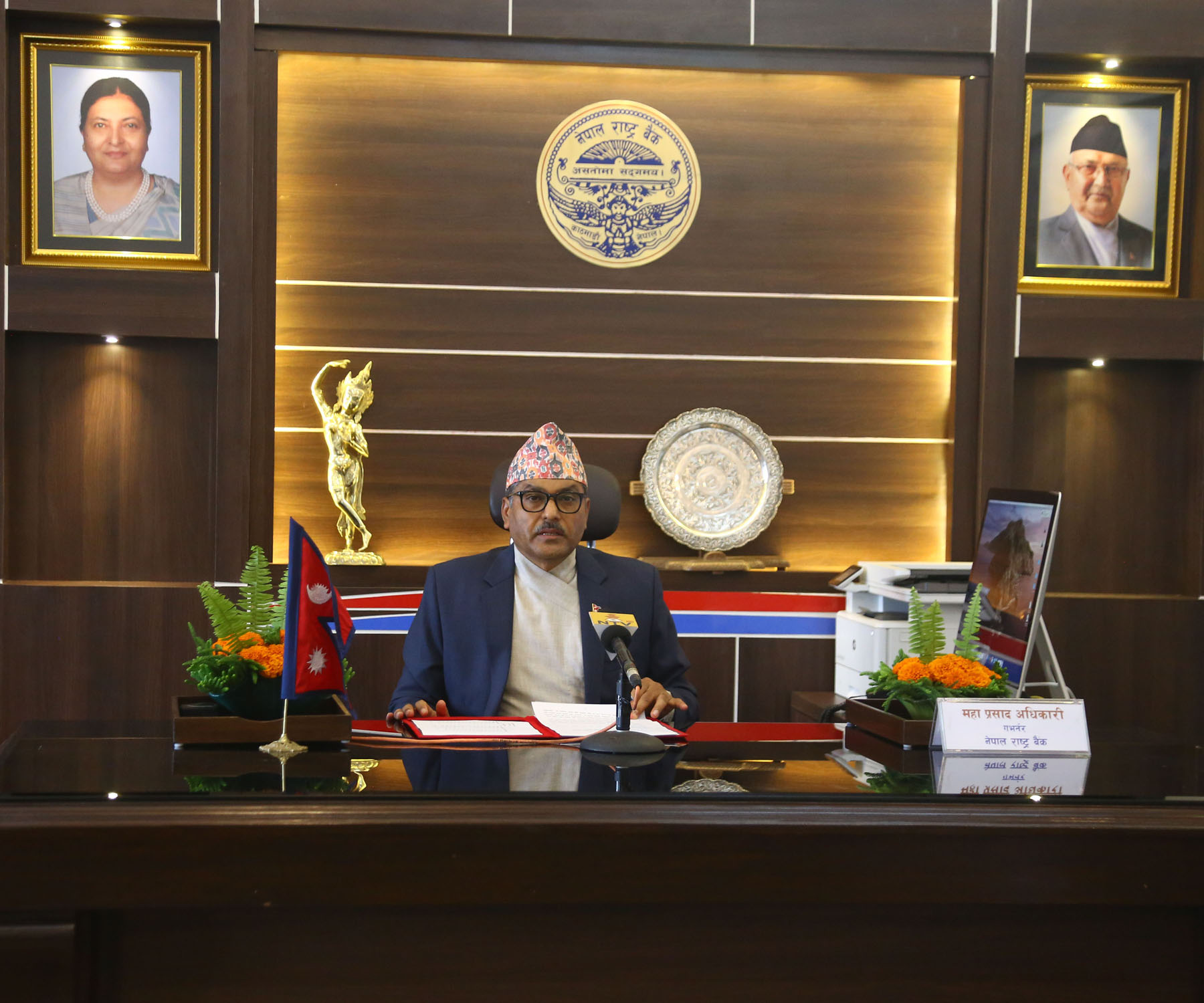
KATHMANDU: The new monetary policy for the current fiscal year announced by Nepal Rastra Bank (NRB) has encouraged the banks and financial institutions (BFIs) for their merger meant for fiscal stability.
The monetary policy made public by the Governor of the central bank, Maha Prasad Adhikari, stated that the BFIs with cross-holding investment would be encouraged for their merger. The BFIs under the control of the same promoters and business houses or having the same commercial interests would be merged, it is said.
Likewise, the ‘A’ class banks would get special facilities if they agree to start their joint transaction from mid-July of 2021 after their merger.
Similarly, the banks can also coordinate with the concerned institutions for the adjustment of the deposits of the institutional depositors. The process of merger and acquisition would be promoted also to strengthen the base of the capital of micro-finance institutions.
The central bank has announced a special relief package to the coronavirus affected sectors. As announced, the monetary policy has extended the period of loan repayment for the coronavirus-hit areas including tourism, industry, education, health, communications and entertainment sectors.
Considering the fact that loan and interest repayment was difficult due to lockdown order, the monetary policy has extended the time for loan repayment and loan’s readjustment as well as its reschedule.
The central bank has further managed the renewal fixing payment deadline by coming January after assessing the condition of a loaner in terms of demand loan and cash credit which had to be paid by the end of the last fiscal year.
The loaners can pay the loan and interest in short, mid and long term basis.
Governor Adhikari informed that the industries which suffered worst by the COVID-19 lockdown as tourism will however be provided adequate time for the payment of a loan. They can pay the loan by the time the industries will have restored to normal condition.
Similarly, if the loan floated to the most affected sectors that are undertaking projects is not restructured normally, the measures as of private equity, venture capital, debt-equity, equity conversion and special purpose vehicle will be adopted for restructuring it.
In the case of the construction of tourist hotels, the monetary policy has provided a grace period of maximum two years. The grace period is for the projects which face difficulty for completion.
The grace period of one year can be extended once for the most affected sector, nine months to the sector suffering in medium-scale and six months to the sectors suffering least to pay the loan. RSS




Comment