




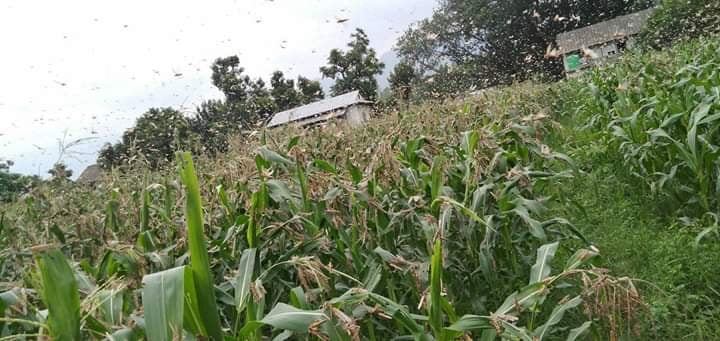
DANG: A group of locusts has been seen in Gadhuwa Rural Municipality of Dang district this morning, said Ram Krishna Subedi, information officer of Plant Quarantine and Pest Management Center.
Earlier, locust swarms had entered Nepal on June 28, which have almost disappeared without causing any significant damage to the crops.
As per the report received from the local levels of Dang, he said that swarms covered fields and farms in wards 2 and 3 of Deukhuri Municipality in the morning.
Local farmers have been worried after the swarms covered the fields and farms though they chased them away by beating empty containers and producing noise.
There might be 1 to 1.2 million insects in a swarm.
He said that the locust swarm which was flying above Gorakhpur and Sitapur of India entered Nepal from Dang district.
The wind is blowing northward from Rajasthan so the probability of other locust swarms entering Nepal within two days is high, he said, adding that they had already instructed technical teams and state and local governments for preparedness to minimize the losses.
He urged the farmers to stay alert to chase the locusts by beating utensils and minimize the losses.
The first batch of locusts had damaged crops in around 1,118 hectares of land in various places across the country.
The locusts had damaged crops, mostly maize and vegetables, mainly in five districts — Dang, Pyuthan, Makwanpur, Arghakhachi and Palpa.





Comment