




In accordance with the decision of the Central Revenue Leakage Control Committee meeting held under the coordination of Finance Minister Swarnim Wagle on April 2, stricter measures have been taken to bring goods through customs checkpoints and open borders.
After the committee’s decision, the Armed Police Force (APF) started spreading notices on the Nepal-India border, informing that goods worth more than 100 rupees should not be brought in without customs clearance, videos of which started going viral on the internet.
When ordinary citizens living on the Nepal-India border—from east to west—brought food items from Indian local markets, the APF started confiscating the goods and conducting unnecessary interrogations.
The order issued in exercise of the authority granted by Sub-section (3) of Section 9 of the Customs Act 2007, with effect from 29 May, regarding the daily commodities that local residents of the borderlands leaving Nepal and entering Nepal from foreign countries are allowed to bring and take with them, was published in the Nepal Gazette on 15 May 2024.
If personal-use goods worth up to one hundred rupees are brought or taken, the Chief of Customs may release them without charging duty, considering the justification.
This decision of the Rastriya Swatantra Party (RSP) government has been widely criticized in the districts of Madhesh. The youth of Madhesh, who are die-hard fans of the current Prime Minister Balendra Shah, have started protesting this move by the government.
The main opposition party, Nepali Congress, has also issued a statement opposing this decision of the government. Madhesh-centered regional political parties have collectively opposed this, while Mahantha Thakur, a member of the National Assembly from the JSP, has also asked the government to withdraw this decision.
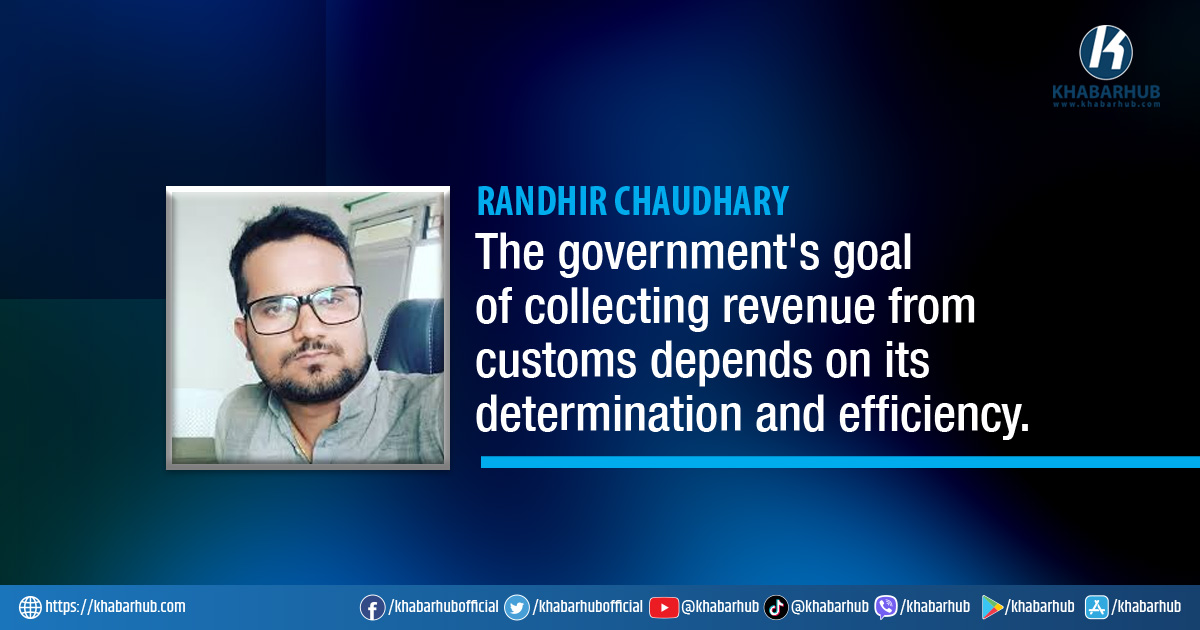
The government’s goal of collecting revenue from customs depends on its determination and efficiency. If the federal police and administration stop the unauthorized facilitation of cross-border smuggling, revenue will increase, and the common people of the borderlands will not suffer unnecessarily.
Half of the total population of Nepal lives in the Madhesh region. Twenty-two districts of India and twenty-six districts of Nepal share an open border of a total of 1,750 km. When Dr. Baburam Bhattarai was the Finance Minister, the government set a new record by collecting more revenue than the target in the fiscal year 2008/2009, but no obstacles were created for common people living in the border areas to buy their daily necessities.
It depends on how well the government intends to use customs revenue collection. Why, even if it wishes to, can’t the new, supposedly strong government avoid enacting unworkable regulations? Alternatively, let us consider why any regulations pertaining to the Nepal-India border should take into account the psychology of the border people.
Oscar J. Martinez, a prominent historian and border studies scholar, identifies three types of borderlands: alienated, coexistent, and interdependent. There is no cross-border movement or interaction in alienated borderlands since borders are functionally closed. The borderlanders become completely estranged from one another as a result. Tensions are prevalent at this type of border most of the time.
A coexistent borderland is characterized by an open border with little interaction. In this case, states lessen their border problems brought on by unfavorable internal circumstances to a manageable degree so that advancements can occur between them.
The Nepal-India border falls under the “interdependent border” category, where increased cross-border interaction brought about by economic and social complementarity expands borderlands, which in turn promotes economic growth and cross-cultural interchange between nearby towns. Such borderlands have cordial and helpful ties.
Mutually trusting relationships have emerged as a result of a “no-conflict” border, where borderlands are home to regular flows of people and products rather than points of friction.
The greatest border area, which has a long history founded on the ideals of “civilization and friendship,” is where Nepal and India meet. Despite the geographical boundaries established by the Sugauli Treaty of 1816, this region’s social and cultural landscape prevents it from being divided.
Be it the Rana regime or the active monarchy—even during any regime—citizens living across the border had the opportunity to shop without any hindrance. But today, this issue has reached the courts. A writ petition has been filed in the Supreme Court against the government’s decision to levy customs duty on goods worth more than 100 rupees imported from India for household purposes.
The petitioners have demanded that the government’s decision be quashed. They have also sought an order of “certiorari” to nullify the customs-related measures being enforced. Does it not sound contradictory that, in the case of gold jewelry, Nepalese coming from abroad can bring up to twenty-five grams for men and fifty grams for women without paying duty?
In the context of the Nepal-India open border, thousands of Nepali pilgrims visit India every day—hundreds return after immersing the ashes of their loved ones in the sacred Ganga. When they return from pilgrimage, they buy prasad and necessary items worth more than one hundred rupees. There is an irrefutable tradition of marriage exchange between the two countries. Not only that, India remains a convenient and affordable destination for those who go there for work from Nepal.
Nepali youth from economically poor backgrounds are still engaged in small businesses in big cities in India. They work in hotels and are employed in various private and government companies. The government has not charged a single rupee in customs duty on televisions up to 32 inches in size for workers returning from foreign employment.
The government has made arrangements for customs exemption not only on televisions but also on many personal goods brought back from abroad.
Similarly, customs exemption is also available for bringing one laptop or computer, tablet, watch, camera, video camera, and cellular mobile phone, etc. Currently available data indicate that between 3.5 and 6 million Nepalese are employed in India alone. When they send goods worth more than 100 rupees to their families, do they have to pay duty to Kathmandu?
The government’s goal of collecting revenue from customs depends on its determination and efficiency. If the federal police and administration stop the unauthorized facilitation of cross-border smuggling, revenue will increase, and the common people of the borderlands will not suffer unnecessarily.
The Office of the Prime Minister and Council of Ministers, the Ministry of Finance, the Ministry of Home Affairs, and the Customs Department have been named as respondents in the writ petition.






Comment