




KATHMANDU: Weak legal infrastructure remains a critical bottleneck in Nepal’s financial sector, as experts caution that unresolved gaps in law and governance are holding back investment and trust.
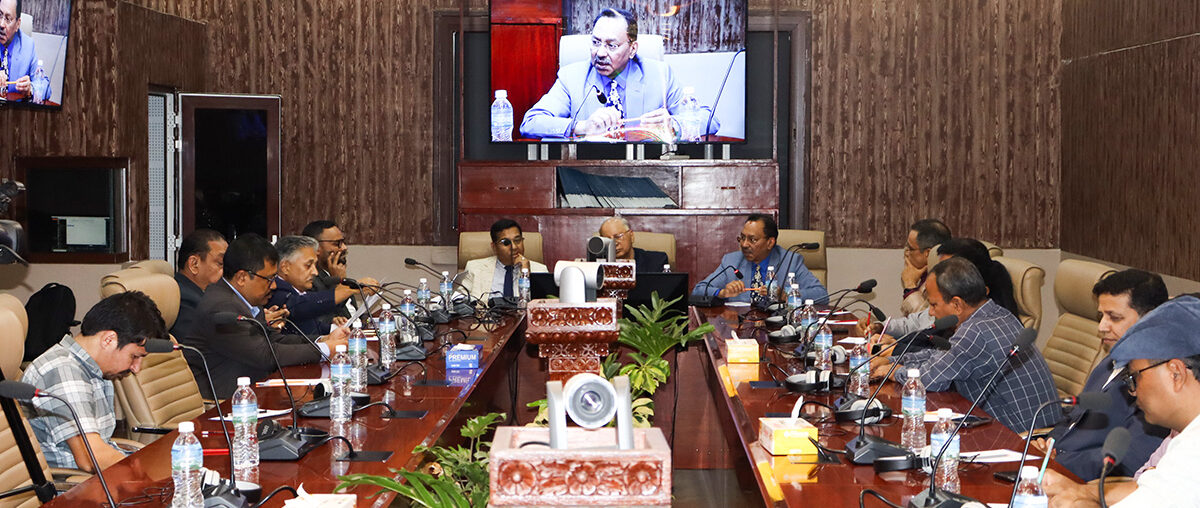
Speaking at a program organized by the Institute for Strategic and Socio-Economic Research (ISSR) in Kathmandu, experts and stakeholders stressed that Nepal’s financial sector still requires substantial legal reforms.
Former Supreme Court (SC) Justice Dr. Ananda Mohan Bhattarai said Nepal has been going through a prolonged period of uncertainty and fear, underscoring the need to reinforce the rule of law. He noted that many thematic areas of law require further development and highlighted the absence of legislation addressing conflict of interest.
Similarly, economist Dr. Sudhan Oli said confidence in the private sector has yet to recover following the Gen-Z protests of September 8–9, 2025. He questioned whether the government would address key economic concerns in its policies, programs, and budget. Dr. Oli also presented data on Nepal’s economic condition and highlighted areas requiring legal reform.
Rajesh Upadhyay, Vice President of the Nepal Bankers’ Association, remarked that increasing labor migration is reducing domestic demand, which in turn is affecting the banking sector. Although Nepal Rastra Bank has projected a 12 percent credit growth rate for the current fiscal year, he said it is likely to reach only around 6 percent.
Upadhyay added that Nepal must focus on fostering entrepreneurship, but noted that existing provisioning requirements for non-performing assets make it difficult for banks to support businesses.
Deepak Shrestha, Vice President of the Nepal Chamber of Commerce, said the private sector has often been discouraged rather than supported. He stressed the need to simplify loan procedures and expressed concern that banks and insurance companies appear to be operating in a syndicate-like manner.
He further argued that financial errors should not automatically be treated as criminal offenses and that entrepreneurs should only be arrested after proper investigation. Shrestha also criticized the government’s recent policy to waive registration fees for companies valued at Rs 250 million, calling it impractical.
ISSR Director Naresh Shrestha and former Foreign Secretary Shankardas Bairagi, also the Chairman of ISSR, shared their perspectives on Nepal’s economy, the role of the private sector, and the current legal framework.





Comment