




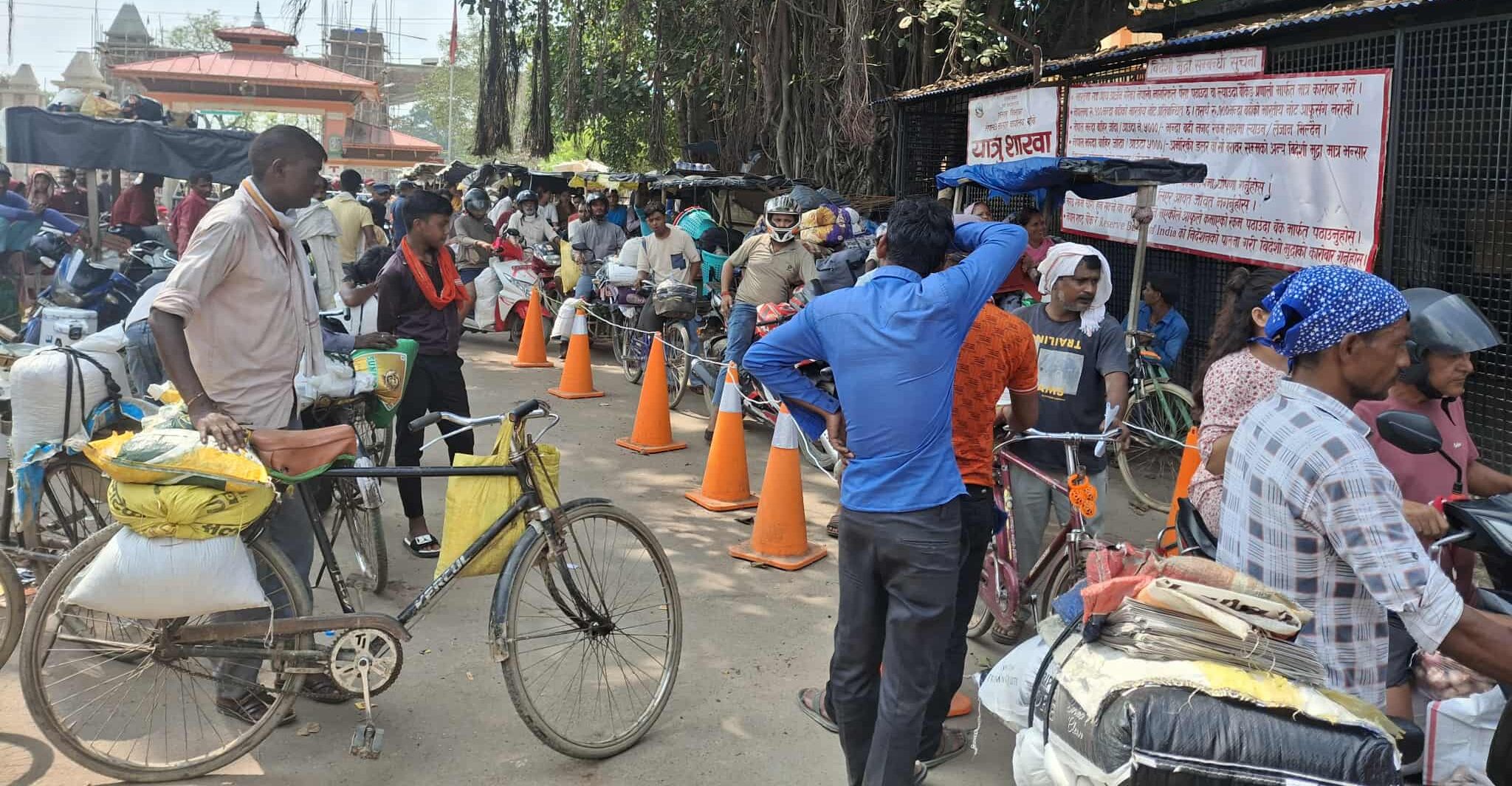
KATHMANDU: The government has recently tightened customs clearance procedures on goods imported from India, making it mandatory for items valued above Rs 100 to be processed through formal customs channels.
Officials said the move is aimed at curbing customs revenue leakage and strengthening enforcement across all border points, from Biratnagar and Birgunj in the east to Dhangadhi in the west.
Under the new enforcement drive, authorities have increased scrutiny of imports entering through all major border crossings. The government has also begun tightening regulations on the use of Indian-registered vehicles in several Terai districts.
Security personnel deployed along the border have been conducting public awareness campaigns using loudspeakers, urging compliance with customs rules.
However, the move has triggered protests in some areas. In Sarlahi, political parties excluding the Rastriya Swatantra Party issued a joint statement warning of agitation, demanding the continuation of the use of Indian number plate vehicles in border regions.
The Nepali Congress also issued a statement on Saturday expressing concern over the enforcement of customs duties on household goods valued above Rs 100, calling for the withdrawal of the decision. The party said any policy that increases the burden on citizens’ daily lives is unacceptable.
Meanwhile, lawmakers from the Madhesh Province affiliated with RSP met Home Minister Sudan Gurung collectively, urging that restrictions on household imports should not be tightened.
The Department of Customs defended the policy, stating that it is simply the implementation of existing laws.
Spokesperson Kishor Bartaual said customs duty applies to goods above Rs 100 as per existing legal provisions. He added that the long-standing practice of individuals frequently crossing the border to purchase small items had distorted local markets.
“The law already provides for customs on goods above Rs 100. People have developed a habit of buying small goods across the border, which weakens domestic trade and strengthens foreign markets. We are simply enforcing existing regulations,” he said.
Business community supports move
Despite protests from consumers and political leaders in border areas, business associations have largely welcomed the government’s decision.
The Nepalgunj Chamber of Commerce and Industry issued a statement on Sunday supporting the move, stating that it would promote transparency and competitiveness in the market.
Similarly, the Siddhartha Chamber of Commerce and Industry in Bhairahawa also backed the enforcement, while other business organizations in the Terai region have not raised objections.
Revenue boost expected
According to government data, Nepal imported goods worth Rs 18.04 trillion in the fiscal year 2081/82, of which Rs 10.71 trillion came from India alone.
In the first eight months of the current fiscal year, imports have already reached Rs 12.89 trillion, with Rs 7.24 trillion coming from India.
Officials believe that stricter enforcement of customs regulations could significantly increase government revenue, especially as informal trade has remained widespread due to the open border and historically lenient import policies.
Economists note that with over half of the population now concentrated in the Terai region and informal trade accounting for a significant share of consumption, the new measures could reshape border trade dynamics and strengthen state revenue collection.





Comment