




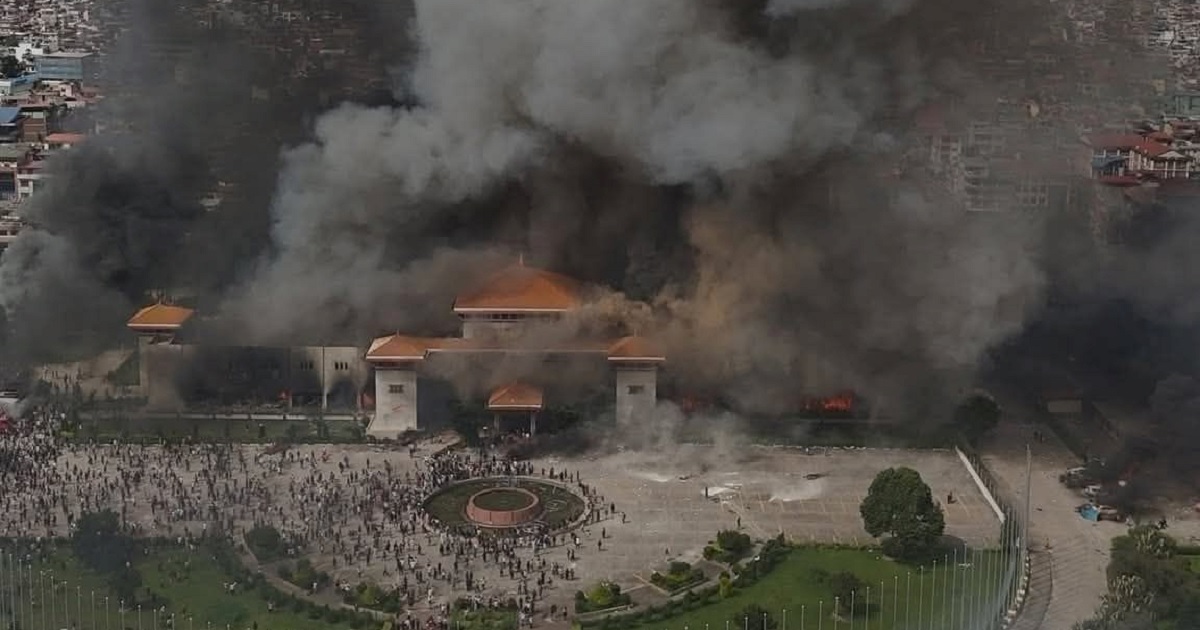
KATHMANDU: The report of the high-level commission led by former Justice Gauri Bahadur Karki, formed after the Gen-Z protests on September 8 and 9, 2025, has been leaked.
The 898-page report includes detailed accounts of the Nepal Police, Nepali Army, and protesters deployed across various locations during the two days.
The report also contains the statement of Central Special Task Force (STF) Commander, Police Inspector Samunnat Adhikari, who was responsible for Parliament building security.
According to Adhikari, although the protest at Maitighar Mandala on September 8 began peacefully, protesters turned violent, entering the Parliament premises and committing arson and vandalism. Police attempted to control the situation using tear gas and aerial firing.
He further stated that on September 9, the situation became more complex. Many high posts at the Parliament were already damaged, preventing the STF team from fully deploying inside.
Despite the challenges, his team was able to protect some critical structures using available weapons and equipment. However, 40,000 liters of diesel, barracks, mess, canteen, CCTV rooms, walk-through gates, and personal belongings of security personnel were destroyed in the fire.
Adhikari highlighted coordination issues between the Nepal Police, Armed Police Force, and Nepali Army, which affected team morale. He suggested specialized training, technical equipment, real-time threat analysis, and a satellite base in each province to make STF operations more effective in the future.
Adhikari’s statement:
“I have been commanding the STF team with 96 personnel since March 2025, responsible for Parliament security. We did not have a written mandate, but our main duty was the direct protection of the building, MPs, staff, journalists, and visitors.
The team had 5.56 mm INSAS rifles, LSW, 9 mm SMG, Type 54 pistols, Petro Beretta, and gas guns.
September 8: The protest was expected to remain limited to Maitighar Mandala. Around 12:35 PM, thousands of protesters became violent around the Parliament. They climbed railings, threw stones, and attacked with rods, slingshots, and machetes. Petrol bombs were thrown at my residence.
Police posts at high points were forced to evacuate after attackers tried to seize weapons. We used 95 tear gas and aerial firing rounds (176 from INSAS, 26 from SMG) under operational command. No STF team member fired directly at protesters. I do not know of any deaths caused by bullets; those could have been from other police or APF units. My right eye was injured by a stone, glasses were broken, and 12 police officers were injured.
September 9: Reports of renewed attacks came early morning. Simultaneous attacks across the valley prevented reinforcements. High posts were already destroyed. Around 1:45 PM, protesters carrying looted weapons entered the Parliament, setting fire to 40,000 liters of diesel, barracks, mess, canteen, CCTV rooms, walk-through gates, and other structures.
Under extreme risk, we merged with the Banehswar team, carrying weapons and communication equipment, and moved to a secure location. Before leaving, we used 2 tear gas cells, 1 rubber cartridge, and 3 INSAS rounds to prevent further fire on the diesel tank.
All barracks, mess, canteen, CCTV, offices, vehicles, personal clothing, documents, weapon magazines, bullets, gas cells, and bulletproof gear were destroyed.
The Nepali Army was deployed after the curfew on the first day. On the second day, army personnel inside did not respond as protesters entered and exited with weapons around 2:30 PM. The APF also did not play a significant role.
Suggestions: Specialized training, special allowances, technical equipment, a real-time intelligence cell, and a satellite base in every province are necessary to strengthen STF effectiveness. The complete destruction of personal equipment greatly affected team morale. Appropriate state compensation and morale restoration are expected.”



Comment