




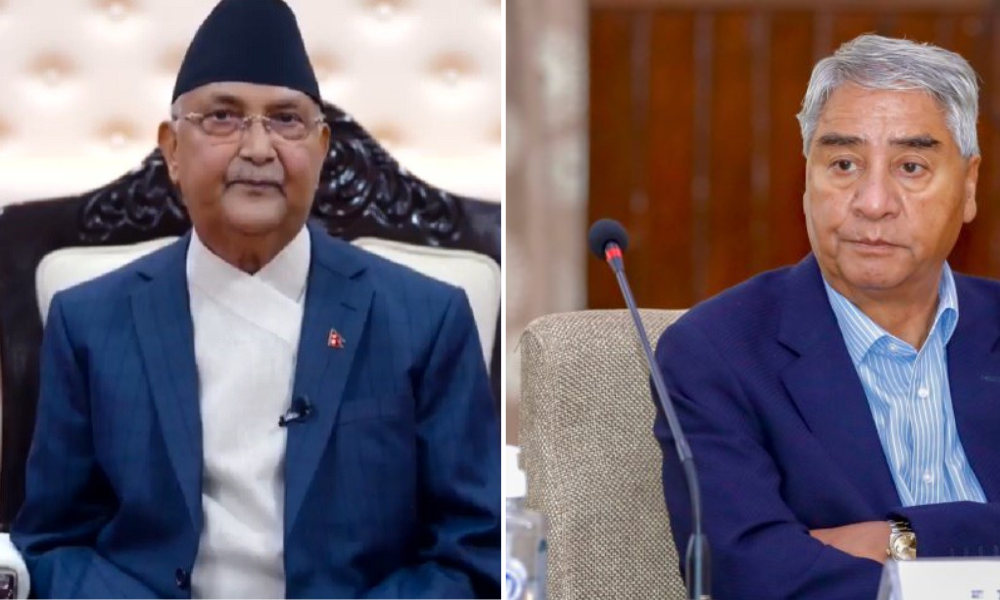
KATHMANDU: On the day Gen-Z protesters were setting fire to homes and government buildings one after another, then-Prime Minister KP Sharma Oli was inside Baluwatar, holding discussions with senior CPN-UML leaders, including General Secretary Shankar Pokharel.
Confident and composed, Oli spoke with General Secretary Pokharel, Deputy General Secretary Bishnu Rimal, and leader Pradeep Gyawali. Protesters’ chants had not yet reached the heavily fortified Baluwatar residence, and the leaders assured Oli there was no immediate threat.
Additional security had been deployed under the command of a senior officer from the Armed Police Force, while the Nepali Army guarded the inner perimeter. But as the situation worsened, security personnel—both inside and outside—stood by, seemingly unable or unwilling to intervene.
As protesters advanced toward Baluwatar, torching offices along the way, Oli was still preparing to convene an all-party meeting scheduled for 6 p.m. There were still six hours to go, but elsewhere, ministers were already being evacuated from the government residence in Bhainsepati by the Nepali Army.
Much like King Gyanendra during the People’s Movement II, Oli remained confident that the state would hold. That confidence began to shake only when the sounds of approaching protesters reached his ears.
By then, Oli—who had been refusing to resign—received a chilling message from the military: all other ministers had been safely evacuated, but the army would only rescue him if he agreed to resign.
Caught off guard, Oli didn’t even have time to personally deliver his resignation to the President at Sheetal Niwas. An army officer carried the letter on his behalf. Only after that was Oli airlifted from Baluwatar by an army helicopter, reportedly taken to Shivapuri for safety.
After spending ten days in army barracks, Oli resurfaced in Gundu, Bhaktapur. He is currently staying in a rented house, which he has turned into a political meeting center near the residence of UML leader Mahesh Basnet.
From there, he has been summoning members of the UML Secretariat individually. While some are pressing him to call a full meeting, Oli has opted for one-on-one consultations—testing loyalties and gauging political sentiment, one leader at a time.
Former PM Oli, currently based in Gundu, Bhaktapur, has begun a series of one-on-one political consultations with senior UML leaders, aiming to retain control over the party leadership despite mounting pressure following the Gen-G protests.
On Saturday, Oli held a lengthy discussion with UML Vice Chair Bishnu Poudel. He continued the consultations on Sunday, summoning Senior Vice President Ishwor Pokharel and Deputy General Secretary Prithvi Subba Gurung. These dialogues extended into Monday as well.
UML General Secretary Shankar Pokharel, Deputy General Secretary Pradeep Gyawali, and Bishnu Rimal are reportedly working to rally support in Oli’s favor. According to party insiders, Oli’s strategy is to consolidate a majority within the UML Secretariat before calling a formal party meeting, thereby delaying any immediate leadership transition.
In these closed-door meetings, Oli has reportedly recounted the events of September 9, when he was evacuated from Baluwatar amid escalating Gen-Z protests. He claims that, before resigning, he attempted to hand over power to Nepali Congress President Sher Bahadur Deuba—an offer based on a seven-point agreement allegedly made at Captain Rameshwor Thapa’s residence on the night of July 1, 2024.
“As per the agreement with the Nepali Congress, I tried to hand over the government leadership to Deuba when I was about to step down,” an official quoted Oli as saying during a meeting in Gundu. “But Deuba was not ready. That’s when I was left with no option but to resign.”
Deuba, who reportedly declined Oli’s offer, was later assaulted alongside his wife Arzu Rana at their Budhanilkantha residence on September 9. Both are currently undergoing treatment at the military hospital, with Deuba receiving 12 stitches to the back of his head.
From the hospital, the Deuba couple has urged Nepali Congress leaders not to push for a leadership change or demand a special general convention until they have fully recovered. NC leader Gopalman Shrestha confirmed their request and noted that internal discussions about the party’s 11th General Convention are ongoing. “It’s not the right time to push for a leadership change,” he said.
Meanwhile, Oli has expressed frustration over what he describes as a lack of support from state mechanisms, including the security forces, during the crisis. He attributes this in part to alleged interference by foreign powers.
Like Deuba, Oli appears unwilling to step aside immediately. His current plan is to convene a Secretariat meeting only after Dashain-Tihar, once he has secured majority support.
The reported seven-point agreement outlined a power-sharing arrangement between the CPN-UML and the Nepali Congress. Under the deal, Oli would lead the government for the first two years, followed by Deuba, who would take the helm until 2027 general elections.
However, the agreement never materialized as planned. Just 15 months into Oli’s leadership, the Gen-Z protests erupted, and rising instability—combined with tensions over the upcoming elections—forced Oli into political retreat.
With Deuba’s turn in power skipped and the political order upended, the country now heads into mid-term elections, scheduled for March 5, 2026.





Comment