




Modern armed conflict remains a central focus in political science research, with emerging analytical models showing that collateral damage is not only a humanitarian concern but also a significant strategic liability.
Economically, individuals facing the bleakest prospects are often the most vulnerable to recruitment into armed conflict or rebellion. This intersection of political instability and economic desperation forms a critical context for analyzing fragile states like Nepal.
Nepal’s current political order is frequently portrayed as an effort to modernize governance and strengthen regime stability. However, the so-called liberal achievements often celebrated in academic and policy circles neither foster distinctive political experiences nor encourage meaningful political engagement. Instead, they obscure deeper structural problems.
Without a cohesive political discourse, traditional, state-centric notions of citizenship remain largely untransformed. Populism thrives in this vacuum, fueled by widespread distrust and political apathy.
Rather than promoting genuine multicultural citizenship or democratic inclusion, or reflecting authentic political differences, Nepal’s political system functions largely as a semi-democratic façade.
While interpretations of Nepal’s political condition vary—between narratives of fragility and resilience—the recurring theme of ‘ungovernability’ demands scrutiny.
Democracy itself is often described as a contested concept—its principles debated and boundaries blurred. Without robust and consensual institutional frameworks, democratic progress can slowly unravel and reverse.
Recent research on political participation suggests that individuals with strong populist sentiments paradoxically tend to express greater support for democracy (Andrej Zaslove et al., ‘Power to the People? Populism, Democracy, and Political Participation: A Citizen’s Perspective,’ West European Politics 44/4, 2020).
Regarding democracy, Przeworski argues that representation is not fixed but a dynamic process—a tâtonnement—in which the represented continuously adjust their preferences based on beliefs shaped by their representatives (Przeworski, ‘Authoritarianism, Authority, and Representation,’ Asian Survey, 60(2), 2020).
In Nepal, however, the darker traits of the political system are increasingly evident. Commitment to democratic norms is superficial, and widespread public cynicism—amplified by political leaders’ narcissistic behavior—poses a serious threat to the system’s legitimacy and long-term stability.
Since the 1990s, Nepal’s democratic journey has been marked by fragile governance structures and a persistent lack of deliberative political participation.
These shortcomings have hindered institutional maturity and the state’s capacity to manage political tensions or inclusively accommodate the country’s diverse communities.
Monitoring institutions are often seen as ineffective in improving governance, particularly when political efficacy, public interest in politics, and political knowledge are weak.
This absence of meaningful participation creates a governance gap that generates a cycle of indecision and institutional paralysis—what can be described as ‘indecisive logics.’
This dynamic directly contributes to democratic backsliding. The deeper fear is not just democratic stagnation but that this erosion will destabilize the republic’s foundational institutions and push Nepal further from its founding ideals.
The constitution plays a central role in the complex process of state formation, particularly in shaping debates on how democracy influences contentious politics.
Ideally, a democratic constitution creates open spaces across institutions and governance levels, fostering inclusion, citizen participation, and meaningful dialogue.
In practice, however, these ideals are undermined by an entrenched system of partocracy—a political culture where party loyalty and financial influence consistently override merit, competence, and integrity.
This system erodes public trust and blocks democratic governance’s transformative potential, making institutional reform and genuine inclusion exceedingly difficult.
Although Nepal’s current political dynamic extends beyond traditional narratives of democratic transition and backsliding, it remains a compelling case study of democratic erosion undermining democracy’s transformative potential.
This is especially clear in the failure to pursue structural reforms that would enable meaningful socioeconomic change and treat all social policy expansion as inherently progressive.
Over nearly two decades, Nepal’s democratic practice has evolved slowly and incrementally, marked more by unintended consequences than deliberate progress. These consequences have contributed directly to the stagnation and decline of political and sociopolitical discourse.
Nepal’s political trajectory—from absolute monarchy to constitutional monarchy in 1990, and then to a federal democratic republic in 2008—was once hailed as historic progress.
Yet, this promise has largely been betrayed by subsequent leadership. Governments led by the so-called “ODD” trio—Khadga Prasad Oli, Pushpa Kamal Dahal, and Sher Bahadur Deuba—have come to symbolize the dysfunction of Nepal’s democratic experiment.
Their regimes are characterized by rampant corruption, bureaucratic inefficiency, and a complete failure to uphold the rule of law. A deeply entrenched culture of impunity has emerged, where elite interests override public welfare, and democratic institutions remain too fragile or co-opted to resist.
This has rendered democratic deepening almost illusory, hollowing out the foundation of a modern, inclusive, and just Nepali state.
Nepal’s current political order, established after the republic’s formation, aimed to empower citizens to engage meaningfully in political discourse and propose alternatives during moments of contention.
However, this promise has been systematically undermined by the same leadership—through blatant disregard for the constitution’s foundational principles.
What was meant to be a participatory and responsive democracy is hollowed out by elites who treat constitutional norms as optional.
Civil society, traditionally a last line of defense against authoritarian drift and state overreach, is alarmingly vulnerable in Nepal. Its institutions remain weak, often co-opted by political elites or fractured by deep primordial and ideological divides.
This fragmentation severely undermines civil society’s capacity to present a unified pro-democracy front, exposing the undemocratic potential within a divided and easily manipulated civic sphere.
The political system in practice relies heavily on top-down control. Democratic institutions are too fragile, underdeveloped, or compromised to check elite dominance effectively.
As a result, a substantial gap persists between Nepal’s democratic aspirations and its political realities, undermining the cultivation of democratic values and blocking the structural modernization necessary for meaningful transformation—despite the formal adoption of a democratic constitution.
One alarming trend is Nepal’s growing resemblance to ancient Rome, where a dominant metropolis controlled political and economic life at the expense of the periphery.
What remains is a façade of democracy behind which authoritarian tendencies thrive unchecked.
While interpretations of Nepal’s political condition vary—between narratives of fragility and resilience—the recurring theme of ‘ungovernability’ demands scrutiny.
A pressing question today is how to characterize the current executive leadership, led by Khadga Prasad Oli of the UML and Arzoo Deuba, the Nepali Congress foreign minister accused of human trafficking.
This duo exemplifies a uniquely dysfunctional regime—one that not only ignores democratic rights but actively pursues blatantly antidemocratic agendas rooted in entrenched self-interest.
Their leadership style is heavy-handed, aimed at legitimizing illiberal measures that jeopardize fragile institution-building and undermine constitutional democracy.
The Oli–Arzoo axis is a stark example of toxic leadership accelerating social and political tensions, draining constitutional legitimacy, and derailing democracy, federalism, and rule of law.
Rather than encouraging open debate and responsive governance, this regime embraces authoritarian tactics cloaked in national interest rhetoric.
This trajectory threatens the state’s legitimacy and extinguishes hope that enhancing governance capacity alone can compensate for the lack of liberal democratic norms. Without genuine democratic accountability and institutional reform, the regime’s legitimacy claims remain hollow.
Federalism was introduced to address the chronic failure of centralized governance to deliver services and support to the poor. The federal model promised to bring government closer to grassroots citizens.
However, a decade into this experiment, the reality sharply diverges from the vision. Instead of fostering inclusion, federalism has become a vehicle for elite capture and corruption.
Populist rhetoric masks exclusionary practices, and citizen engagement is often symbolic. Federalism risks becoming a remedy as flawed as the disease it sought to cure.
Unless countered by purposeful, inclusive political reform, this dynamic will delegitimize the federal model and fatally weaken its capacity to deliver, deepening public disillusionment and widening the gap between citizens and the state.
One alarming trend is Nepal’s growing resemblance to ancient Rome, where a dominant metropolis controlled political and economic life at the expense of the periphery.
As noted by Cem Karayalcin and Mehmet Ulubasoglu (‘Romes without Empires: Urban Concentration, Political Competition and Economic Development,’ European Journal of Political Economy, 63, June 2020), such centralization stifles competition, weakens accountability, and distorts development.
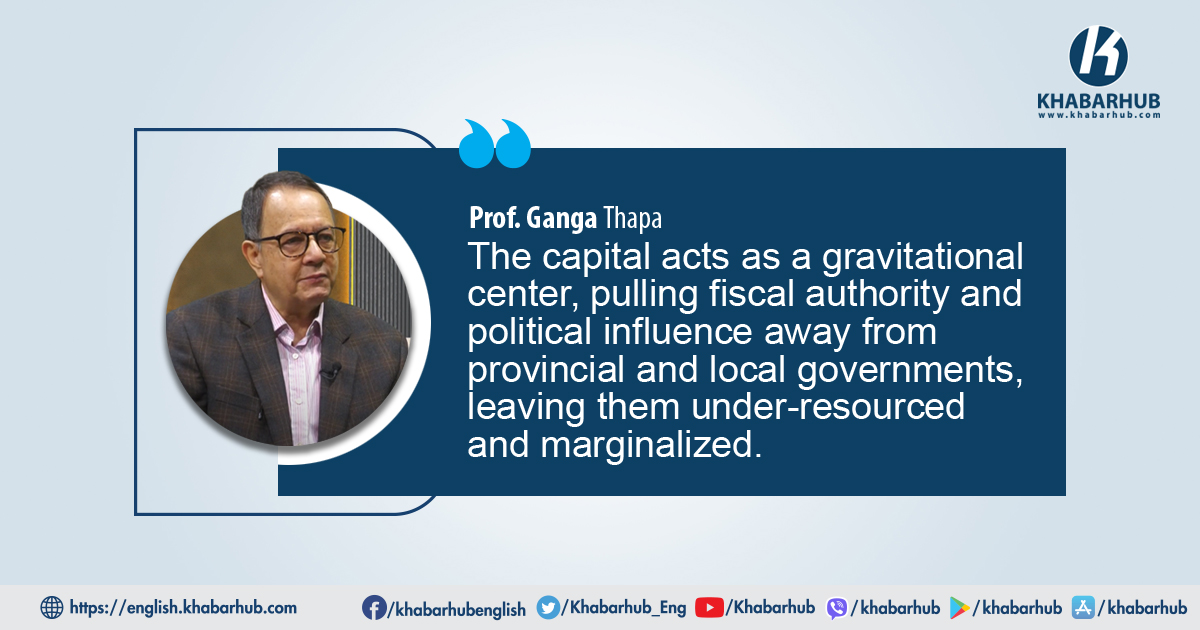
Despite Nepal’s formal federal transition, power and resources remain concentrated in Kathmandu. The capital acts as a gravitational center, pulling fiscal authority and political influence away from provincial and local governments, leaving them under-resourced and marginalized.
This urban centralization has fostered a predatory alliance between state institutions and profit-seeking elites who exploit public structures for private gain.
Unless countered by purposeful, inclusive political reform, this dynamic will delegitimize the federal model and fatally weaken its capacity to deliver, deepening public disillusionment and widening the gap between citizens and the state.





Comment