




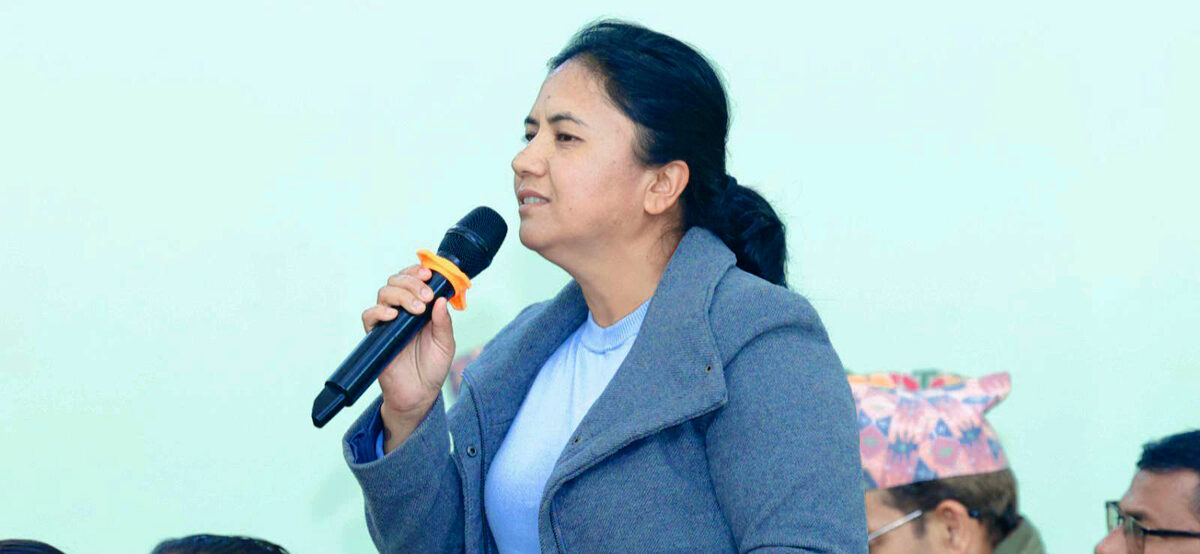
KATHMANDU: The upcoming local-level elections could prove a crucial test for CPN-UML leadership, with central member Rachana Khadka saying the party’s debate over leadership restructuring and generational transition is likely to intensify after the polls.
Khadka also said former President Bidya Devi Bhandari could emerge as an alternative to Chairman KP Sharma Oli at the next general convention.
Khadka said Bhandari’s elevation to the position of senior leader was based on a decision by UML Chairman Oli, who, she said, had also seriously reflected on his earlier attempts to prevent Bhandari from joining active party politics. She welcomed Bhandari being given second priority after Chairman Oli in the UML hierarchy.
However, Khadka acknowledged that the UML faces significant challenges ahead of the local-level elections and said the party does not yet have sufficient grounds for optimism. She described the upcoming local elections as a test for Oli and said that debates over leadership restructuring, generational change, and leadership transition are likely to resurface after the polls.
Khadka also said there is currently no immediate prospect of holding a special or early general convention of the UML. In this context, we spoke with CPN-UML central member Rachna Khadka. Excerpts:
Has the debate over leadership restructuring, transformation and generational transfer ended in the UML?
The debate over party transformation, generational transfer, and leadership transition is an ongoing process. The party will move forward through this process. It would be incorrect to say that the issue has been resolved.
After the elections, a task force was formed to recommend ways to transform the party, and the task force has prepared a report. Although that report has not yet been presented to the Central Committee, the leadership has committed to implementing its recommendations, as stated at the Central Committee meeting held yesterday.
The implementation of the task force’s report, as well as the report presented by Chairman Oli at the Central Committee meeting, remains an ongoing issue. These reports also address how the leadership transition process can be facilitated at different levels. This issue will not disappear; it will continue.
So, has the possibility of holding a special or early general convention ended?
For now, the Central Committee has decided to postpone the issue and focus on the local-level elections. Our primary responsibility at present is to prepare for and contest the local elections. That is where our focus will be.
Can the UML face the local-level elections under the current leadership?
Elections reveal the kind of public opinion expressed by voters. As I mentioned earlier, the local-level elections will also help determine what needs to be done regarding the party’s leadership.
The current leadership will be tested in the local elections. After that, the party will have to determine which political line, policies, programs, and leadership it should pursue.
You were previously among those raising the issue of leadership restructuring within the UML and advocating an early or special general convention. However, after the sudden Central Committee meeting and the decision to place former President Bhandari second in the party hierarchy, you have remained relatively quiet. Was this what you were demanding?
In the past, Chairman Oli was involved in decisions concerning the continuation of former President Bidya Devi Bhandari’s party membership. He has now realized that the decision taken at that time was wrong.
The setbacks the party has faced after the elections are also linked to such decisions, and the fact that the people did not elect us reflects the consequences of those mistakes. Chairman Oli has generally acknowledged the mistakes he made in the past and recognized that some of his decisions were wrong.
Can Bidya Bhandari become Oli’s alternative at the upcoming general convention?
We cannot say with certainty today what will happen tomorrow. What we can say now is that, like several other leaders, Bidya Bhandari is also a potential alternative to Oli.
Since Bhandari entered active politics, many have said that she could become one of the most accessible and closest alternatives to Oli within the party. So why should we hesitate to say that?
Bhandari could emerge as a unifying, strong, and viable alternative at the upcoming general convention.
So, are you happy that Bhandari has been given priority after Oli? Or do you think it is inappropriate for a former president to return to active politics?
Bidya Bhandari had clearly said that she would continue in politics. If the party had accepted her decision and facilitated her return from the beginning, the situation would not have become such a major issue.
In any case, after her party membership was continued, she also needs to play her role and demonstrate what she can contribute. The issue is not simply about renewing the membership of a former president. The party itself is facing a crisis, and its relationship with the people has been damaged.
Some have argued that giving Bhandari second priority has muddled the debate over party transformation and generational transfer. What do you say?
There is no basis for saying that. The party constitution contains a provision allowing changes in special circumstances, and Bhandari was given second priority on the basis of that provision.
The debate over leadership restructuring has not stopped. We should wait until the elections and see what the results show. Since the leadership has asked us to wait until then, we have accepted that position.
Are you satisfied with the current leadership as the party heads into the local-level elections?
We are not satisfied. We have not reached a point where we can be satisfied. The public response has been deeply disappointing.
It would have been much easier if we had been able to implement some of the suggestions and demands raised by party cadres. There was also a debate about the effectiveness of leadership at every level. It would have been better if we had been able to send a clear message of change.
However, there is no room to go beyond the decisions made by the Central Committee. The Central Committee is the party’s highest decision-making body, and there is no alternative but to implement the conclusions reached by the higher body.
But this will not be easy. Winning back public trust and entering the local-level elections will be a major challenge. The entire party organization will have to work hard to convince the people.
There are many challenges ahead as we enter the electoral environment. We have to contest the elections with the understanding that the decisions we have made so far may not be sufficient to address all of these challenges.
The party’s senior leader and former President Bhandari is in regular contact and coordination with you. What does she say?
She is personally very concerned about the country and the party. She is preparing to take appropriate steps to address the contradictions and grievances that have emerged within and around the party.
She has an important role to play in coordinating efforts and resolving problems. Some of the issues are related to the leadership’s working style, and she can play a guiding and constructive role in correcting them.
Similarly, the broader left movement in Nepal has reached a somewhat defensive position. She could also play a constructive role in bringing the movement together around common agendas and policies.
I believe she is trying to rise above personal and factional interests and restore the CPN-UML’s standing and reputation. Her role is focused on correcting shortcomings in the party’s working style, resolving internal contradictions, and keeping national interests at the center.




Comment